
Mieko Hirota – On A Sorrowful Day
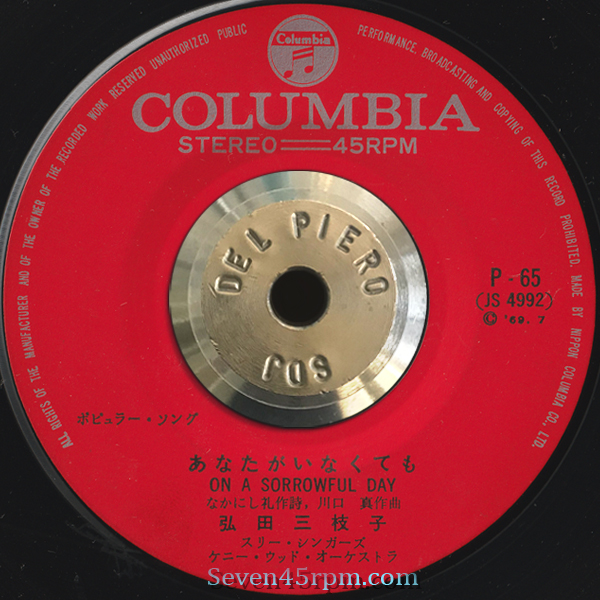

Columbia – P-65 Released 1969
Track B – あなたがいなくても On A Sorrowful Day
Here’s another gem from Japan, from perhaps a lesser known singer (well on our shores at least) which will always appeal more to me, but a track and artist I felt I needed to share. The singer was called Meiko Hirotota, had the nickname of Mico (also spelled Miko), and in Japan was very prolific and successful, releasing fourteen albums on Columbia between 1968 and 1977, (and a career totaling 35 albums) and was known in her country as “The Queen Of Pop”.
This will be another short and brief post, as I cannot find a lot about Hirota, which is surprising, considering her success in Japan throughout the late sixties, seventies and eighties. I’m really just trying to string together a few facts I have found out, here and there, into some kind of summary. So please reach out for any more info or helpful links! I would be most appreciative.
Hirota was born in Setagaya, Tokyo, on Feb. 05, 1947. She grew up listening to pop and jazz, and is believed to have started singing at US Occupation camps in Tachikawa, from the age of 7. Her brother who performed Hawaiian music, helped her with music and also learning the English language by teaching her nursery rhymes, while she was in Elementary school. By the time Hirota was 14, she had her first single release through Toshiba Records, in 1961. A cover version of Helen Shapario’s “Don’t Treat Me Like A Child. She would be releasing a lot of covers from the western world, in this early pop era of her career, following with “Vacation”, a Connie Francis’s cover, which in 1962, became a big hit for Toshiba and Hirato. 1962 would also see the release of her first LP, and she’d end up releasing around 35 albums in her time. Music critic Hisao Murata argues, “As a means of overcoming the problem of the Western rhythm, melody line and the language’s ability to communicate as a Japanese language, it is Mieko Hirota who invented English-like Japanese”. Hirota released around 25 singles through Toshiba in the space of 4 years, but in October 1964 she left the Toshiba music industry and moved to Nippon Columbia.

The world was changing it’s sound, and Hirota was maturing in her field, and developing more of a Jazz direction. Hirota recalls it was all because of a chance meeting in 1964, with jazz promoter extraordinaire George Wein on the Japanese Shinkansen bullet train, who convinced her that she had the range to explore Jazz. * In July 1965, Hirota performed with the Billy Taylor Trio at the American Newport Jazz Festival. This was a massive achievement to play at such a revered event, who’s line up also included so many esteemed musicians and groups such as John Coltrane Quartet, Thelonious Monk Quartet, Muddy Waters Blues Band, Dizzy Gilllepse Quintet, Drave Brubeck Quartet, Herbie Mann Octet, and the list goes on. Alongside Billy Taylor on piano, Hirota would have Grady Tate on drums and Ben Tucker on Bass. **
Her first Columbia LP release in 1966, was “Miko In New York” accompanied by the Billy Taylor Trio. There’s some beautiful work here from Hirota, covering some great standards including Torme’s “I’m Coming Home Baby”, and apparently the first Japanese woman to cover bobby Hebb’s Sunny. Hirota would then release a bunch of live albums, including “Exciting R&B Vol.1 and Vol.2” which mostly were covers, but with more zest and live energy (The live version of “I’m Coming Home Baby on Vol.2 is pretty great).
Hirota’s featured single from 1969, “On A Sorrowful Day” is her “swingiest” beat dancer release for sure. Far more fun and I’m sure hip to what was charting at the time of the late sixties in Japan. Lot’s of go go action with this one, with that great kinky beat and swinging horns. I have to say, as is common with the genre, to my ears there’s some similarities here, to other songs from the popular artists of that scene, which is something I actually love about this sound. The opening verses have very similar phrasing to Jun Mayuzumi’s “You And The Sun” and Segawa Mieko’s “Asa Ga Kurumaeni”, but the flavour here is more sultry coming from Hirota. In her huge catalogue of music, this is a groovy track that is more to my taste for sure, and somewhat overlooked I feel.
Hirota would keep releasing music for a very long time, and continued to have a huge fan base in her home country. She also worked a lot in the commercial world with diverse promoting from Japanese beer to coffee brands. And she will always be lovingly known as the voice to the theme song, “Leo no Uta”, for the animated television series Kimba the White Lion. Hirota died on July 21, 2020, at the age of 73 following a fall.


Research and referencing…


 Seven45rpm
Leave a comment