

Latest
Janis and Her Boyfriends – Bang Bang

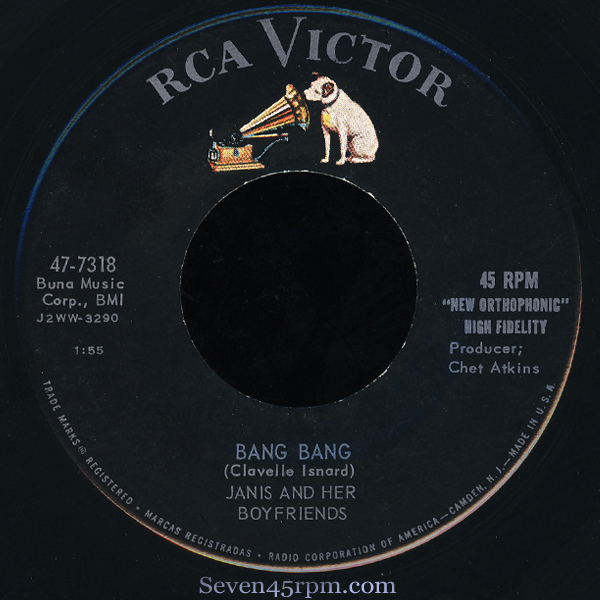 RCA Victor 47-7318 US Year 1958
Janis Darlene Martin was born in Southerland, Virginia, just east of Danville, on March 27, 1940. With a stage mum on one side and a father and uncle who were musicians on the other, surely it was inevitable that her destiny was laid out as a musical performer.
By the age of six, the little lady had mastered basic chords on the guitar and began singing, and although the young Janis may have been small, she packed a voice that was loud and strong. At eight, she entered her first talent contest and scored a proud second place. For the next two years, she entered eleven contests over a three-state area, winning first place in each one…and one those talent shows had over 200 contestants that took four days of elimination.
By 11, Martin was playing and singing as a member of the WDVA Barndance in Danville, Virginia. From the barndance, she traveled with Glen Thompson’s band for two years and then went on the road with Jim Eanes, a former Starday recording artist.
In 1953, the teenager appeared at a Tobacco Festival with Ernest Tubb and Sunshine Sue. As a result of this appearance, Martin was invited to become a regular member of the Old Dominion Barndance in Richmond, Virginia.
 At that time, that stage show was the third largest in the nation, and included such stars as Jean Shepherd, Hawkshaw Hawkins, Sonny James, Martha Carson, and the renowned Carter Sisters who encouraged Martin to try for the “big time”. With two years of travels with the show, Martin would not only gain valuable show business experience, but also the realization that she now only lived for one thing – entertaining people.
Two staff announcers at WRVA (the station that carried the barndance over the CBS network) were successful songwriters and wrote a song called Will You, Willyum (this was just at the birth of the fifties rockabilly music explosion). They asked Janis to sing it on the barndance for audience reaction, and also cut a demo tape of it which they passed on to their publisher in New York. When the demo tape arrived at Tannen Music in New York, the publisher not only accepted the song but rushed over to Steve Sholes of RCA Victor, so he could hear it. Sholes wanted to know who the vocalist was on the tape and called Richmond to find out. Janis was contacted and invited to Nashville to record the song on Victor Records.
So, at the age of fifteen, she became a recording artist, and that release would end up being her biggest career hit, selling a massive 750.000 copies! To add to that, on the flip Drugstore Rock And Roll, a song that Janis wrote herself, which you could easily say is her most well known song and is probably the most played in the current scene.
Now this was must have been all very exciting for Martin, who although was still relatively very young, had already felt really bored with the slow mainstream country songs she had be singing in the past. She’d already had the spell of R&B over whelm her even as a younger girl, but at that time in the fifties, she would found it difficult to follow that path, being a white girl.
In a interview with Bobby Tremble, Martin would remember…”I would go up the road…there was a black church right up above my house…my little cousins wanted to play on Sundays and I would want to go up and lay in the weeds and listen to them sing”. She goes on to say…”It was that soul, it was that rhythm….and when I heard it…I said that is my music”. Martin and accompaniment were determined to find a new sound however, so they combined what you would then call hillbilly music with rhythm and blues…and this was all part of the birth of rockabilly music…which would grow like a beast and change many lives.
But Martin recalls just how tough it was for those first ladies, who were breaking out into this new crossover wave, which would include Wanda, Brenda Lee and of course Charline Arthur (who was the first female singer in country music to perform in pants, and she supposedly used the extra freedom to prowl the stage). There was some nasty slander coming from some of the men at the time, accusing Martin of being spawned from the devil, but the barefooted ponytail teen would not let that get in the way!
This was all happening at the time when Elvis Presley was the biggest rock singer in the country, who also happened to record for RCA Victor. Presley and RCA were so impressed with Janis’ delivery of a song, that Janis was given permission to use the title of “the Female Elvis Presley.”
Bu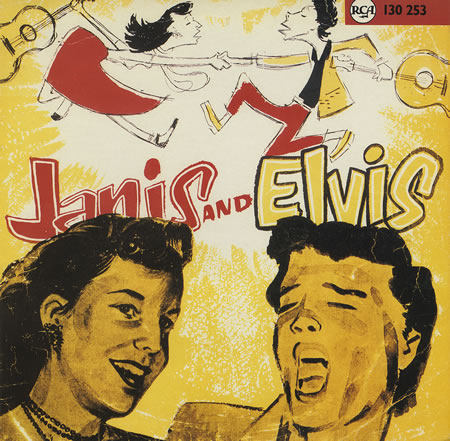 t some of the publicity rebounded for Janis as fans felt she was hooking her style as a means of exploitation. And although they both used the same session musicians and shared the same country-R&B interests, Martin never saw the Memphis Flash perform until he made it to national television. By that time she had independently developed her own amazingly similar performing style which was well established and locked down. Additionally, she only met Elvis twice, both times very briefly, with hardly a word exchanged. The two found themselves converging on a similar point.
There was a 10″ Ep release titled Janis And Elvis (RCA-T31,077) which included 4 tracks from Martin as well as 4 tracks from the King himself, however it seems it was was pulled only 2 days on the market! And all because Elvis’ manager, Colonel Tom Parker didn’t want Janis’ name printed in front of Elvis’ name! Of course this record is worth a heap!
Eventually Martin was not only accepted, but would be in constant demand for TV, radio and stage appearances all over the US, and would appear on the Tonight Show, American Bandstand and Ozark Jubilee. She did her first road tour with Hank Snow and went on other tours with many greats including Johnny Cash and Carl Perkins.
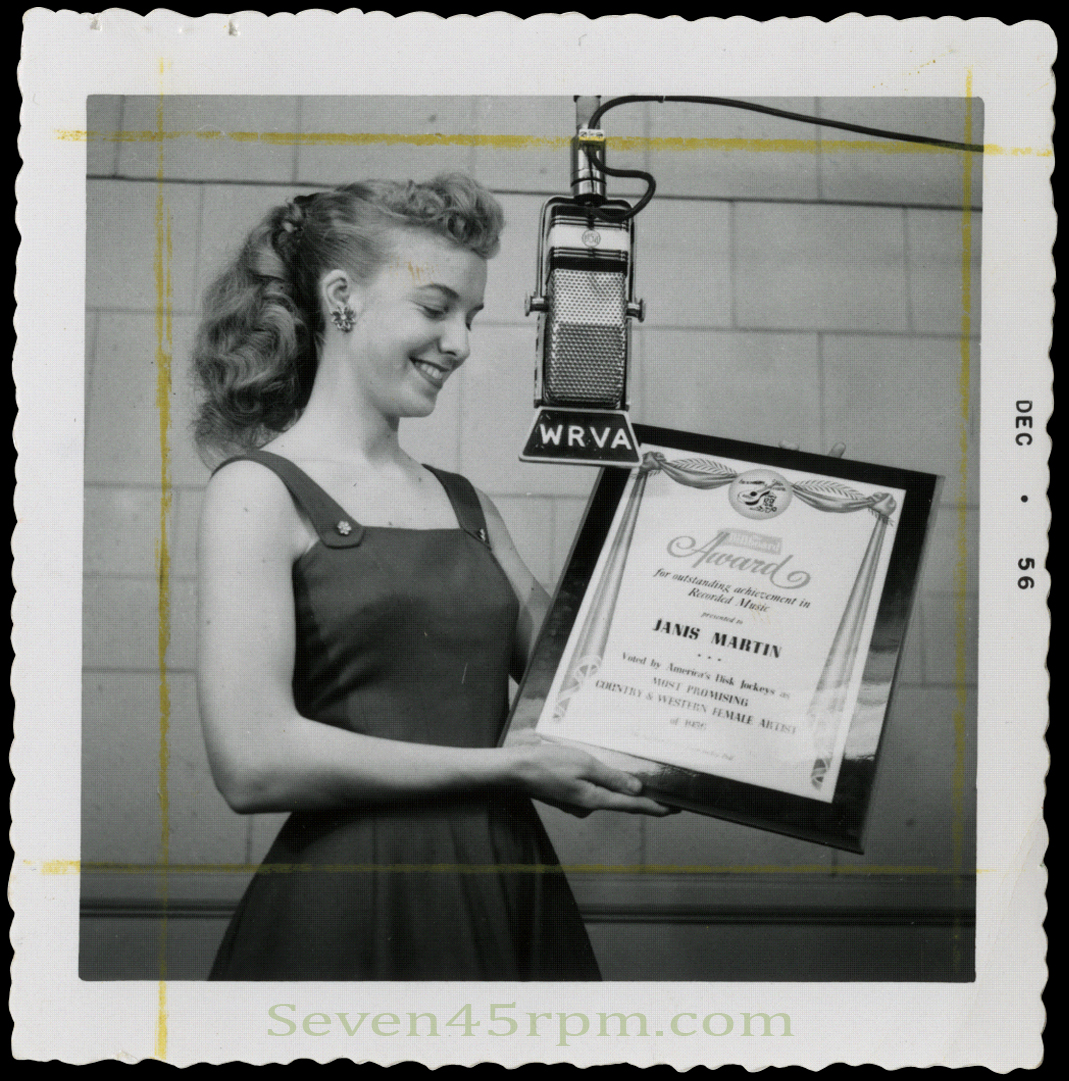 Martin was voted the Most Promising Female Artist of 1956 at the annual disc jockey convention and received the Billboard Magazine award on plaque. With much success behind her, she formed her own band called Janis Martin and the Marteens and began her travels in the U.S. and Canada, playing clubs and fairs. Apparently she also did a screen test for MGM, but not sure that pretty face made it on film…which would be a damn pity!
In 1957, she was chosen by RCA to become a regular member of the Jim Reeves show and traveled with him exclusively. The show went overseas to entertain the armed forces in Europe. On returning to the States, Janis appeared on the Today Show with Dave Garroway to tell of their experiences and to sing her latest record, My Boy Elvis. After this show, she was invited to appear at the Grand Old Opry.
The next year Janis and Her Boyfriends released this little beauty, Bang Bang. It’s credited to Clavelle Isnard, someone I can’t seem to find out too much about, other than he co wrote some tracks with Jimmy Holland…but never the less…this has to be my Janis Martin pick! Martin also loved this tune, as noted by Stephanie P. Lewin-Lane on her 2012 Sweet Nothings thesis…”I loved it because it moved. Bang Bang Bangitty Bang Bang…(laughing)…kinda vulgar for the ’50’s, ya know? Hidden messages and all of that, but I mean I liked the song, I didn’t think about the words then, I just liked the tempo, the tune of it, how it moved…” It certainly does move Miss Martin!
Everything seemed to be going well for Martin, well until 1958, when it was discovered that the teen had been secretly married to Tommy Cundiff, since 1956. Martin met the singer who was about six years older, when she was only 11 (they both played on the same show on WBTM), and the two started dating when she was 13. He would soon join the paratroopers but before being shipped out to Germany, he wanted to marry Martin and showed her a diamond ring. The two eloped when Martin was only 15…they married on January the 2nd of 1956. Martin actually didn’t record for RCA until March the 8th of 1956, so she didn’t tell the record company, nor did she mention it to her parents until about 3 months later. Tommy was off overseas only 8 days after their marriage and Martin wouldn’t get to see him for another fourteen months or so.
 Martin was on the USO tour in March/ April of 1957 and meet up with her husband in Frankfurt, who was able to get a 30 day leave so they could spend some time together. As a consequence from their a romantic interlude, Martin fell pregnant. The record executives were furious with Martin when they had finally found out about this, saying she had destroyed the innocent teenage image they worked so hard to sell her on…and was dropped by the label in short order. A pregnant teen they believed, would not be to good for marketing, especially upon learning that this innocent cute girl got hitched at 15.
For all of her early success, Martin was never able to sustain a rock & roll career, mostly because of her gender and the changing times. Her stage moves and lusty delivery appeared unseemly (or so people said, especially on the country circuit) in a girl, once the initial furor and enthusiasm for rock & roll quieted down. Her record company and management wanted her to keep pushing rockabilly in her stage act, while promoters doing the bookings preferred that she do straight country, and Martin found herself caught between conflicting currents.
Martin tried to keep a music career going and was courted by both King Records and Decca Records before signing with a Belgian-owned label called Palette, for which she cut four sides in 1960. She was on her second marriage by then, and husband number two (whom she later divorced) didn’t take well to her popular stage career, and persuaded her to leave show businesses.
 But by the seventies, Janis had had enough of being the “ordinary” little housewife and cook, and really missed the adoration that she once got from her fans. So she formed a new band…Janis and the Variations, which included her husband on drums. The band did become fairly successful in that they had constant work playing 3 state areas every weekend. However hubby wasn’t liking the journey as much as Martin, claiming it was interfering with their marriage. In 1973, he mistakenly gave her the ultimatum again, their marriage or the band! But this time…about 13 years after that first time he made such a statement, Janis gladly chose her music. Her son, who had been playing drums since the age of 7, gladly took the vacant spot and they would go on to tour Europe, where she encountered strikingly enthusiastic audiences, ready to embrace her as though it were still 1958. The band continued ’til 1982.
Martin passed away on September 3, 2007, after being diagnosed with terminal cancer which had spread all over her body. She had been suffering from severe headaches over the past several months so she found it necessary to cancel her recent booking at the Americana Festival in England. The headaches turned out to be stress related from all the grief she had to endure from losing her son Kevin who passed away in January that year.
She may have had a short career in recording music, but it was so fantastic, and so very important, as without a doubt she paved the way for future women rock singers!
DISCOGRAPHY
1956 – Drugstore Rock And Roll / Will You, Willyum RCA VICTOR 47-6491 35
Ooby-Dooby / One More Year To Go RCA VICTOR 47-6560
My Boy Elvis / Little Bit RCA VICTOR 47-6652
Barefoot Baby / Let’s Elope Baby RCA VICTOR 47-6744
1957 – Two Long Years / Love Me To Pieces RCA VICTOR 47-6832
Love And Kisses / I’ll Never Be Free RCA VICTOR 47-6983
All Right Baby / Billy Boy, Billy Boy RCA VICTOR 47-7104
1958 – Cracker Jack / Good Love RCA VICTOR 47-7184
Bang Bang / Please Be My Love RCA VICTOR 47-7318
1960 – Hard Times Ahead / Here Today And Gone Tomorrow PALETTE PZ 5058
1961 – Teen Street / Cry Guitar PALETTE PZ 5071
1977 – I’m Movin’ On / Beggin’ To You BIG DUTCH 2085
Rockin’ All Over The World / Live And Let Live BIG DUTCH 2086
Ep
1956 – Let’s Elope Baby/ Barefoot Baby
All I Can Do Is Cry/ St. James Infirmary RCA Victor (N.J.) DJ-38
1957 – Love Me To Pieces/ Two Long Years
Calypso Sweetheart/ Marriage And Divorce RCA Victor (N.J.) DJ-76
Just Squeeze Me (But Don’t Squeeze Me)/ My Confession
I Don’t Hurt Anymore/ Half Loved RCA Victor (N.J.) EPA-4093 [mono]
1978 – THE FEMALE ELVIS WITH THE JORDANAIRES : THE UNISSUED
William / Love Me Cha Cha / Love Me Love / Blues Keep Calling DOG GONE EP 81677
Lp
1959 – Janis And Elvis RCA T 31.077 (South African only)
Referencing and recommendations!
Stephanie P. Lewin-Lane Sweet Nothings
Cat Tales #20
Janis Martin Kickstarter
History of rock
Interview with Bobby Tremble
JEAN JACQUES PERREY E.V.A.


Vanguard 3637 Brazil 1973 33 1/3 RPM
Jean-Jacques Perrey, was born in a little village in northern France, on January 20 1929, and received his first musical instrument, an accordion, when he was just 4, as a Christmas present. He would go on to teach himself to play the piano by ear, although he did once attempt to study music at the Amiens Conservatory, but was kicked out for violating school rules by performing in public.
Perrey must have had some sort of epiphany in Paris in 1952, after meeting inventor Georges Jenny. In 1941, the Frenchman had come up with the Ondioline, a very unique vacuum-tube powered electronic keyboard, suspended on special springs which made it possible to introduce a natural vibrato if the player moved the keyboard from side to side with their playing hand. The result was a beautiful, almost human-like expressive vibrato.
 Perrey, who at the time was a student of medicine, must have realised that it was actually the science of electronic sound, that was really giving him a buzz, as opposed to the science of medicine. Upon that first meeting, Jenny must have enjoyed Perrey’s excitement towards this new instrument and actually gave him one to take home for six months, to see what someone with Perrey’s mind and talent could do with it. On the return, Jenny was quite impressed, and probably never heard anyone play it like he did. Perrey ditched his medical studies and Jenny hired him as a salesman and demonstrator of the new instrument. Out of these demonstrations grew a cabaret act in which Perrey played piano and Ondioline, at times simultaneously. Titled Around the World in 80 Ways, the show was quite popular and Perrey took it on tour throughout western Europe. Working the nightclub circuit, Perrey became acquainted with singer/songwriter Charles Trenet and also legendary jazz guitarist Django Reinhart, who he ended up recording several songs with, one of which, The Soul of a Poet, became a major hit in Europe.
One night after a presentation of the show, Perrey received the notice that someone wanted to talk to him at the bar. To his surprise this person was Jean Cocteau (and by the way, myself having a huge adoration for that artist, when this fact was revealed, my brain exploded a just a little bit). The influential poet gave Perrey the advice to go to the U.S. to follow his music career there. “He said there would be more possibilities and an audience for my approach to music. He asked for my phone number and told me he would hand it to somebody that he knew who could help me find the sponsor in New York I needed. He gave my contact to Édith Piaf!”
Piaf was already really interested in the sounds of the Ondioline, and took Perrey under her wings. They would bond, perform and record together, and she would pay for studio time that enabled Perrey to record his own compositions. But Piaf’s biggest contribution was to send one of these tapes to Carroll Bratman, a music contractor in New York City. Bratman responded immediately, sending plane tickets to Perrey with one word marked on the envelope: “Come!” He moved to the U.S. in March 1960 and stayed there for 10 great years.
 Now be sure to watch the online footage of Perrey demonstrating his incredible musical vocabulary on the Ondioline, which was televised on the American I’ve Got A Secret show in 1960 and also in ’66. Quite remarkable to see the reactions for what must have been for the majority of the audience, their first steps into the new world of electronic music.
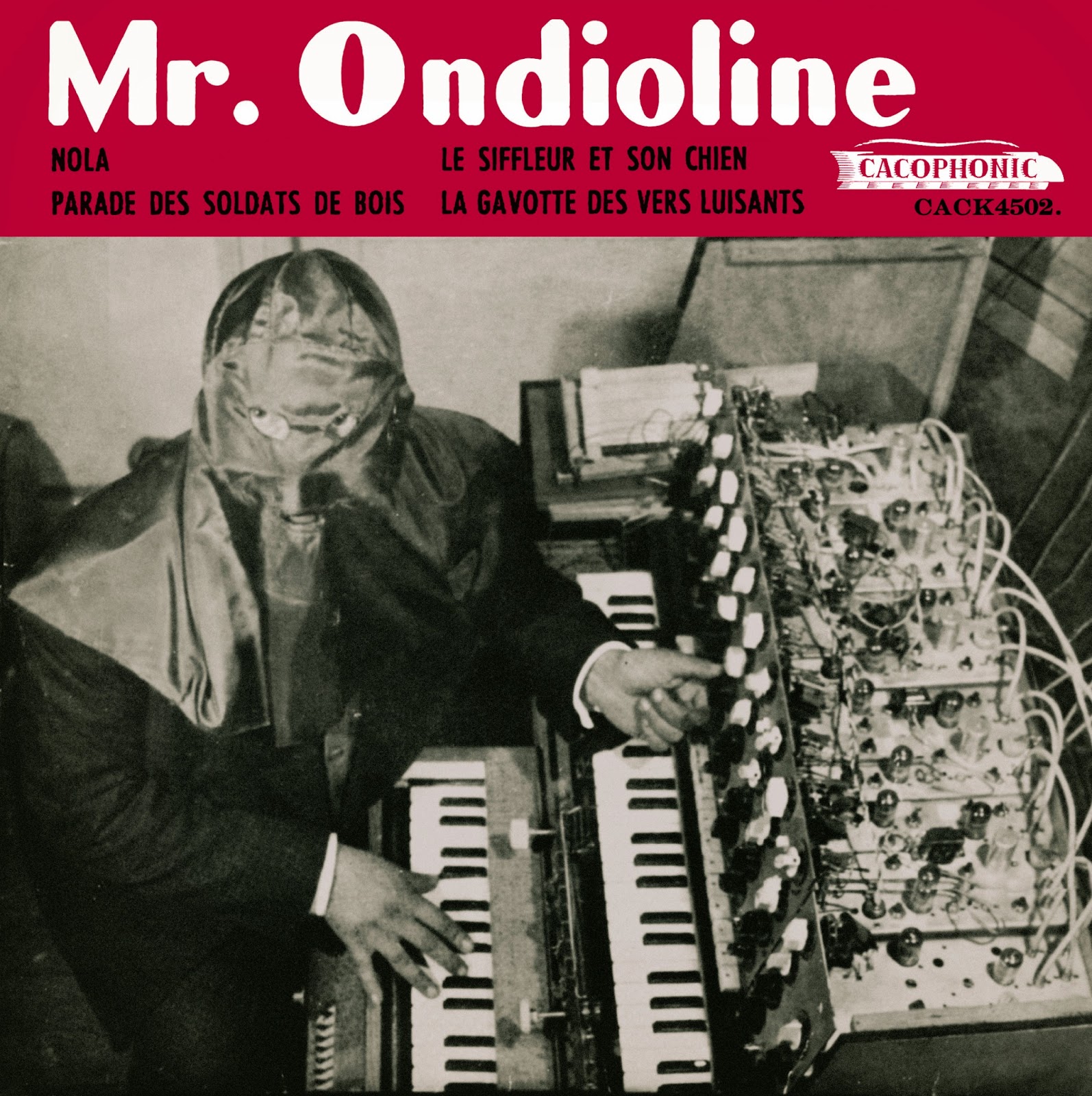
Also, before Perrey moved to the U.S. he did release two EP’s under the adopted persona of Mr. Ondioline around 59-60 for Pacific Records. The result may have been whimsical commercial pop bent into kooky novel shapes, but it’s probably that bizarre mysterious cover that makes this 7″ EP so sort! Crazy for it’s day!
Bratman built Perrey an experimental laboratory and recording studio, where he would he invent “a new process for generating rhythms with sequences and loops”, utilising the environmental sounds of musique concrète. Like a mad scientist, he’d spend endless hours, even weeks, splicing tape, and tape recorders with scissors, piecing and “looping” together a unique fantastical take on the future.
In 1965 Perrey met Gershon Kingsley, who you could say was a like minded contemporary German American composer, and a former colleague of *John Cage, and at the time was a staff arranger at Vanguard Records. There must have been a strong and obvious connection from the get go. They both shared each others way of musically thinking, way out side and far beyond any square. And it wasn’t long before they found themselves recording together in the Vanguard studios, which normally specialized in folk, and not in avant-garde. The end result of their first collaborative effort was The In Sound from Way Out! released in 66.
 With Perrey’s tape loops, and his inventive melodies twinning together with Kingsley’s complementary arrangements and instrumentation, the album created, was filled with tunes that sounded like some kind of surreal animated cartoon from out-of-space gone berserk. And since this was decades before the advent of widespread digital technology, each tune took weeks of painstaking editing and splicing to produce. Their second and final collaborative effort came in 1967 with the release of Kaleidoscopic Vibrations: Electronic Pop Music From Way Out!, and although sounding similar in style, this release was particularly different in two ways. Firstly, most of he compositions were versions of popular songs of the day. And secondly, Perrey’s tape loops and effects were added in post-production after Kingsley’s orchestrations were recorded, a technique now commonly used by electronic artists to this day. Also the album was one of the first to use the new Moog modular synthesizer, a massive, complicated electronic instrument resembling an old-style telephone switchboard.
Kingsley continued to do his own work with the Moog, while Perrey joined with producer John Mack and arranger Dave Mullaney and their company, Laurie Productions, to compose and record, mostly for radio and television advertisements. Perrey recorded two more albums for Vanguard, The Amazing New Electronic Pop Sounds of Jean Jacques Perrey and the legendary sort after Moog Indigo in 1970.
The back cover liner notes to this far out LP read…”Without a ship Columbus could not have traversed the Atlantic, without a telescope Galileo could not have charted the solar system, and what the MOOG SYNTHESIZER opens up for the future of music is beyond dreams”. The enthusiastic proclamation would continue with…”The most amazing instrument is nothing without a mind behind it, and Jean Jacques Perrey’s mind is that of a combined musician and scientist, with a special love for what is happy and vital tin popular music. The way Paganini thought musically in terms of the violin, Perrey thinks musically in terms of the Moog”.
As you’ve probably guessed, there were some pretty great spaced out tracks laid down on this 12″ slab, and as expected from Perrey, cosmically twisted, fun and swinging. There’s the great opener Soul City that every space mod must have played on their Weltron 2007 while preparing a Martini, and also the dark and slinky Cat In The Night. But the real track here, that took Perrey to a new level of greatness, is of course E.V.A.!
Now I know this infamous track is nowadays quite well known, and not just amongst the vintage space pop fanatics, but it’s hard to believe that is was never to be officially released by Vanguard as a 7″ in the US. In fact even the UK had to wait two years for the first Moog Indigo single, and that wasn’t even EVA, but instead the loopy Gossipo Perpetuo with the title track on the flip! THANKFULLY the vanguard people over in Brazil had the sense to release it 3 years after it was recorded as a single and as featured here, a gorgeous EP picture sleeve, that actually runs at 33rpm.
This track is pretty special to me for a number of reasons. It played on the dance floor at Sounds of Seduction when I meet my wife many years ago, and it also played at our wedding and is featured on our Super 8 wedding video. It’s so smooth, it has beats, it has fuzz and Wah wah, and it even has bells…but most importantly, it has so much integrity! And while so many other Perrey recordings happily and contently sit back in that other time from the past, this unstoppable track is still soaring far ahead, smashing through electronic genres, only leaving a traces of space glitter on the occasional hip dance floor.
And so what does E.V.A. stand for? Well to tell you the truth, I don’t know, but it is a space term for extra-vehicular activity, so maybe that was a reference point?
 Perrey returned to France in 1970 and became the musical director of a ballet company. He wrote and recorded music for a television commercials and a number of French cartoons, and released several albums of this music on the Montparnasse label. He also continued to work on music for therapeutic purposes, including one project that involved recording with dolphins in the waters near Vancouver, Canada. “It was remarkable,” Perrey says. “If you played sounds of a certain frequency, the dolphins began to swim in perfect circles.”
Perrey’s influence would reverberate for years – The In Sound from Way Out! inspired a tribute from the Beastie Boys, who borrowed both the album’s title and cover art for their own album 30 years later. But sadly, none of this translated into personal fortune. Perrey did not own the publishing rights to his music when it was licensed to Disney, while Stanley Kubrick was able to incorporate some of Perrey’s sound effects into 2001: A Space Odyssey for next to nothing. Perrey says: “Jean Cocteau told me, ‘Thirty years after I die, you will retire a rich man.’ Well, Cocteau died in 1963 and I haven’t been able to retire yet.”
I highly recommend this video interview by Richard Lawson from 2004!
An RL Music Interview with Jean-Jacques Perrey.
Also great Perrey references here…
Space Age Pop!
The godfather of techno!
iCrates
*John Cage, who was one of the leading figures of the post-war avant-garde, and is perhaps best known for his 1952 composition 4′33″, which is performed in the absence of deliberate sound. Musicians who present the work do nothing aside from being present for the duration specified by the title. The content of the composition is not “four minutes and 33 seconds of silence,” as is sometimes assumed, but rather the sounds of the environment heard by the audience during the performance.
*Photo credit to Marco Zanoni
CULT45 has flipped over to SEVEN45rpm!
 To all the supporters, followers and fans, just letting you know that Cult45 has now made a flip over to the new and improved Seven45rpm.com!
So if you wish to continue to follow this fantastic journey through time and lost music on that lovely 7″ vinyl format, and I do hope you do, please re-Follow and Like! This way you will keep continuing to receive the occasional update with sound clips, images and hopefully a whole lot of information that I spend way too much time sourcing, while most people are peacefully sleeping!
It’s so gratifying to know that other music lovers out there share this obsession of mine, and the interest and comments that I have received from you all, really gives me some kind of hope for the survival of this great music, and also the music of the future! Hope to see you over there, on our new shiny dance floor!!!
Piero
Brigitte Bardot – Harley Davidson / Contact

 Disc AZ – AZ 10 346 France Dec. 1967
Track 1 – Harley Davidson Track 2 – Contact
Brigitte Anne-Marie Bardot was born in Paris on 28 September 1934. Daughter to a very strict homemaker mother, Anne-Marie “Toty” Bardot and a wealthy industrialist Louis Bardot, she grew up in a middle-class Roman Catholic observant home, with her younger sister, Marie-Jeanne.
It was particularly tough for the young girls growing up with incredibly harsh, stringent parents. At one point in her young life, after an innocent playful incident, which lead to an accidental breakage of an expensive Chinese lamp, Brigitte was told by her parents, they would from that day on, disown her as a daughter, as she was to address them only in a formal way, as a stranger would. This alienated her for the rest of her life. Inwardly, Brigitte dreamed of escaping her rigid monitored world….and she would hunger for that missing love.
Her socially ambitious mother pushed her daughters to do well not only at school, but also at ballet. Brigitte had an adoration towards for dance, and progressed particularly well, however her younger sister, Marie-Jeanne didn’t share that passion, and eventually gave up the lessons and did not tell her mother. Brigitte worked hard with determined concentration, and in 1947, was accepted to the Conservatoire de Paris.
 Gifted with ridiculous amounts of beauty, the young starlet was noticed during her ballet studies at 14, and was approached with offers of modelling, a direction her mother encouraged her daughter to follow. Soon she would have her first modelling experience in a fashion show in 1949. In the same year, she modeled for a fashion magazine Jardin des Modes and soon the stunning 15 year old appeared on the cover of the french edition of Elle magazine in March 1950.
Director and screenwriter Marc Allégret was captivated by this image of beauty, and ordered his assistant, who was a young upcoming rebel film director named Roger Vadim, to go out and find her. He tracked her down and Allégret quickly offered Bardot the opportunity to audition for Les lauriers sont coupés. There’s conflicting stories whether Bardot landed the role or not, but the film was cancelled, and it is certain that this opportunity made her consider becoming an actress. Vadim became immediately smitten by her pouty sensuality…Brigitte fell madly in love with this bad boy…she had never meet anyone like him before, and in 1952 the 22 year old became her husband. Her parents were infuriated, but funnily enough, the two newly weds had to spend their honeymoon night at her parents home, as they had no where else to stay. They were forced to sleep in separate rooms, and Bardot was not even permitted to kiss her new husband goodnight. But Bardot wasn’t too bothered…”we had our wedding night a long time ago”.
A new path had been laid out for Bardot, leading away from her early ballet desires…now it was a different stage and spotlight calling her name. 1952 saw the start of her acting career, and she would appear in obscure films, generally lightweight romantic dramas, some historical, in which she was cast typically as “Ingenue” or “Siren”, often appearing nude. But in ’57 she really became world-famous with the release of the Vadim’s controversial film Et Dieu créa la femme (And God Created Woman).
 Vadim’s now infamous film was certainly the vehicle that launched Bardot into the public spotlight, immediately creating her “sex kitten” persona, making her an overnight sensation. When the film was released in the US, it pushed the boundaries of the representation of sexuality in American cinema, and most available prints of the film were heavily edited to conform with the prevailing censorial standards of 1957. The film was also condemned by the Catholic League of Decency. Bosley Crowther, the film critic for The New York Times, wrote, “Bardot moves herself in a fashion that fully accentuates her charms. She is undeniably a creation of superlative craftsmanship”.
A proper English TV journalist asked the vivacious but innocent Bardot about these sexy roles she was becoming famous for, “Do you really like doing these kind of films, or would you want to be a serious actor?”. B.B. replies “On no, I prefer this kind of films…I will be a serious actor when I get older”.
Vadim and Bardot separated in ’56 amidst rumors that Bardot was having an affair with her And God Created Woman co-star Jean-Louis Trintignant, but remained friends for the rest of Vadim’s life. He would later direct her in The Night Heaven Fell, and Don Juan, or If Don Juan Were a Woman.
Bardot would continue to follow her acting demands playing some very famous roles in new wave cinema. She later starred in Jean-Luc Godard’s 1963 masterpiece Le Mépris (Contempt) and Masculin Féminin in 66. Bardot was nominated for a BAFTA Award for Best Actress in a Leading Role for her part in Louis Malle’s 1965 film Viva Maria! Although she was in high demand in Hollywood, she continued to declined offers of filming in the US…she detested the way Marilyn Monroe was treated, a woman who she so much adored, and she didn’t have an enjoyable experience previously there. Eventually, Hollywood would accept her terms and they would have to come to France to film her, where she had a cameo in Hello Brigitte (which also starred Billy Mumy from Lost In Space fame, who apparently scored the first American on-screen kiss from the french beauty).
 Bardot was appearing on record covers long before she first sang a note, and it’s pretty obvious the marketing strategy was aimed to appeal to the male audiences. She was plastered on covers for soundtracks to films she’s appeared in, unofficial tributes and promo records and of course, to her own musical efforts. Virtually everything Bardot-related is sort after, with collectors rarely distinguishing between albums merely depicting her likeness and ones on which she sings. But while there’s definitely a desirable kitsch and kookie wonderment about her recordings, I find that there’s a further unique beauty there, behind her stunning looks, that drew me in a long time ago, and which I have always obsessed over, for some time.
Bardot’s first 7″ vocal release was on the lullaby Sidonie, (delicate guitar work by Bardot) which was the first track on the Vie privée (A very private affair) EP in ’62, a film directed by Louis Malle which she herself starred in, alongside Marcello Mastroianni. This track was included alongside three instrumentals on a French EP issued by Barclay as well as a US single on MGM. An early version of “Sidonie” also appeared in the autumn of 1961 as part of issue 23 of ‘Sonorama’, the innovtive 7″-sized playable magazine which incorporated several flexidiscs to accompany the features. It’s such an adorable track…innocent, so gentle and so sweet!I love this side of Bardot!
Bardot had now signed to Philips, and the next year she would have two more Ep releases, Invitango and the great L’Appareil À Sous. The title track, penned by Gainsbourg (who was still concentrating on writing for other artists at this stage of his career), is a favourite upbeat dance floor spinner for me…1.24 mins. of french hip twisting mayhem! Her self titled debut album followed which was made available in two versions – a superb deluxe edition with a gatefold sleeve and a poster, and a standard single-sleeve album. The album contained a mix of styles and tempos, and included the beautifully strummed El Cuchipe sung in Spanish, and Everybody Loves My Baby sung in English.
The following couple of years she would continue to release fun pop french hits including Moi Je Joue (taken form her 64′ lp B.B) Bubble Gum in ’65, and the ever so dreamy Le Soleil in ’66, which had the fab off beat Gang Gang on the EP flip (these tracks were arranged by the British musical director Charles Blackwell, perhaps best-known for his work with Joe Meek in the early 60s).
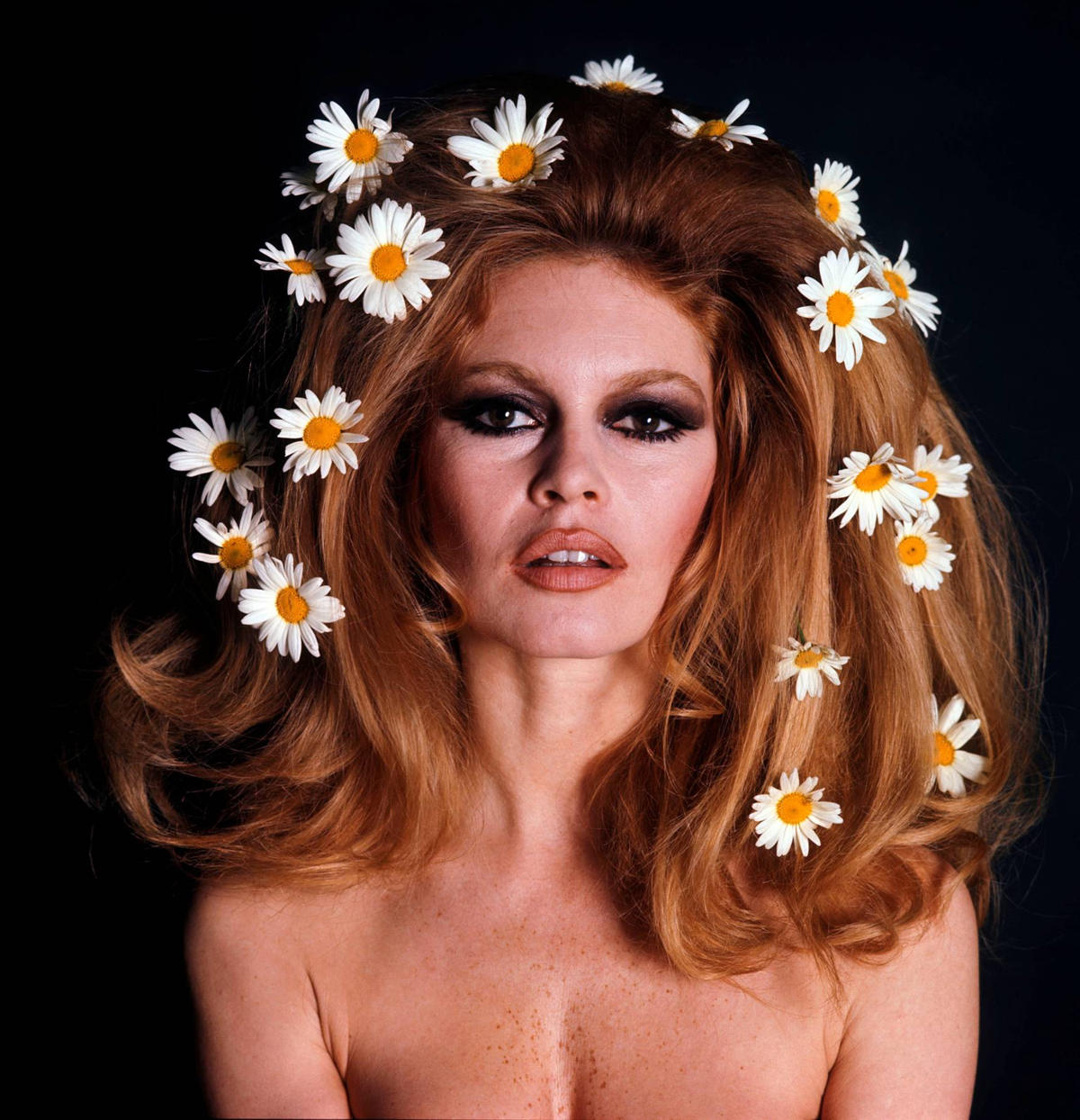 In 1967, Gainsbourg was having some kind of an affair with Bardot, who was going through a difficult time with current husband, German businessman Gunter Sachs. One night in particular, Gainsbourg, who often was nervous around Bardot, drunk with his infatuation…and probably something more, made an ass of himself. And he was sure that this time, there was no hope in hell that Bardot would ever fall back into his arms. But Bardot’s request, as an apology, was that Gainsbourg write her the most beautiful love song he could imagine. That night he wrote two songs, Bonnie and Clyde, and also Je t’aime…moi non plus. They soon recorded an arrangement at a Paris studio in a two-hour session in a small glass booth, however, news of the recording reached the press and an angry Mr. Sachs! Bardot pleaded with Gainsbourg not to release it. He protested that “The music is very pure. For the first time in my life, I write a love song and it’s taken badly”.
But in 1969, Gainsbourg recorded a version with his new lover, Jane Birkin. The single had a plain cover, with the words “Interdit aux moins de 21 ans” (forbidden to those under 21), and would end up being banned in several countries owing to its sexual content. In the UK, it was released on Fontana Records, but, after reaching number 2, it was withdrawn for sale. Gainsbourg arranged a deal with Major Minor Records and on re-release it reached number one, the first banned number one single in the UK and the first single in a foreign language to top the charts. It stayed on the UK chart for 31 weeks. Bardot may have regretted not releasing her version, but she did give permission for a release of her Gainsbourg recording in 1986. With a slight re-edit, it was virtually ignored by the public, who were perfectly happy with the existing Jane Birkin version.
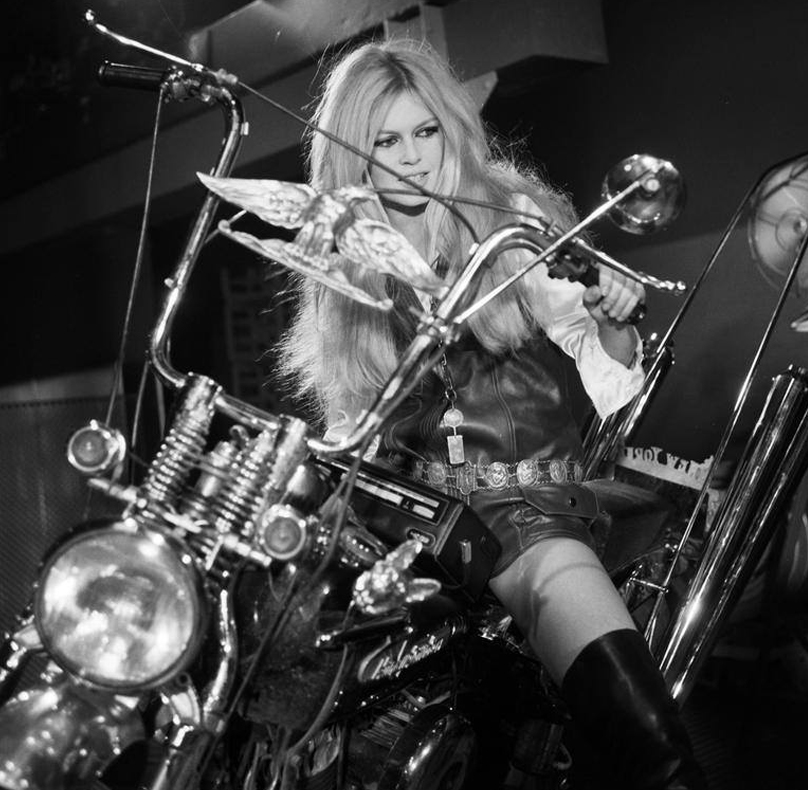 On New Year’s Eve 1967, French TV broadcast a special colour programme devoted to B.B. called Le Bardot Show. Filmed over several months between November and December, the 60 minute show was years before its time, and it effectively consisted of a collection of video-clips, which made an incredible impression on the French public. And this when audiences would first hear…and SEE, Bardot’s Harley Davidson. Phew! I can only imagine the thoughts that were going through both male and females minds when they first shared this moment. Yeah, she had the look, the big wild blonde waves, the tiny leather shorts and high boots, and her signature dark eyeliner, but the way she sang this, is just so defiant and…well…so Bardot (can’t think of any other way to describe it). I don’t need anyone…on a Harley Davidson…I no longer recognize anyone….on a Harley Davidson…I press the starter…and here is where I leave the earth…maybe I’ll go to heaven…but at top speed on a train from hell!
 These songs were released on the soundtrack LP, Brigitte Bardot Show in ’68. Adding to the sexual appeal, Bardot was pictured on the sleeve of the LP (and the spin-off EP) virtually naked, but carefully masked by a layer of wrapping-paper. Fans declared the design a masterpiece. The flip to this iconic track is Contact, and I have to say that this track I find even more desirable, but I’m a sucker for 60’s psychedelic spaced out minimalist sitar flavored dance floor grooves! And I’ll never forget the first time I laid eyes on the film clip of Contact, with Bardot draped in Paco Rabanne!
Bardot retired in 1973, aged just 39, withdrew to her beloved Madrague, her retreat in St Tropez where she could dedicate herself to animals and a barefoot Mediterranean life. She would only leave her home to protest about animal rights (and make some ill-advised comments about immigration). Bardot’s passion for animals could be traced back to her childhood, a time when she transferred affection she missed from home, to whatever 4 legged creatures she could find. In 1986, she established the Brigitte Bardot Foundation for the Welfare and Protection of Animals, and would constantly meet with the French President and other world leaders to protest any case of cruelty towards animals. Bardot has never resorted to any cosmetic surgery, (as so many of her contemporaries have) and has retained her authenticity.
I know many of us were bitten by the BB phenomenon many years ago, but it’s always great to get these records out again and play them out, especially to the “hip kids”, that for some reason are new to her. Her songs always bring back fond memories of great times, and they can still get the punters dancing…and smiling! I think she was an amazing woman with a whole lot more going on than meets the eye! And still is quite beautiful.
Recommended reading and references…
Dusty Springfield – Haunted
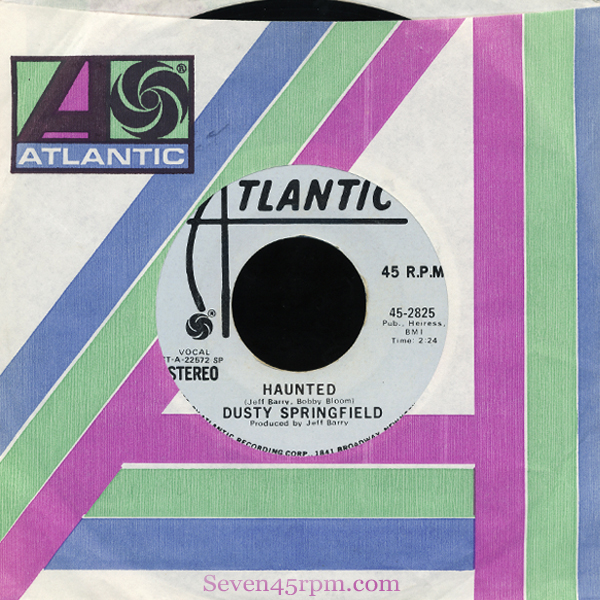
 Atlantic – 45-2825 US Year 1971
Mary Isabel Catherine Bernadette O’Brien was born on 16 April 1939, in West Hampstead, London, and grew up in a very influential music loving family. She learnt how to sing at home, and it was her childhood friends that first gave the young rough ‘n’ tumble tomboy her more suited name, Dusty.
By the late 50’s, Dusty had obviously been influenced with the music scene that was getting around town, and had grown into quite a fashionable and stylish young lady, ditching her glasses and finding her own look. She also was very keen to get out there and sing, and by 17 she had made her professional debut as a singer at a small club near Sloane Square. While she would continue to perform folk music as a solo artist, at small London clubs (apparently she was paid less than £10 a night), in ’58 she spotted an advert in The Stage from an established sister singing act, who were looking for a third member.
 They were called the Lana Sisters, and was formed by Riss Chantelle along with Lynne Abrams. Under the management of the Joe Collins agency, the trio secured bookings on television’s Six-Five Special and Drumbeat, and scored big with tours alongside Cliff Richard and Adam Faith. They also signed a contract with the U.K.’s Fontana Records, and between 1958 and 1960, they released seven singles…but it was all short lived for Dusty. In 1960 she left the group to join her brother Dion O’Brien and his friend Tim Feild, who had been working as a duo, The Kensington Squares. Dion became Tom Springfield, and Mary became Dusty Springfield, and the folk-pop trio The Springfields, was born. The Lana Sisters’ Riss Long, who had been calling herself Riss Lana, became Riss Chantelle and formed The Chantelles, and had some moderately successful records in the mid-60s.
Tom Springfield was a very knowledgeable folk singer, songwriter and arranger, and with the groups strong vocal harmonies as well as Dusty’s powerful lead, the mix was to prove perfect for success. They were signed to Philips Records in London and released their first single, Dear John, in 1961, followed by two UK chart hits with Breakaway and Bambino. They scored numerous television appearances and quickly the trio soon became very popular in the UK. Feild would be soon replaced by Mike Hurst, but the Springfields became even more successful. In 1962, their version of “Silver Threads and Golden Needles” reached the US Top 20 (Billboard), the first single by a British group ever to do so. The record also reached #1 in Australia!
The Springfields would go on to sell millions of records and score big on the charts, however Dusty felt limited by the group’s folksy act and Tom’s lead role within the trio, and also a shared frustration towards their growing American audience that mistook them for a country western group. At the end of 1963, Dusty decided to leave for a solo career, at which point the group disbanded.
In November 1963 Springfield released her first solo single, I Only Want to Be with You, which was was produced by Johnny Franz in a manner similar to Phil Spector’s “Wall of Sound”. Co-written and arranged by Ivor Raymonde, the instant smash hit rose to No. 4 on the UK charts, remained on the Billboard Hot 100 for 10 weeks, and it sold over one million copies! And on 1 January 1964, it was one of the first songs played on Top of the Pops, BBC-TV’s new music programme.
 On 17 April 1964 Dusty issued her debut album A Girl Called Dusty which included mostly cover versions of her favourite songs including Lesley Gore’s You Don’t Own Me, The Shirelles’ Mama Said, and the Burt Bacharach song Wishin’ and Hopin‘, which became a US Top 10 hit. She also released an incredible Italian version entitled Stupido Stupido on a 7 picture sleeve was is just ridiculously awesome!
In December 1964 Dusty’s tour of South Africa was controversially terminated, and she was deported, after she performed for an integrated audience at a theatre near Cape Town, which was against the then government’s segregation policy. That same year, she was voted the Top Female British Artist of the year in the New Musical Express poll, topping Lulu, Sandie Shaw, and Cilla Black. Springfield received the award again for the next three years.
Dusty would go on to release a string of successful 45’s and lp’s in the next few years, but lets touch on some of the really great stuff…well at least my 45 picks. Firstly in ’67, there’s the Philips release, What’s It Gonna Be…killer dusty stuff! Then there’s the spine tingling Am I the same Girl from ’69…um…wow! And then of course, from 1970, there is Spooky! As if saxophonist Mike Sharpe’s original version wasn’t fantastic enough, Dusty sprinkles her soul over it like haunting seductive icing…her voice dripping like warm honey all over the lyrics taken thank-you very much from the Classic IV’s ’67 release.
The Memphis Sessions: In ’69, Dusty who was now signed to Atlantic, was hoping to reinvigorate her career and boost her credibility as a soul artist, and turned to the roots of soul music. Although she had sung R&B songs before, she had never released an entire album solely of R&B songs, but was about to release in my opinion, her strongest and most important album, entitled Dusty in Memphis. She began recording the Memphis sessions at the infamous American Sound Studios which were recorded by the A team of Atlantic Records. It included producers Jerry Wexler (who coined the term “Rhythm and Blues”), Tom Dowd and Arif Mardin, the back-up singers Sweet Inspirations and the instrumental band Memphis Cats, (who had in the past backed Wilson Pickett, King Curtis and Elvis Presley), led by guitarist Reggie Young and bassist Tommy Cogbill. It sounds like these recordings were a challenge for Wexler, who was not used to working with an artist who was in such habitual pursuit of perfection.
To say yes to one song was seen as a lifetime commitment for Dusty, who claims that she actually did approve of Son of a Preacher Man and Just a Little Lovin. Wexler was surprised, given Dusty’s talent, by her apparent insecurity, but she herself later attributed her initial unease to a very real anxiety about being compared with the soul greats who had recorded in the very same studios. Eventually Dusty’s final vocals were recorded in New York.
While Memphis did include the now absolute Dusty classic Top 10 UK hit, Son of a Preacher Man, this powerful and incredible album did not garner significant commercial success upon its original release, and remained out of print for many years!
Faithful would have been the title of Dusty’s third album for Atlantic Records, which was entirely recorded in the first half of 1971. Two singles from the planned album, I Believe In You (flipped with Someone Who Cares), and Haunted (flipped with Nothing Is Forever, a track that supposedly was never intended for the album) were released in the U.S. in the fall of ’71, but both releases failed to chart nationally. Due to poor response (although how hard they were promoted I don’t know), and a rumoured falling out with Atlantic executives, Springfield’s contract with the company was not renewed, and the planned album was never given an official release, catalogue number, or title. Apparently a third single was planned I’ll Be Faithful, where the title Faithful was taken…but that never surfaced either.
For years it was believed that a fire in the mid-seventies at one of Atlantic’s storage sites was thought to have destroyed the Faithful session tapes, leaving only the two singles (and the possible third single) from the sessions intact. However, in the nineties the album’s producer, Jeff Barry, was asked about the sessions and revealed he had kept completed stereo mixes of all the tracks. Most were released as bonus tracks on the Rhino Records/Atlantic deluxe remastered edition of Dusty in Memphis in 1999.
Haunted is a profoundly beautiful soulful composition, and probably way to mature for commercial pop success. Dusty wasn’t the kind of gal to write for the only purpose of seeking sales and chart success, although she probably would have been grateful for the recognition. She was an incredible musician only interested in moving forward into new challenging territories…with no interest at all in recording the same song over and over, regardless of the success she may have received from past hits. Here she’s giving us that warm pure tone (that’s unmatched by any), as we would expect from her, but there’s also a new sound here…and that, she must have found exciting. I love this song. Loved it the first time I heard it…and I love it even more, every time I’ve heard it since…and believe you me…that’s a lot of times! Dusty would admit to be very demanding and standing her ground when it came to her art. But how could anyone question her talent and vision, or stand in her path of exploration…it’s just mind blowing.
 After the release of Dusty in Memphis, Springfield struggled to find musical compatibility with record labels, producers and musicians who all either misunderstood her vision or wanted her to be something other than herself. This resulted in a string of standard albums that achieved nominal success, but I can’t help but think that this path Dusty was on, was a path that she was given and not one that she chose, or was searching for.
She had a great love for animals… particularly cats, and became an advocate for animal-protection groups.
She had some tough times…her alcoholism and drug dependency affected her musical career.She was hospitalised several times for self-harm, by cutting herself, and was diagnosed with Bipolar Disorder. She was constantly be “accused” about her sexual preferences and couldn’t understand the prying interest into her personal life. “Many people say I’m bent, and I’ve heard it so many times… I know I’m perfectly as capable of being swayed by a girl as by a boy. More and more people feel that way and I don’t see why I shouldn’t”.
In January 1994 while recording her final album, A Very Fine Love, in Nashville, Dusty Springfield felt ill. When she returned to England a few months later, her physicians diagnosed breast cancer. She received months of radiation treatment and the cancer was in temporary remission. The next year, in apparent good health, Springfield set about promoting the album. In mid-1996 the cancer had returned, and in spite of vigorous treatments, she died on 2 March 1999. Her induction into the Rock and Roll Hall of Fame in Cleveland, Ohio, had been scheduled two weeks after her death.
Note…During the Memphis sessions in November 1968, Dusty suggested to the heads of Atlantic Records to sign the newly formed Led Zeppelin. She knew the band’s bass player John Paul Jones, who had backed her in concerts before. Without having ever seen them and largely on Dusty’s advice, the record company signed a deal of $200,000 with them. For the time being, that was the biggest deal of its kind for a new band.
Recommended reading…
Ganimian & His Orientals – Come With Me To The Casbah
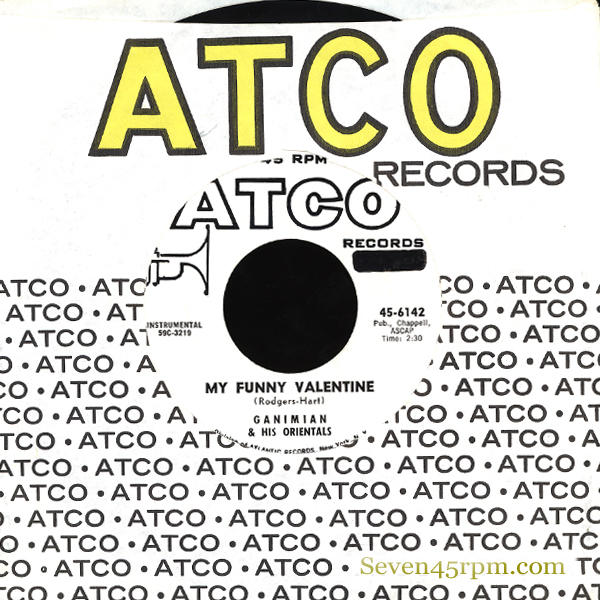
 ATCO 6142 US Year 1959
Charles “Chick” Ganimian was born in 1926 in Troy, New York, to Armenian parents who had emigrated from Marash in 1922. In his home he often heard the music of the “old country”, and the distinctive sound of the oud, performed by his immigrant father (who had arrived from Turkey). From an early age, young Charles had been fascinated with the music of his heritage, and after initially studying the violin and attaining quite some skills on the instrument, he would follow his father’s path and also switch to the oud.
So a bit about this “oud”. It is a pear-shaped stringed instrument commonly used in Arabic, Greek, Turkish, Hebrew-Jewish, Somali and Middle Eastern music, and it’s construction is similar to that of the lute. It is readily distinguished by its lack of frets and smaller neck, and is considered an ancestor of the guitar. According to Farabi, the renowned scientist, cosmologist, musician and philosopher of the Islamic Golden Age, the oud was invented by Lamech, the sixth grandson of Adam. The legend tells that the grieving Lamech hung the body of his dead son from a tree. The first oud was inspired by the shape of his son’s bleached skeleton. It has ten strings (five pairs tuned in unison), and sounds like a hoarse low pitched guitar.
Chick picked up a lot of interest towards this exotic and strange (to western ears) music, from his father. His awareness and taste for these foreign sounds developed more and more, and he would start to understand the rhythm patterns, phrasing and the varies complex styles.
In 1948, Chick first formed the Nor-Ikes Orchestra, a group largely comprised of Armenian musicians, with Steve Boghossian, Eddie Malkasian, Aram Davidian, and Souren Baronian. The band’s name was suggested by Souren Baronian’s father and means “new dawn” in Armenian (nor ayk), and they were one of the first to consciously revive this exotic music for mixed audiences, touring the eastern United States and playing for the broader Arab-American community.
In 1959, ATCO released G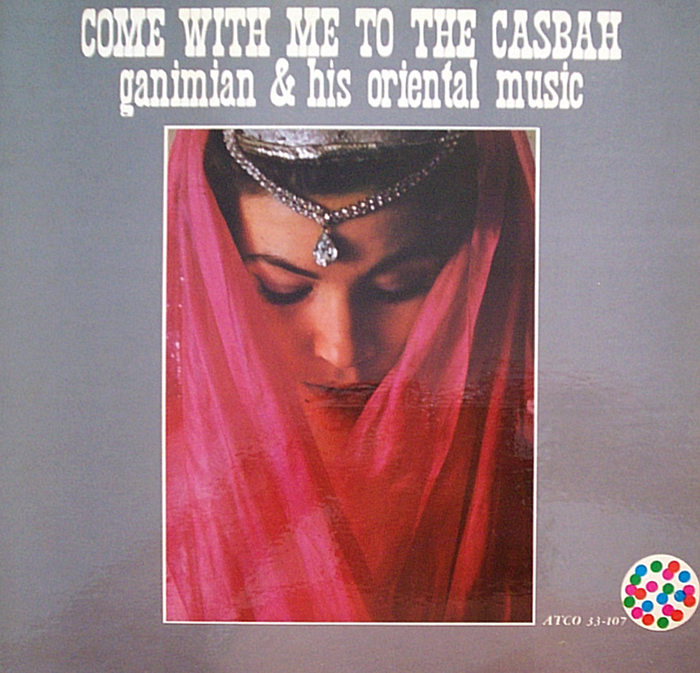 animian’s first LP Come With Me To The Casbah, which included 12 truly mind blowing exotic crossovers. Including some crazy oriental compositions, jams and some twisted standards, the album is really quite amazing and thoroughly enjoyable! While Chick is the clearly the musical fountain head for the band’s Near Eastern approach, having Steve Boghossian and Souren Baronian on reeds, who both add their honest feel for their instruments as played in the old traditional style, adding so much authenticity. An unusual example of jazz musicians who have done about as remarkable a piece of musical transformation as humanly possible.
According to Chick, It was all due to Steve’s (who plays clarinet) experience and musical background that allowed the band to successfully work out the difficult technical problems in playing this kind of music. Souren plays second clarinet, baritone-tenor sax and castanet and also came with very exceptionally high musical talents, and in fact, all the arrangements on the lp were by the three long time partners. Other members of Ganimian’s ensemble include Eddie Malkasian on tenor sax and various percussions, Aram Davidian is on oriental drums, and Ahmet Yatman is on the the kanoon. The kanoon (also spelled qanun) can be described as a lap plucking box zither with a narrow trapezoidal soundboard, with 63 to 84 strings, and has the most beautiful and distinctive shimmering sound.
Onnik Dinkjian provides English vocals on Hedy Lou, Daddy Lolo, and Haluah, although live, he supposedly also sang in Armenian and other Near Eastern tongues. Daddy Lolo (Oriental Rock And Roll) was released a year prior to this album’s release as a 45 on the EastWest label with Halvah on he flip, and Chick’s group was credited as Ganim’s Asia Minors . There is certainly a jazz influence on Ganimian’s recordings. To thank for that are jazz cats Peter Ind on bass, Billy Bauer on guitar, Al Schackman also on guitar and Pete Franco on drums. There’s certainly some amount of science and math that’s gone into some of the backbone scales going on here, with curious names! Oriental Jam is in “Nevahijaz”, The Whirling Dervish is in “Sabah”, while the turkish melody Nine-Eight is in “Hijaz”, which means yeah…it’s in nine-eight timing.
Come With Me To The Casbah is the big dancer from these recordings, and ‘ll be forever grateful that ATCO did decide to give it a 7″ release in ’59. The eerie intro is quite devilish, but the feverish tempo quickly kicks in, and really there’s no hope of doing anything other than dance and wiggle like crazy, for the remaining 2 and a bit minutes. I love dropping this one down and watching the dance floor’s reaction and transformation. It always makes me giddy, and brother, does it sound great on a good sound system! “How do you like the Casbah you little one? Man I dig it!”
Ganimian would continue performing in the ‘60s and ‘70s, making regular live and studio appearances and enjoying residencies in New Jersey and New York. Apparently there’s an independently-released 1975 LP with the Nor-Ikes out there…somewhere?
A standout collaboration I have to mention, would be his work he did with Herbie Mann on his Atlantic album from 1967, The Wailing Dervishes. Mann sits a bit back here and lets his dream team shine on this live recording which took place at Village Theater in New York City. An Lp that is quite an esoteric excursion for Mann, with no commercial or ethnic compromises. With the superb dumbek player Moulay “Ali” Hafid on percussion, Roy Ayers on vibraphone, Reggie Workman on bass, and Bruno Carr on drums, amongst others, this is one great platform for Chick to really let loose on and do his thang! There’s also a great version of Norwegian Wood where all the band get the opportunity to do some wild jammin’ and includes some incredible zither action by Esber Köprücü.
Chick also recorded on Mann’s prior Impressions of the Middle East Lp, which had the fine 7″ release Turkish Coffee.
Unfortunately, Chick’s dependence on alcohol had a debilitating effect on his ability to earn a living, and later on his health. Ganimian died in late 1989 while a resident of the Armenian Nursing Home in northern New Jersey.
But I did find some youtube footage of a live performance from the great man back in early 1984 here. I’m so grateful to the person who had upload it, and to see this for the first time was a pure joy.
Bobby Day – Pretty Little Girl Next Door

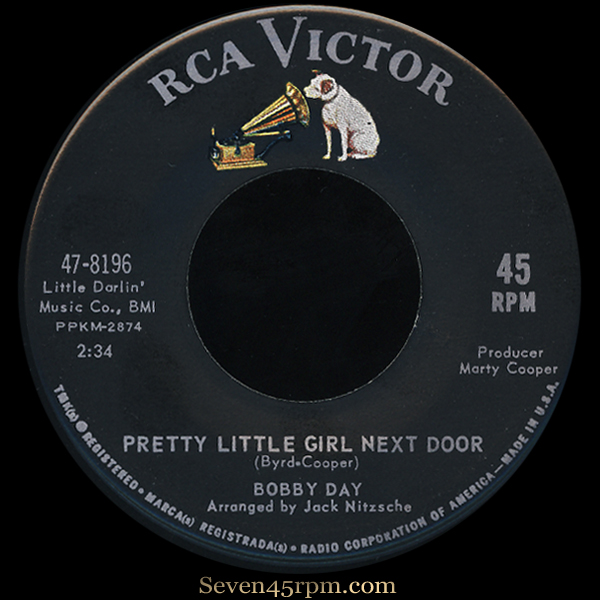 RCA Victor – 47-8196 US Year 1963
Track 1 – Pretty Little Girl Next DoorTrack 2 – Buzz Buzz Buzz
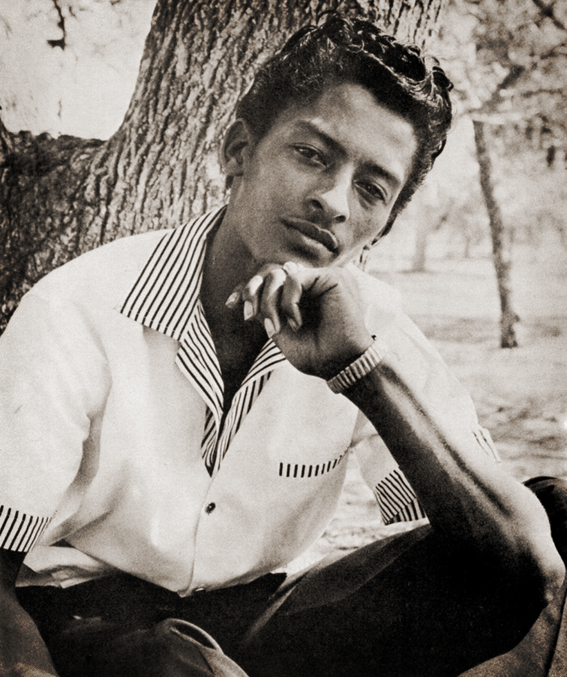
Okay, first thing’s first…Robert Byrd, alias Bobby Day, of the Hollywood Flames, who were formerly The Flames, is not to be confused with Bobby Byrd of the Famous Flames, who were formerly…The Flames…got that? Good!
Robert James Byrd was born July 1, 1928, in Fort Worth Texas, and moved to Los Angeles in 1947. His first vocal group, The Flames, originated in 1949, when all members were in there teens. They all met at the Largo Theater in Watts at a talent show given by the theater’s owner, which brought together many singers from various high schools in Los Angeles.
Bobby strung together tenor David Ford, second tenor Willie Ray Rockwell and eventually Curlee Dinkins, who sang baritone and bass (Byrd would sing bass, baritone, tenor). They quickly learned how to sound pretty darn good together, and as they all needed to earn some dosh, they decided to brave up to an audition they had heard about at the Johnny Otis owned Barrelhouse. They started winning a few prizes here and there and were offered a few little jobs, sometimes making five dollars each.
The Flames existed from 1949 to 1966. In that time, they recorded under a bewildering variety of names (Four Flames, Hollywood Four Flames, the Jets, the Ebbtides and the Satellites), for a bewildering number of labels, with a bewildering cast of personnel.
 In ’57, Byrd penned and recorded the great, Buzz Buzz Buzz, (Earl Nelson on lead) as The Hollywood Flames on Ebb. When the song became a hit, Bobby found out that he didn’t have any publishing rights and only half the writer credit…and never received any money owed to him. That same year with his back up group the Satellites, he also wrote and recorded (as Bobby Day) the fab foot tapping hand clapping Little Bitty Pretty One, released by Class in August. Popularized with success for Thurston Harris, whose release beat Bobby’s out the gate, it reached No. 6 on the U.S. Billboard Hot 100 and No. 2 on the R&B chart…but I much prefer Bobby’s!
But the next year Day was the first to record Leon Rene’s (under the pseudonym of Jimmie Thomas) Rock-in’ Robin…the perfect counter attack, and Day’s most recognize and successful recording, which became Number 2 hit on the Billboard charts! Its flip, “Over and Over,” was a hit in its own right, and a cover by Dave Clark Five in ’65, brought a much more hip, modern youthful version back to the dance floors!
Bobby Day went on to partner with Earl Nelson and recorded as Bob & Earl from 1957 to 1959 on Class.
Moving on to 1963, and Bobby releases the incredibly uplifting Pretty Little Girl Next Door on RCA. I’m sure everyone reading this, has one song that they can rely on, that will always bring themselves a big damn smile, no matter what life is throwing at you! This is mine! From beginning to end, it’s a quite the pleasant build up. With it’s sweet caterpillar like beginnings, it quickly sprouts it’s wings and soars! The slinky groove grows, and it soon smothers you. And I’ve proved that this song can and will draw everyone within a kilometer radius of your turntable, onto your dance floor. Day gives it his all…he really shines in this one, and of course those gorgeous female backing vocals brings it all into perfect harmony! Imagine seeing this performed live by Mr.Day in ’63!
And on the flip, what a delight to have a revisit of his early Buzz Buzz Buzz! Just as great as the original, however this version may have a slower tempo, but certainly holds a stronger groove…and much more developed for the early sixties hipster dancers. Both tracks produced by genius Jack Nitzsche!
Bobby Day died from cancer on July 27, 1990, in Los Angeles and was buried in Holy Cross Cemetery in Culver City, California. He was survived by his wife, Jackie, and four children. He may not have had the successive chart success he very well deserved (he never achieved another Top 40 Hit apart from Rock-in’ Robin), but in my book, he was just as important as the best of them, especially with his major part in the early days of doo wop! He always lifts me, and Pretty Little Girl just makes me drunk with happiness!
Essential reading for a very in-depth and thorough journey with Bobby Day and his Hollywood Flames, by Marv Goldberg…The Hollywood Flames.
Big Buddy Lucas – I Can’t Go

Caprice 120 US Year 1963
Born Alonzo W. Lucas, 16 August 1914, Pritchard, Alabama, Buddy moved to Stamford, Connecticut, at the age of three. In years to come, a good neighbour noticed the young 11 year old’s interest in music and gave him a clarinet. This kind act must have been the true begins of where it all really started for Buddy! In the late 1940s he went to New York City, where he met drummer Herman Bradley, who helped him get his gigs and record dates.
But it wasn’t until ’51, when Lucas would make his first vocal recording on Soppin’ Molasses, for Jerry Blaine’s Jubilee label. Jubilee specialized in rhythm and blues and was the first independent record label to reach the white market with a black vocal group, when The Orioles recording of Crying in the Chapel reached the Top Twenty on the Pop charts in 1953. Lucas became leader of the house band and renamed his combo “The Band Of Tomorrow”. Scoring a #2 hit on the R&B charts in 1952 with the slow revived Diane, may have given the saxophonist some attention, but the flip Undecided is far more foot tapping and exciting! This set the pattern for most of his following Jubilee singles : a lush ballad on the A-side and an R&B sax led instrumental on the flip.
Lucas had one other hit on Jubilee, Heavenly Father (I Love You is the much preferred flip), sung by Edna McGriff (# 4 R&B in 1952), before moving on to RCA and its subsidiary Groove. Releasing a handful of 45’s, including the raw Greedy Pig, my pick of this bunch would have to be the Groove two sider My Pinch Hitter (along side Almeta Stewart, who I honestly have to say, I do not know enough about) and of course the great flip I Got Drunk! The title alone tells you that this here track was always going to be good! Also No Dice (flip to High Low Jack), should NOT be ignored, as Buddy really gets the opportunity to have some sexy fun with his sax and harmonica skills here!
From ’56 to ’57, Buddy had seven 45’s released on Bell Records, a budget label specializing in covers of the big hits of the day, including Hound Dog….okay stuff. BUT also in ’57, he comes out with the hammering Bo-Lee, on the Luniverse Records label. Established in 1956 by struggling songwriters Bill Buchanan and Dickie Goodma, but ceasing production in 1959, this label, with a few exceptions, were nearly all Buchanan-Goodman titles. As much as I admire Budy’s instrumentals, I think his vocal releases are just the bomb, as is the case with Bo-Lee!
in 1958, he became the nucleus of the Gone All Stars, George Goldner’s session band for his Gone Label. Fun stuff, but no real earth shaking releases, well especially compared to the previous Luniverse monster.
Carlton released Beulah in ’59…fantastic stuff, but incredibly similar, if slightly more bizarre, to Bo-lee!
Many more releases were to come in the next few years from Lucas on various labels including Vim, Tru-Sound and Pioneer (I recommend Get Away Fly on the latter label), but let’s move to 1963 and this mind blowing Caprice release!
At just age 28, Gerry Granahan became the youngest record executive in the music biz to that time, when he formed his own company, Caprice Records. He was a former disc jockey at WPTS in Pittston and in 1957, he was the first white artist on the Atlantic’s subsidiary label, Atco. He had a lot of success with numerous solo and group projects (including as pseudonym Dicky Doo and the Don’ts and group The Fireflies), but in 1960, he found being a performer, composer and producer for all his different acts, was too much to handle and realized his future success would come from sitting on the other side of the desk. Granahan had used Buddy’s talents on some of his own previous recordings, so it’s no surprise he brought him over to his new label. I can’t really find out much about the Gerry Granahan Orchestra that accompanies Buddy’s composition. While the label did have some major successes (and why this track wasn’t one of those I’ll never understand…although I have to suspect poor marketing perhaps?), the label folded in ’63 due to some dodgy “off the books sales” from a business partner.
I Can’t Go is an absolute Big Buddy gem! He writes about finding love and fame, and not holding onto to either tight enough. It’s blues…I guess…but so contradictorily upbeat! The cheeky keyboards, the wriggling bass and the outstanding dry production are all perfectly synced. Sometimes I really struggle to understand how music can be this great! And I’d love to find out who is responsible for the fabulous backing vocals…perhaps again former Granahan collaborators?
After researching this great musician, it seems evident that Buddy is much more known and credited for his prolific tenor sax and harmonica contributions, than as the cool cat vocalist that he certainly was. And he did put down some mean grooves with plenty of talent. In the 50’s he worked with Frankie Lymon & The Teenagers on Why Do Fools Fall In Love, and also with Little Willie John on his remarkable Fever take! He would work with blues and soul queens Big Maybelle, Big Mama Thornton, Aretha Franklin, Roberta Flack and Nina Simone! He would also get wild with Bernard “Pretty” Purdie, Yusef Lateef, Jimmy Smith and Count Basie. It’s obvious that here was a man with incredible talent to share, and I’m sure many friendships were made in his lifetime. And while his recording credits can be all laid out to a point without too much unraveling, it kinda saddens me that I can’t seem to find out much more about the man himself, behind those great notes, with such an important historic relevance to soul and blues. There must be interviews out there somewhere with either himself or collaborators. Even some photos?!
Buddy would continue to work with countless more musicians including Hendricks and George Benson, offering his harp and sax skills. In 1980, Buddy had his right lung removed after cancer was discovered, but continued to play alongside his old friend Herman Bradley, that he meet back in the ’40’s. In December 1982, due to ill-health, he finally had to give up doing what he loved most. He passed away on March 18th, 1983.
Referencing Dik from Black Cat Rockabilly
Also great Buddy discography here at Hallelujah Rock ‘n’ Roll
…and here at WangDangDula
And some definitive reading on Caprice Executive Gerry Granahan
 Seven45rpm
Recent Comments