
Rita Monico – Thrilling (La Regola Del Gioco)

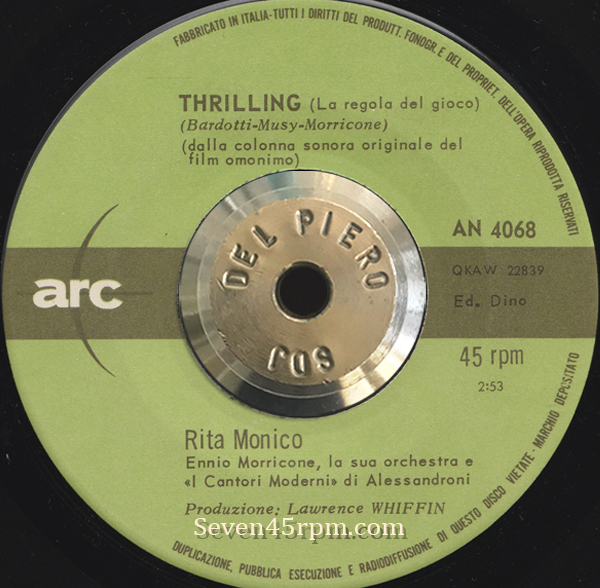
Label: Arc – AN 4068 Italy Released 1965
Track A: Thrilling (La Regola Del Gioco)
Thrilling: adjective – causing excitement and pleasure; exhilarating… “a thrilling adventure”
That’s a definition that is so well suited to this Rita Monico soundtrack single, released back in 1965. This featured track defines the Italian dramatic movie theme sound of the sixties.
I’m finally diving into this Morricone-Monico thriller title track, a much loved record, and a rare diamond in my collection. Quite a notable singer in Italy, and releasing a modest amount of singles early in her career, I mistakenly thought I would be able to uncover a whole lot more about Rita than I could. There has to be fans out there that can shine more light on her than I can here, but for now, I need to share what I have found out about her release.
Monico was born in Milano in 1950, and began singing at a very early age. She participated in the Zecchino d’Oro, an Italian festival/competition held annually since 1959, showcasing children singing songs (the winners are the writers and composers of the songs, not the young performers). She also sang in other competitions such as The Golden Mask and Golden Colosseum.
Her first credited recording release was in 1960 (she must have been 10), a collaboration with Armando Galimberti, singing the children’s Rhyme “Vorrei Volare”. At 11, alongside Laura Belloni, she narrates a record of “Tiritera Dell’Arcobaleno”, which I am assuming is a children’s story accompanied by music. Then in 1964, she had her first actual pop (chanson) release on the ARC label with “Se Tu Non Mi Vuoi” and “Di Sera”. That same year she release “Non Ho L’Eta (Per Amarti)”, a song also sung by Gigliola Cinquetti, who would end up winning the 1964 Eurovision song contest, with her performance of it.
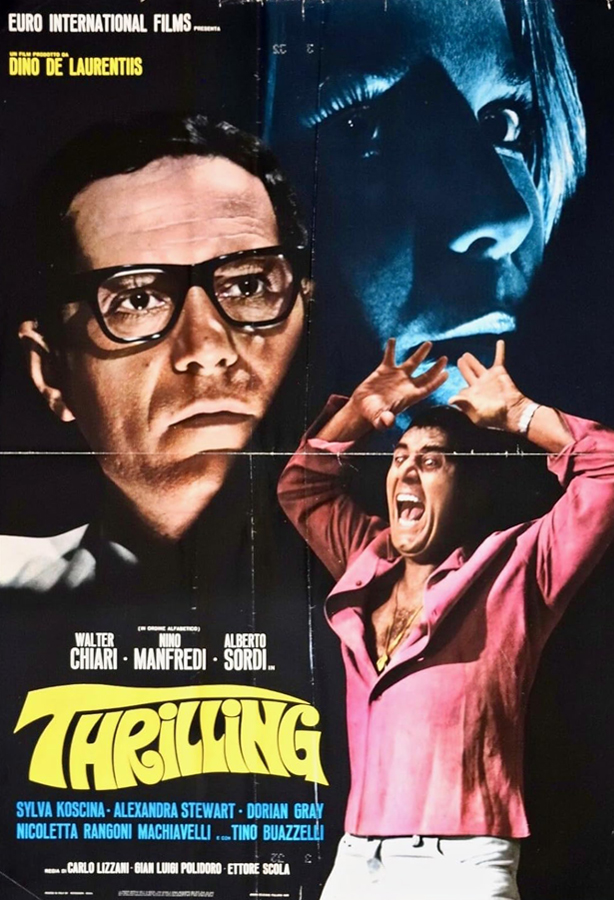
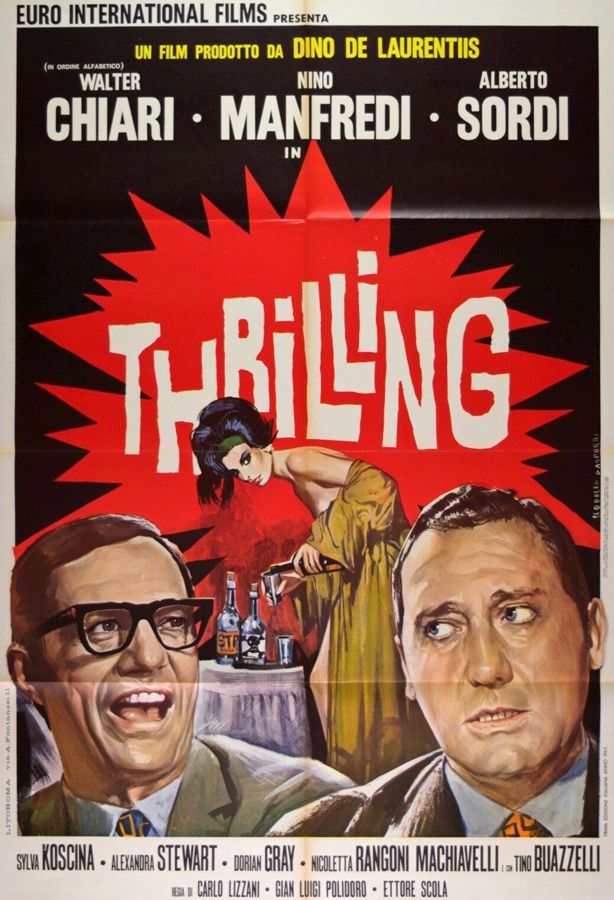
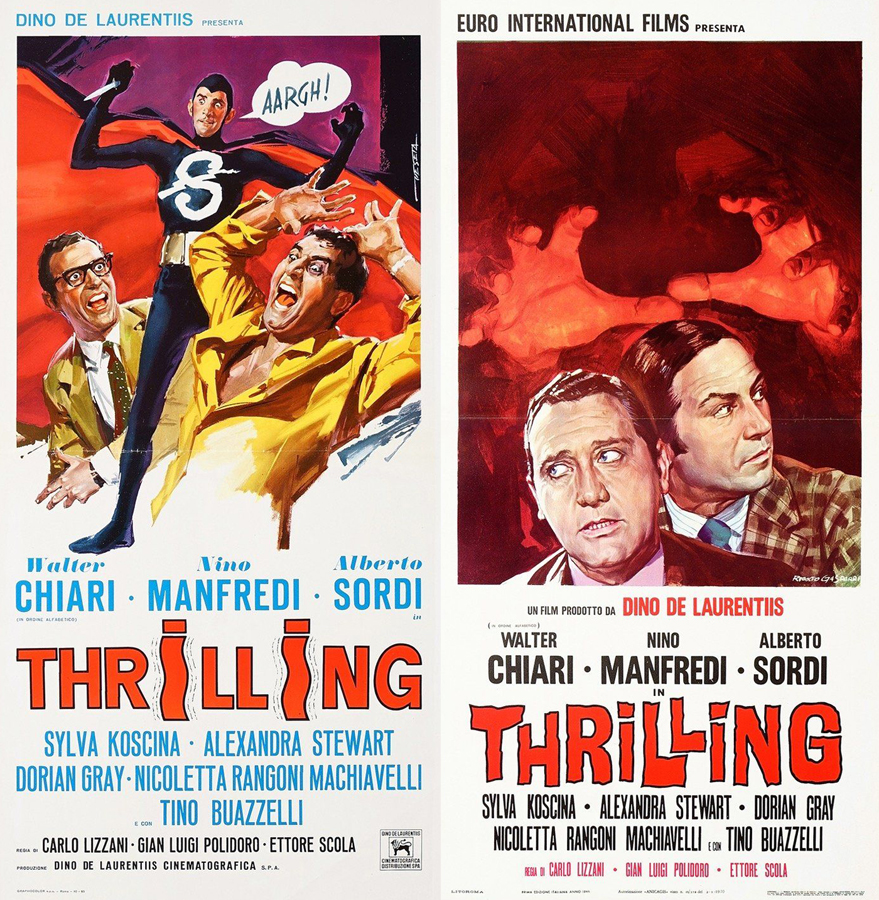
1965 saw the cinematic release of “Thrilling”, released in Italy by Dino De Laurentiis Cinematografica, filmed in Rome, Lazio. Filed as “mystery/thriller/comedy”, it’s an anthology made up of three short films, about three ordinary men who become involved in violent crimes. Each chapter had it’s own director and each included an array of iconic or up and upcoming Italian actors and actresses, all brilliantly cast. Here’s a brief depiction of the three chapters that make for the fun kooky ride.

Il Vittimista (The Victim) – The first story is about a Latin teacher named Nanni Galassi, who suspects his wife Frida (who also happens to have a creepy doll collection), is out to kill him. So convinced that she wants him dead, he consults a psychologist, to determine if it’s a reality or just a wild paranoid fantasy. His anxiety becomes so overbearing, and his tired hallucinating mind starts to break him down. His psychoanalyst reveals that his obsession is caused by a guilt complex stemming from an extramarital affair, so he breaks off all ties with his lover and resumes a quiet life with his wife. But his lover Luciana, isn’t too pleased to be brushed aside, and Nanni may have to pay the price. If you like Italian black humour and absurdity, then this is very enjoyable. Nino Manfredi plays the manic, witty Nanni superbly, and having both Alexandra Stewart as Frida and Magda Konopka as Luciana in the cast, makes it a delicious, if hardly thrilling short film. Ennio Morricone scores this first chapter with thriller instrumental themes, but the celebrated track to Il Vittimista is from Petula Clark, and her song Ciao Ciao (her Italian take on Downtown). It is heavily used in this first episode of Thrilling , and it is both genius and hilarious, as how it is placed in the final sequence.It’s the final master stroke by director Ettore Scola.
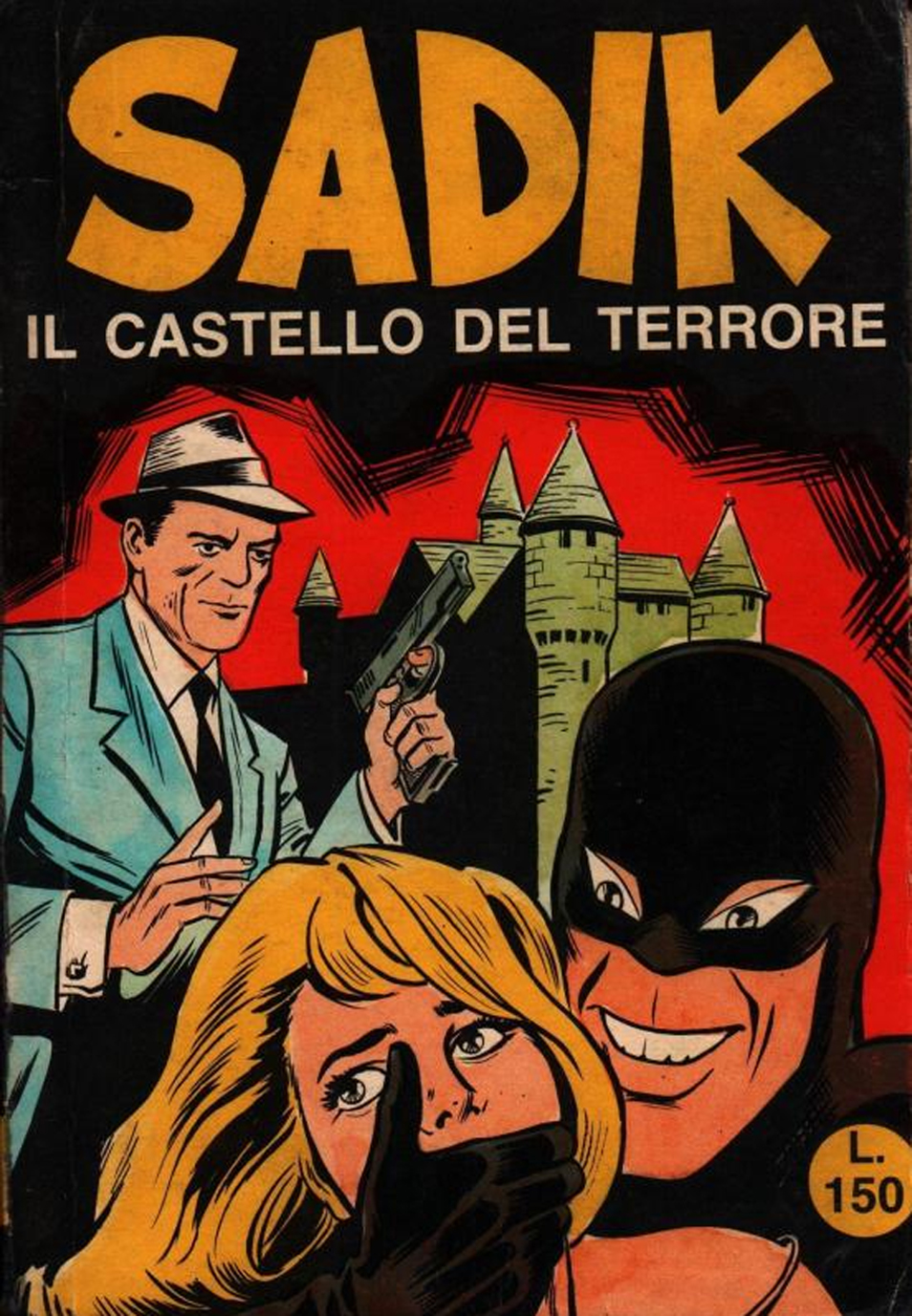
Sadik – Based on the comic series of the same name, this is the second story about a very stressed out business man-engineer named Bertazzi, who is struggling with debt and unpaid bills, but also having relationship troubles in the home, with his comic book obsessed wife. When Bertazzi comes home after a big day at the office, we first meet Veronique, lost deep into one of her comic books, that litter their living area. She pays him very little attention, far more interested in the adventures that picture the pages of her favourite Sadik paperback. After failed attempts of any real conversation, Veronique springs up an idea that may just spice up their relationship. She convinces her husband to dress up as her comic book hero and then break into their house, while she innocently waits in the bedroom. And yes she happens to have a replica costume, that really looks like she made it herself, ready to go. And miserable husband is willing to give it his all. The exotic escapade starts off well, but of course we know it’s not going to go to plan. The phone rings, his wife rejects a valuable business phone call from Switzerland, and he reacts by completely identifying with the comic book role imposed on him. Directed by Gian Luigi Polidoro, and starring Walter Chiari as Bertazzi and Dorian Gray as Veronique, this is a short but amusing adventure, with Monico’s title track used perfectly throughout, to give that wonderful Italian melodramatic and utmost thrill.

L’autostrada del sole (The Highway of the Sun) – The final film of the trilogy starts with Fernando Boccetta, driving sporadically on a freeway, deluded he’s behind the wheel of a Ferrari rather than the incredibly tiny Italian car he actually is driving. Whippin’ and zippin’ through frantic traffic, throwing out attitude to truck drivers, flirty looks to passing ladies, and just being a little insane really. After ditching a suspicious hitch hiker, he ends up having a little bungle with the driver of a sports car he was egging on. The driver takes off and the pursuit starts. But Boccetta breaks down and is forced to spend the night at a mysterious inn run by a very strange family, that it seems are murdering their guests. He meets Paola, a beautiful guest also staying at the inn, along with the very suspect family members. Boccetta senses evil doings and after discovering a body in his cupboard, he really starts losing the plot. He tries to warn an unconvinced Paola, but realising he is likely the next guest to be disposed of, he does his best to make his own getaway. The framed Bocetta almost succeeds, until the final reveal. Director Carlo Lizzani chose well to cast Alberto Sordi as the hilarious and cowardly buffoon lead. And if you have a thing for Italian screen starlets, this short film is a delight! Two sisters of the creepy family are played by Nicoletta Machiavelli as Lea, and her sister Claudia, played by Oretta Fiume, and also the female lead Paola, played by Sylva Koscina, who was actually a Croatian starlet, very popular in Italy in those days.
The title track “Thrilling (The Rules Of The Game)”, is another Morricone film score masterwork, and even though it was only this single that come out for the films release, I peak it very high, as one of his best. He’s collaborated with the highest calibre of female vocalists, but no one could ever better Rita Monico’s performance, or even be more suited for this particular track. It’s really hard to believe she was 15 or 16 when she recorded this! What an incredible range, from her sultry verses to the the big beautiful choruses. And so dramatically performed, in the way that only the Italians can do. And there is also icing of this cake with Alessandro Alessandroni’s musical vocal group Cantori Moderni di Alessandroni helping this become such a Morricone masterpiece. “Thrilling” is predominant used in the second act, but Morricone did create similar themes that really carries that beautiful eerie background atmosphere that is so good for this genre of Italian film making. There was never an actual LP soundtrack released for the film, however just recently in 2024, Solisti E Orchestre Del Cinema Italiano & EverKent, had released a “reconstruction” of Morricone’s music score for the three episodes as a limited run on CD. I’m honestly not a big fan of such modern day re workings (I struggle with the modern production sound, and definitely not the talent), but it could be good, and may even give Monica’s obscure original release more recognition.

The flip side to this official release has Monico singing what is now a Hal David – Burt Bacharach classic, Quando Tu Vorrai (What The World Needs Now Is Love), which has nothing to do with the movie, but it is such a beautiful version. On record, it is Jackie DeShannon who was first to release the vocal song version in April of 1965, so possibly it was some very clever marketing to have an Italian version on the shelves. Not an uncommon occurrence from European or foreign labels at that time. Also, if you want this version of Thrilling, a more achievable 7″ to find, was an EP released in France which also includes “Non È Mai Tardi”, a take on The Shangri-Las 1966 track “Dressed in Black”. Another beautiful cover from Monico, but not as dark as the original, which is always so alluring about The Shangri-Las.

Monico would release singles yearly up until 1975, but I really couldn’t find too much about her career movements or personal life after that period. If I was going to pick a stand out from her further releases, I would suggest the 1975 single Sono Mia / Leggenda Del Futuro, which was used for the documentary “Pianeta Donna – Italia”. The first in a series of documentaries dedicated to the condition of women around the world, produced to coincide with the UN’s “International Women’s Year”. The documentary explores the daily life of Emilia, a 28-year-old woman who emigrated from sunny southern Italy to foggy Turin, northern Italy. She lives with her large family (herself, her husband, four children, two sisters, and a nephew) in a squalid attic, and tries to make the income by working as a housemaid. Her life is devoid of entertainment and discusses the difficulties faced by immigrant families, similar to those faced by approximately 7 million Italians living in the North. The only footage I could find of this, was through the two clips of both songs posted on you tube. It actually looks ethereal and psychedelic, with trippy dance sequencing that plays against both songs, but particular well over Sono Mia. I believe Monico’s tracks are played for both the opening and closing sequences, but I would love to find the series… it’s very intriguing.
I must recommend the film “Thrilling”, to put on your watch list if you have never seen it, especially if you love this era of Italian cinema. The film has never had an official non cinematic re-release, on DVD or for purchase, other that the exclusive VHS (Domovideo and BMG) releases many, many years ago. This is madness! There are some shared opportunities online, but none of the recordings were of the best quality, and likely taken from a VHS copy. Most versions were in Italian with no subtitles, and while my Italian is very poor these days, that didn’t stop me from absolutely enjoying the whole ride, from beginning to end.
If you adore Morricone’s soundtrack work particularly from the sixties and seventies, you will understand why I absolutely treasure this obscure Monico release.
– del Piero

Christy – Deep Down (Danger: Diabolik OST)


Parade PRC 5052 Italy 10 Jan 1968
TRACK : B Deep Down
For many years I’ve been a huge fan of those dark Italian cinematic soundtracks from the 60’s and 70’s, but If I had to specify a period in my life where it all started, I have to honestly say it was way back in my childhood. Growing up in the 70’s, occasionally those great spaghetti westerns were screened on the TV, if very late, on a Saturday night. And while I was most of the time permitted to sit alongside and experience these great films with my papa, I somehow doubt I would have lasted the distance at that time of night. However the dramatic opening titles definitely pulled me in, and they stuck and still are quite memorable for me today. The Good, The Bad And The Ugly was one of those films, and it so happened that my papa also owned the picture sleeve 45 (the Hugo Montenegro version) which I would play over and over.
But it wasn’t until many years later, as I was growing up and started to dig deeper into the heart and soul of music, did I start realising the great names and achievements of these composers. Nino Rota, Armando Trovajoli, Piero Umiliani, Piero Piccioni…these and many more were true masters of the genre. But there is no argument that it is Ennio Morricone who is the ruler of the castle, who stands tallest without a doubt, on that high cinematic mountain.
One of Morricone’s strongest elements of his work has to be depth and atmosphere, and in the 60’s, there was a plenty of it. Many of his compositions and film scores were immersed with very deep, haunting and many times sensual flavours. Moody female vocals would be key, and were often used as background instruments rather than lyrically. Now while this Morricone sound is famous today, and those vocals are such an important and recognisable ingredient, it’s still difficult to find out a real lot about these incredible singers, as is the case with Christy (and also Edda Dell’Orso from previous post). Luckily I have a few friends who are big fans (such as Brendan Young aka dj Diabolik) who have been able to give me a few leads to follow.

Maria Cristina Brancucci was born in Rome on April 20, 1940. In 1966 Morricone took her into the recording studio to lay down some vocal tracks for Sergio Sollima’s feature La Resa Dei Conti. It was a big spaghetti western that deserved a big opening title track, which she provided so appropriately with Run Man Run. The film falls under the subgenre called Zapata Westerns (spaghetti westerns with some political context usually concerning the Mexican revolution) and was co-written by long time Sergio Leone collaborator Sergio Donati. With Tomás Milián who plays Cuchillo and bounty hunter Jonathan Corbett, who is played by Lee Van Cleef, it is today considered as one of the best Italian Westerns ever made due to its tightly directed staged scenes and genius score. The English release, The Big Gundown, would also provide an alternate English version of “Run”, but I definitely lean more towards the more pure Italian version.

In 1967, Christy calibrated with Morricone for the spy spoof OK Connery (re-titled Operation Kid Brother for the US). The plot involves an evil criminal named Thanato, who is bent on taking over the world, using a magnetic wave generator that will cause all metal-based machinery to grind to a halt. However, the secret agent normally assigned to such tasks isn’t available, so they engage his civilian brother, Neil, who is a world class plastic surgeon, hypnotist, and lip reader, which turn out to be precisely the skills required for thwarting Thanatos. Sean Connery’s brother Neil, actually plays the role of the surgeon, and the film includes a bunch of familiar bond faces including Bernard Lee, the original M from the Bond series, and the original Moneypenny, Lois Maxwell. Former Miss Rome and Miss World 1960 runner up Daniela Bianchi, is also starring in the wild romp and she sizzles just as you would hope and expect from an Italian beauty queen!
In 1968 Christy would be called upon again for another western, Tepepa (also known as Long Live the Revolution and Blood and Guns), this time directed by Giulio Petroni. The film stars Tomas Milian as the Mexican revolutionary leader, Jesus Maria Moran a.k.a. Tepepa, and in opposing roles, Orson Welles as Colonel Cascorro, and John Steiner as Doctor Henry Price, who saves Tepepa from the firing squad in order to exact personal revenge for the death of his fiancée. Christy provides the fitting dramatic Al Messico Che Vorrei, again with Morricone at the wheel.

In the late sixties, Christy’s 7″ release Deep Down was recorded for Mario Bava’s diabolical Danger: Diabolik masterpiece. If you happen to be a fan of pop mod spy action films, then this is your movie! It’s bizarre Italian cult cinema at it’s best, and needless to say, it’s legendary with Italian genre film buffs. But even before the 1968 cinematic hero existed, the myth was well and truly alive in the form of a long running controversial pocket sized publication entitled Diabolik. It was created by former secretary, editor and model Angela Giussani, who founded the Astorina publishing house, a company that was limited to board and Western card games. Angela really studied the market and concluded that many commuters liked to read mystery novels. She imagined a magazine commuters could read during their trips, that was entertaining yet intriguing, with breathtaking action.

Inspired by Marcel Allain and Pierre Souvestre’s Fantomas, Angela and her younger sister Luciana, who had now started working with her, came up with the handsome masked criminal, who would be seen really as an anti-hero for grown-ups of both sexes. The first issue had a dark yet vibrant cover of a masked man in the background and a woman screaming in the foreground, with the subtitle “Il fumetto del brivido” (The comic book of terror). This really highlighted that the publication was aimed at an audience of grown-ups, who likely preferred noir novels, something rather unique for those times when comics were considered as light entertainment for kids. Luciana collaborated with her on the series’ stories starting from issue #13, and the exciting adventures evolved. Diabolik was soon a successful working man’s super hero which has sold more than 150 million copies since he made his first appearance.
In the Dino De Laurentiis produced feature film, John Phillip Law plays the “master sports car racer, master skin diver, master lover”, Diabolik, and the stunning Austrian Marisa Mell plays his girlfriend Eva Kant. The movie is a real trip. It’s got that great 60’s vibrant Technicolour palette, over the top action and charismatic characters, and like its De Laurentiis companion Barbarella, it’s damn sexy! (1*)

So the plot in a nut shell is. After an armored car leaves the bank with ten-million dollars, Diabolik manages to attack and steal the money, escaping with his partner. He heads back to his secret underground electronic hideout where he decides to steal the famous Aksand emerald necklace for Eva’s birthday from the Saint Just Castle. He out smarts the law, as he has done so many times before, and succeeds, but gangster Ralph Valmont finds a way to kidnap Eva and holds her up for ransom. With the ten million dollars and emerald necklace for trade, Diabolik sets off to the rescue. Eva makes her escape and Diabolik kills Valmont, but this time he is trapped and faces a shiny gold plated death. The police find Diabolik and proclaim him dead, but soon it is revealed that he has in fact faked his death through a technique taught to him by Tibetan lamas. He returns to life, however if he does not get the antidote within 12 hours, he will die. I think I’ll leave it there and keep you all hanging, so you can go out and find a copy to see how it all unfolds for the anti hero.

The film is typical of a De Laurentiis production, and while some just can’t see the beauty in this genre, tagging it as camp and cheese, I seriously love this kind of film making. For me everything works as it only could have, in that late sixties era of cinema history. And when the psychedelic spiraling open titles kick in, again we have the great Christy-Morricone collaboration with Deep Down. This time, as opposed to her previous more expressive soundtrack recordings, Christy is far more subtle with her approach. It’s actually very sensual and her vocals riding nicely up alongside the distorted whaling guitar that brands the composition. Don’t get me wrong, she stills sings with her gusto and passion, but this time it’s the whispery voice that really draws you in here. The genius of Morricone shines in this perfect collaboration. Some may find this surprising, but this Parade 1968 single featured, is the only vinyl to be officially released from this infamous underground cult film. The word on the street is that all masters and recordings of Morricone’s work for the film were destroyed in a studio fire. An “unofficial” soundtrack on Sycodelic in 2001 was released but it is believed that these recordings may have been ripped from a laser disc edition of the film, as some sound effects and dialogue are evident throughout. What you will find on this release are 3 alternate versions of Deep Down performed by Edda Dell’Orso (featured on my last post) and the incredible psychedelic Valmont’s Go Go Pad and Underwater Wah-Wa. Crazy fabulous stuff! This featured isolated Diabolik single is flipped with the unconnected Amore Amore Amore, which was produced by Piero Piccioni for Alberto Sordi’s 1967 film Un italiano in America.

Deep Down is such a great little 7″ and a bit of a shining gem in my collection, obviously because it’s an important piece of Diabolik history, but also because I just love this song so, so, so very much. It’s not too difficult to find and it plays nicely for those early cocktail sets. Deep Down was recently covered by Mike Patton on his Mondo Cane Lp, and there’s some great clips online, in particularly the live footage at the Holland Festival in Amsterdam, you may want to search. Whether fans agree if Patton gives the song it’s deserved justice or not, I don’t know, But I have to say, once those horns kick in on that live version, the hairs do rise!
In the late 60s Christy recorded more pop songs (including a great version of Quando Quando Quando) and ended up a popular Italian TV variety artist for a number of years. Today she’s now a well known voice actor, who dubbed Barbara Streisand’s voice for the Italian version of Funny Girl, and has worked on countless animated films including The Princess and the Frog, Anastasia, Bambi, Beauty and the Beast, The Three Musketeers and The Lion King 3.
(1*) The release of Barbarella and Danger: Diabolik lead to a minor trend of adaptations of comic strips that emphasized mild sado-masochism and late 1960s fetish gear. These films were followed up with Piero Vivarelli’s Satanik (1968), Bruno Corbucci’s Isabella, duchessa dei diavoli (1969) and Corrado Farina’s Baba Yaga (1973) which had a Piero Umiliani soundtrack.
Black and white photo. Angela and Luciana Giussani, the creators of the comic book Diabolik, in their studio, 27th September 1966 (photo credit unknown).
Danger: Diabolik! Trailer
Recommended reading… Anna Battista’s irenebrination
Edda Dell’Orso – Kukumbe (Le montagne della luce)
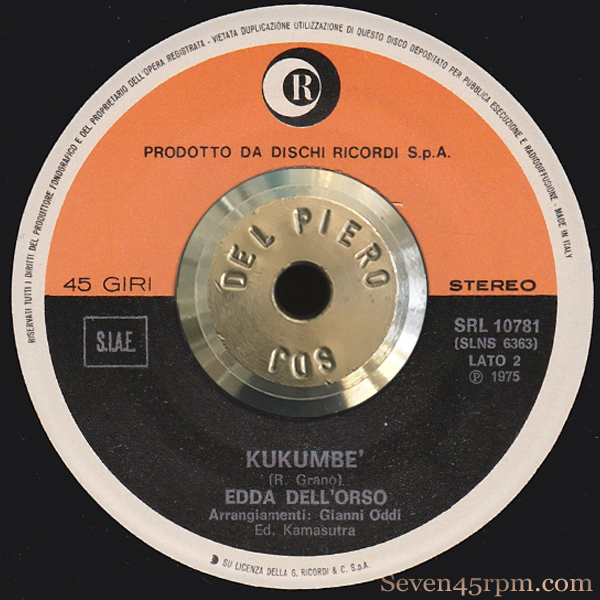
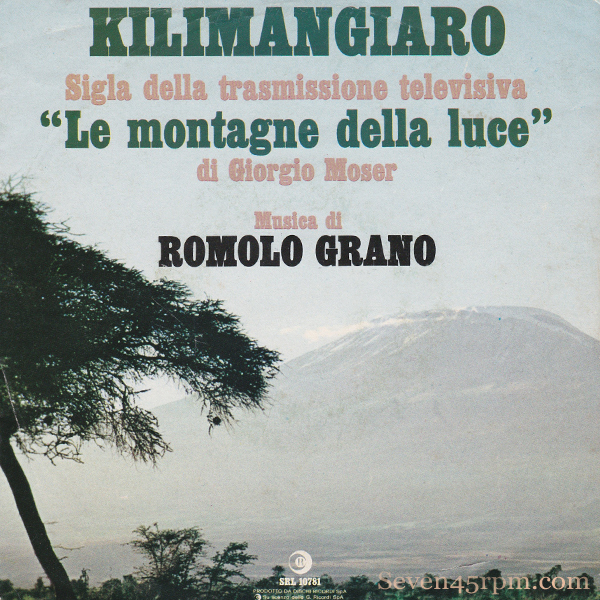
Ricordi SRL 10781 Italy 1975
Track 2 – Kukumbe (Le montagne della luce)
As that saying goes, behind every great man, there is a great lady, but there was more than one that strengthened one particular composer’s work if we’re talking about Morricone. A key element so important to his sound, Morricone would expose and you could even say, flaunt his leading ladies up front in the mix down, even if they were at the time providing background sounds or atmospheric vocals.
I’m going to parallel two posts celebrating two important women with names that are synonymous with Morricone, particularly from the 60’s and 70’s, when that era of his film scores were infamous for that beautiful sensual psychedelic and at some times haunting sound. But I also want to present other composer’s that all contributed to that now distinctive classic Italian cinematic sound if that time. This post I’ll be looking into an Edda Dell’Orsa composition she undertook for one of those other composers, and with a follow up post, I will pursue a journey into the works of Maria Cristina Brancucci, also known as Christy. As always, I wish I was able to enlighten you all with more information about Dell’Orso’s musical journey, but facts and life details are a little mysterious and not too easy to come by. However I will go through a bunch of my favourite Edda tracks and touch on some of those great composer contributions.
Edda Lucia Sabatini, was born in Genoa, Italy on February 16, 1935 and married pianist Giacomo Dell’Orso in 1958. She studied singing and piano at the National Academy of Santa Cecilia in Rome from around 1958, and in time she would possess a beautiful soprano voice with a three octave range that would stamp many now legendary composers work.

Around the mid sixties, Morricone was the first composer and conductor to use her astonishing voice for a feature film, and with immense artistry, he created unforgettable innovative vocal lines and sound effects. One of those early soundtracks was for Sergio Leone’s 1966 Il buono, il brutto, il cattivo (The Good, the Bad and the Ugly) and it includes one of the most celebrated Morricone’s themes, The Ecstasy of Gold, which is played while Tuco is frantically searching a cemetery for the grave that holds $200,000 in gold coins. This amazing piece of cinematic music has been covered from Yo Yo Ma to Metallica, but as famous as this soundtrack is today, Edda was actually was uncredited for her part. The soundtrack album was on the charts for more than a year, reaching No. 4 on the Billboard pop album chart and No. 10 on the black album chart. The main theme was also a hit for American musician Hugo Montenegro, whose rendition on the was a No. 2 Billboard pop single 2 years later in 1968.
This was an incredibly busy period for Dell’Orso recording from film to film, studio to studio. Westerns were of course very popular after the success of A Fistful Of Dollars, and the hard working Dell’Orsa kept providing the goods, including the very moving titled track C’era una volta il West (Once Upon a Time in the West) for Sergio Leone in 1968, another Morricone partnership (1*). Again in ’71, another fitting title track with the quirky Giù la testa for Leone’s Duck, You Sucker! (also known as A Fistful of Dynamite and Giù la testa), but she also worked far beyond the Italian West.

In 1967 Dell’Orso scores the opening swinging title song Seli, for the Italian science fiction film Mission Stardust (…4 …3 …2 …1 …morte), composed by Antón García Abril & Marcello Giombini. Some fans of the genre consider this offbeat film so appallingly bad that they playfully deny its very existence, however this rare soundtrack is also called a masterpiece by many jazzy lounge aficionados, which I tend to support. The next year Dell’Orsa contributes to the infamous Danger: Diabolk soundtrack, offering 3 alternate versions of Deep Down…The Shower, Eva’s Holy Dress and the tripped out, whimsical Emerald Bikini version. The title track was performed by Christy, another female legend of the Italian cinema soundtrack that Morricone liked to work with. 1969 offered up a true classic Dell’Orso-Morricone cooperative, with Metti una sera a cena for the Italian drama film of the same name, directed by Giuseppe Patroni Griffi. One of my favourites.
Dell’Orso moved into another film genre with the thriller La stagione dei sensi (Season of the Senses), bringing with her the lovely bossa styled Una Voce Allo Specchio. The title track for Giuseppe Patroni Griffi’s 1969 drama, Metti, Una Sera A Cena, is classic and rich in Dell’Orso spices, and was covered a few years later quite nicely by Milva. The 1967 chilling score for Bruno Gaburro sci-fi post-apocalyptic Ecce Homo I Sopravvissuti, which gave Morricone an alternate opportunity to get down low into the darker side of Dell’Orso’s vocal soul, and the outcome is a soundtrack which offer varied versions of Venuta dal mare throughout, that all raise the hairs. Staying on the horror theme, Dell’Orso contributed to two films by Italian shock horror director Dario Argento, the first in 1970 called L’uccello Dalle Plume di Cristallo (The Bird With Crystal Plumage), and then for Perche Si Uccidono? (Why Do They Kill Themselves), a film essay about drugs and self-destruction. For the latter 1976 film, the score was a collaboration with composer Fabio Frizzi and instrumental band Goblin (often used by Argento), under the pseudonym of Il Reale Impero Britannico.

Dell’Orso was also providing her voice for other prominent, mostly Italian composers of those times, and was also a key figure of the I Cantori Moderni choir, which was founded by Morricone’s childhood friend and composer Alessandro Alessandroni (2*)(3*). Piero Umiliani was one composer that regularly worked with Edda & I Cantori Moderni, and some of the best Dell’Orso work came from this collaboration. One of Umiliani’s most recognised tracks is Mah Na Mah Na, which he did for Svezia, Inferno E Paradiso, a 1968 pseudo-documentary about sexuality in Sweden, which ironically was later popularized by Sesame Street and The Muppet Show. Another Umiliani-Dell’Orso standout is the fuzzed up Le isole dell’ amore, for the 1970 film with the same title, which to be honest I know absolutely nothing about! Another soundtrack worth mentioning from the same year, is the impossible to find whacked out 5 Dolls for an August Moon, originally titled 5 Bambole per la Luna d’Agosto, and directed by Mario Bava (4*). Also check out the very chic Luna Di Miele, which was recorded for the documentary directed by Mino Loy and Luigi Scattini called Questo Sporco Mondo Meraviglioso, and includes whistling by Alessandro Alessandroni.
So lets now move on to the feature 7″ which was recorded for Giorgio Moser’s TV special Le Montagne Della Luce. Kilimangiaro is a beautifully produced composition with Dell’Orso’s trademark atmospheric artistry. Arranged by Gianni Oddi and composed by Romolo Grano, this track alone is well worth the effort it will take to find this rare thing. However while the titled A side was probably the selling point, it’s the magnificent B-side Kukumbe, that I think is the dynamic and most grooviest track she’s worked on. Big breaks, fender rhodes, jazzy trumpet, congas and top scat vocals by Edda, all amount up to a very sizeable and rhythmic killer production. I’ve been fortunate enough to play this on a big sound system and it was real fun! That bass drive grooves very nicely with that back beat. Now if you’re hoping that there’s a few Dell’Orso 7″s that you need to get a hold off, well in fact as far as I know there are only a few officials, one other being an earlier release from ’69 titled Sospendi Il Tempo, for the psychodrama La stagione dei sensi.

Dell’Orso would continue to record for many soundtracks and collaborate with many musicians. There was a very pertinent chemistry delivered in 1974 when Dell’Orso voice was utilized quite significantly on Italian master guitarist Bruno Battisti D’Amario’s album Samba Para Ti, which includes the beautiful spaced out Show Samba and the frantic upbeat Playa Sin Sol. The following year proceeded with a second team-up album called Granada and includes the standout upbeat latin dancer Su Delicia and a very cool version of Ipanema. In 1976 she worked alongside her hubby’s brother Gianni Dell’Orso, and laid down the sexy discotheque track Night Magic for Mondo Di Notte Oggi (directed by Gianni Proia), a soundtrack which has some nice funk moments, in particular on Soul Meeting.
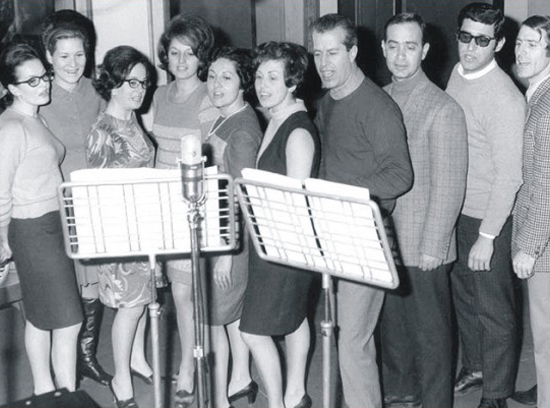
Many years later in 2011, Danger Mouse and Daniele Luppi released Rome, a soundtrack for a non-existent movie, that took five years to record. Obviously die hard fans of that era of Italian cinematic sound, the producers had their hearts set to develop the sound and process as authentic to that time as possible. The album was recorded using only vintage analogue recording equipment and musical instruments from the 1960s and 1970s. They also took the opportunity to reunite Alessandroni’s Cantori Moderni choir, who had not performed together since the early 1980s. Dell’Orso’s beautiful voice can be heard on the Theme of Rome track. The album also features vocals by Norah Jones and also Jack White who also provided the lyrics for his three songs. Even more recent, Dell’Orso was picked up by Alex Puddu, another true devotee of Italian vintage sound, to work on his 2013 album Registrazioni Al Buio, where she laid down 3 very smooth tracks (5*).
To try and cover all the composers, producers and productions Edda Dell’Orso worked with especially in the specific 60′ to 70’s period, would be a bit of a feat, and true fans will agree that I’m really only scratching the surface here. Her work is the epitome of intelligence and sophistication and she is the sound of Italian cinema, and remarkably she still continues to perform today with her strong distinctive voice. And obviously there’s a lot more we can talk about, regarding those great Italian composers that she worked with, that thankfully are now getting the praise they have always deserved. In time I’m hoping to cover a special selection of favourite cinematic Italian 7’S, but for now, stay tuned because there will be a follow up post tomorrow, celebrating another Italian female legend of the cinema soundtrack, Christy.
(1*) Edda Dell’Orso performing C’era una volta il West live in 1982.
(2*) Alessandroni was an accomplished whistler, and he can be heard quite famously on numerous Leone’s western soundtracks, and also was responsible for THAT twangy guitar riff that is central to the main theme for The Good, the Bad and the Ugly.
(3*) I Cantori Moderni, was an eight-to-sixteen person vocal group featuring Edda Dell’Orso, Giulia De Mutiis (Alessandroni’s first wife), Gianna Spagnuolo, Augusto Giardino, and Franco Cosacchi.
(4*) Mario Bava’s work from the “golden age” of Italian horror films is said to have kick-started the giallo film genre and the modern “slasher film”. He was also a special effects artist and had all director, screenwriter, and cinematographer credits for many movies including Danger: Diabolik, Planet of the Vampires, The Whip and the Body, Black Sabbath and Kill, Baby, Kill to name but a few.
(5*) Dell’Orso with Alex Puddu band captured live in Copenhaghen.
Research and referencing…
 Seven45rpm
Recent Comments