
Victoire Scott 4ème Dimension
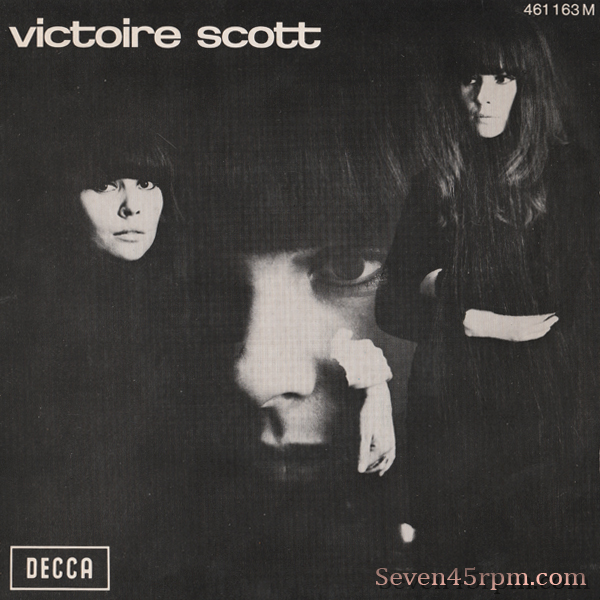

Decca – 461.163 France Released April 1968
Track A1: 4ème Dimension
Track A2: Une Fleur Dans Le Coeur
So the whole purpose of this blog was initially to contain information of all the things I have discovered about some of the musicians that have recorded on some my favourite 7″s. Artists or songs, that aren’t so well known, that has taken me hours and nights of digging into very particular music websites, elusive but specific forums, archival news articles, linar notes and even old fashion books. But there’s so many artists I want to feature here that for the life of me, I just cannot find anything on them! So I’ve decided to start a new “mysterious unknown” category on Seven45RPM, in hope that someone out find has something to enlighten me with, that I can add. This track, from Victoire Scott, has to be in my top sixties french femme list, and it needs to be shared!
Her real name apparently is Claudie Deneuville, and the only consistent word on this singer that I’m hearing, is that her whereabouts is famously unknown. We do know she released eight 7″ releases, between 1968 and 1971, with 3 ep’s include in that small mix. Decca released her french EP’s in the sixties, then possibly new management, or a deal, for her CBS releases for her early seventies releases. Her two canadian single releases were on London. So no real overseas pursuits by the looks of it?
4ème Dimension is her first release and her best. Haunting intro and versus, with psychedelic power pop bursts into choruses. The lyrics picture a dream like moment, where the world around is all unknown, perhaps lost in a 4th dimension. It’s all very psychedelic, fantastical, and paints all the images you need for a the surrealist’s journey. Shattered glass, one eye window and golden butterflies. It’s all so perfectly dreamy and bliss!

But this is not a “must have one track” EP, or no! The following track is also brilliant and beautiful. “Une Fleur Dans Le Coeur” follows a similar pattern to the opener, with it’s gentle but eerie start, but this time we are lead more into a prog garage blues shift, albeit still with catchy pop choruses. This track is actually a take on The Shamrocks* “Rich Life” from 1967. But it’s not a cover. Scott’s song title translates to “A Flower In The Heart”, and the lyrics are very different, this being a love song, again, quite pure and dream like. Where as The Shamrocks talk about Chevy’s, Swimming pools, Egyptian jewels and king size beds. No guessing which portrayal I prefer. French writer Christian Schaeffer gets a credit for “Une Fleur Dans Le Coeur”, but so do Shamrocks’ Keith Chambers and Peter Pawson, which would be for the rights to use the melody and song construction. Scott’s take blows away the original into fragments of rainbows. The following two B side tracks are also great, similar in spirit, and just adds to this whole package of pysche sixties delight.
Scott would release a second EP in October of 1968 and is another worthy release if you like her first release. The title track ” Un Garçon, Une Fille” is psychedelic floating pop, but has a really strong and catchy chorus, and wonder why this is obscure, as it has everything and more, than other more popular hits of the time, in he similar genre. Maybe the radio french weren’t into the psychedelia. Or maybe they were and it did well? I just don’t know. But it’s brilliant! And as an extra treat, there’s a clip of her singing this track (search it on you tube), so maybe the expectations were hopeful for this release, by record executives?
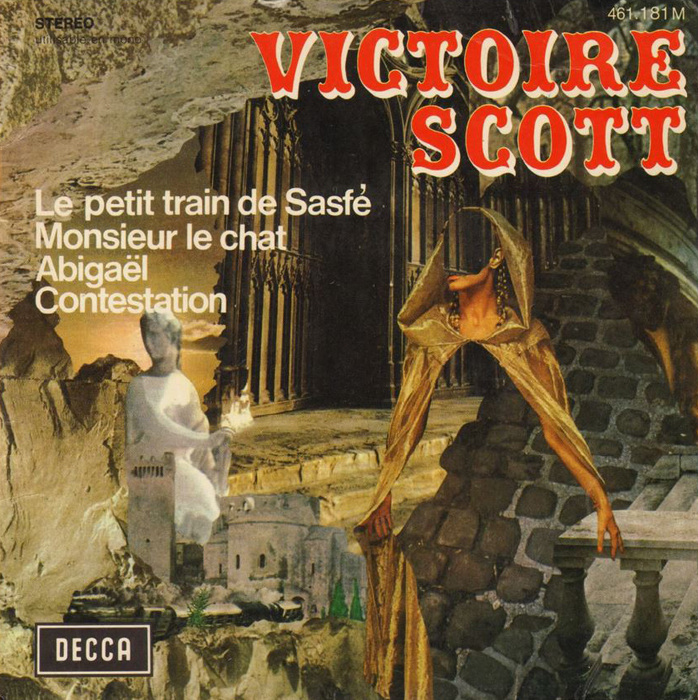
Her 1969 Ep “Le Petit Train De Sasfé” doesn’t just have that amazing surrealist collage pic sleeve, but it also includes the incredible haunting “Abigaël”, which I’ve always been in love with. This is Victoire Scott, her voice, her mystery, her sound, and her everything. Some other artists that I love of this time, would release a one off psychedelic track, perhaps it was a thing that they felt needed, to fit all that was so happening at the time. But in Scott’s case, I feel it was coming from a more genuine place.
Scott would release “Hey Mamma” in 1970, and now she’s moved more in to a harder edge sound, not too far from what the Beatles were moving into, with an early taste of glam, and guitar heavier than early releases. Then 1971 saw the release of her much more radio friendly “Bientôt San Francisco”. And this is where it stops for Scott and her recording releases…as far as I know.
I will always respect artist’s privacy, especially when I have no idea of what their recording experiences were like, or their lives at that time or in following years. So I have to appreciate if these singers and musicians prefer to stay secluded and away from recognition. But I also hope that they do know how much their music is valued and loved all these years later. So, please, if anyone out there knows anything about the wonderful and mysterious Victorie Scott, please shine a light!
– dj del Piero
* The Shamrocks were a phenomenon as they never charted in Sweden, but were the most successful Swedish Rock band in Europe in the the ’60s, and charted in German, France, Netherlands and even Japan.
Other things I found out:
Therion “Une fleur dans le cœur” in 2012.
Scott appeared on “Musicolor” in the Episode Les moyens de locomotion that aired on June 19, 1969.
Writing credits for “4ème Dimension” go to Guy Bonet and Christian Turban, the older brother of Alain Turban who covered this song as a disco track (!) in 1978 on Carrere.
Victoire Scott starred on Au Risque De Vous Plaire rare tv show directed by Jean-Christophe Averty. The clip below supposedly is taken from her appearance in 1968 and includes surreal artworks by Belgian surrealist Paul Delvaux and Dutch graphic artist M. C. Escher.
If you like this you may also like Maki Asakawa.
Vetty – Nicolas

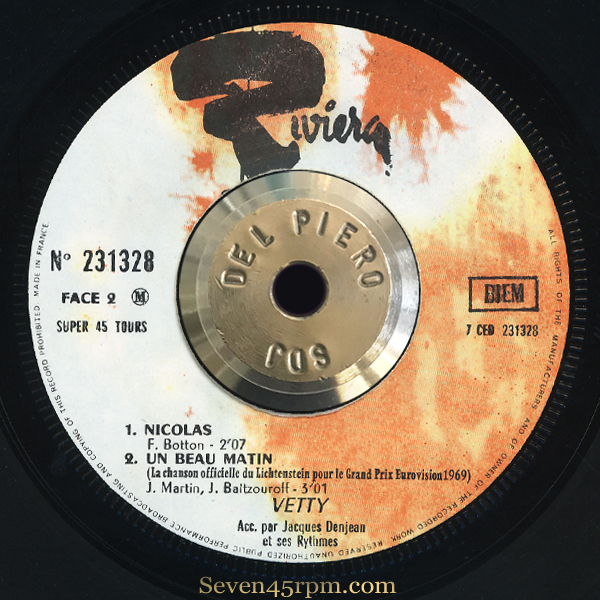
Riviera 231328 France Released 1969
Track B1 – Nicholas
Well here’s a favourite french 7″ that fits into a few categories. It’s beat ye’ ye’, it’s groovy French pop, it’s got a funk kick and it could definitely be filed under oddities. This is all I could find out about the mysterious Vetty that is behind this big rare french monster 45!
Yvette Levis was born in 1941 in La Croix Rousse, a small city high on the hill that shares the same name, in Lyon, France. In 1962 she was spending time in Switzerland and had a connection (possibly working) with La Chaux-de-Fond, in an establishment run by Jacques Marjo: La Boule d’Or, a few kilometres south of the French border. It is said that she started acting before any musical ventures, but I have no information as when and where this took place, in these earlier years.
In January 1966 she landed in Paris and took part in a game show, “Le Palmarès des Chansons” which was broadcast every week from 1965 to 1968 on the first French channel on television. On each show, a renowned singer is invited and young artists must perform one of this singer’s hits, or a potential new hit song, unknown to the general public. The winners were determined using a “computer machine”, where all the punched cards from the viewers where fed into and sorted automatically (this added a technical and modern side to the show). Some of the big french artists to appear on the show included Serge Gainsbourg ,Jacques Dutronc, Sheila ,Sylvie Vartan, Johnny Hallyday and Francoise Hardy. It is here, on this popular TV show, where Vetty was noticed and scored a three week opener for Gilbert Bécaud at the Olympia. Vetty then was able to jump onto another tour with a big name attached, the pop star Claude François, that really would have focused her in an even brighter spotlight.
In 1969, she recorded her only solo release, a 4-track EP titled “Vetty” through Riviera. On it’s release, the better known track was the opener “Johnny (Si Tu Viens À Saint-Étienne)”, co written by TV – radio host, comedian Jacques Martin. I am not an expert by any means with the French language, but I feel like it’s a call out to idol Johnny Hallyday from the fan girl. “Johnny if you come to Saint-Etienneuh, for one evening, I want to be yours”. A quirky and fun tune, but c’mon the real reason to sought this EP out is because of NICOLAS! My goodness what a track! This is as good as go go beat gets, and Vetty’s unique vocal, makes this such a stand alone track. Yes her odd vocal style, somehow fits this dance floor mover, and because of it’s peculiarity and distinctiveness, it actually demands attention! I don’t play this out much, but when I do, it turns heads and is responsive!
(Emma) Vetty would also appear on the “Petipatapon” LP, the soundtrack to a musical french show played at Bobino (Paris), April 1967. Recorded in 1968, the album would also feature Jacques Martin and chanson Catherine Franck, who sang the beautiful track Plus La Même (He’s My Little Devil).
So what happened to Vetty? I believe she found plentiful work through voice acting with children’s TV shows, and have read that she was the voice of the main character of the series “The Universe of M. Touchatou” from 1968 to 1970. She also toured with Nana Mouskouri in 1970, and for a time, worked in small theatre plays, and had a movie role in the 1983 film Sandy.
This is a prized 7″ and feel lucky to have found a copy a long time ago. Like I said, it doesn’t go into my dj box too often, but whenever I do play it, I’m just reminded how bizarre, great and gigantic this little Vetty treasure is!
– DJ del Piero
JEAN JACQUES PERREY E.V.A.


Vanguard 3637 Brazil 1973 33 1/3 RPM
Jean-Jacques Perrey, was born in a little village in northern France, on January 20 1929, and received his first musical instrument, an accordion, when he was just 4, as a Christmas present. He would go on to teach himself to play the piano by ear, although he did once attempt to study music at the Amiens Conservatory, but was kicked out for violating school rules by performing in public.
Perrey must have had some sort of epiphany in Paris in 1952, after meeting inventor Georges Jenny. In 1941, the Frenchman had come up with the Ondioline, a very unique vacuum-tube powered electronic keyboard, suspended on special springs which made it possible to introduce a natural vibrato if the player moved the keyboard from side to side with their playing hand. The result was a beautiful, almost human-like expressive vibrato.
 Perrey, who at the time was a student of medicine, must have realised that it was actually the science of electronic sound, that was really giving him a buzz, as opposed to the science of medicine. Upon that first meeting, Jenny must have enjoyed Perrey’s excitement towards this new instrument and actually gave him one to take home for six months, to see what someone with Perrey’s mind and talent could do with it. On the return, Jenny was quite impressed, and probably never heard anyone play it like he did. Perrey ditched his medical studies and Jenny hired him as a salesman and demonstrator of the new instrument. Out of these demonstrations grew a cabaret act in which Perrey played piano and Ondioline, at times simultaneously. Titled Around the World in 80 Ways, the show was quite popular and Perrey took it on tour throughout western Europe. Working the nightclub circuit, Perrey became acquainted with singer/songwriter Charles Trenet and also legendary jazz guitarist Django Reinhart, who he ended up recording several songs with, one of which, The Soul of a Poet, became a major hit in Europe.
One night after a presentation of the show, Perrey received the notice that someone wanted to talk to him at the bar. To his surprise this person was Jean Cocteau (and by the way, myself having a huge adoration for that artist, when this fact was revealed, my brain exploded a just a little bit). The influential poet gave Perrey the advice to go to the U.S. to follow his music career there. “He said there would be more possibilities and an audience for my approach to music. He asked for my phone number and told me he would hand it to somebody that he knew who could help me find the sponsor in New York I needed. He gave my contact to Édith Piaf!”
Piaf was already really interested in the sounds of the Ondioline, and took Perrey under her wings. They would bond, perform and record together, and she would pay for studio time that enabled Perrey to record his own compositions. But Piaf’s biggest contribution was to send one of these tapes to Carroll Bratman, a music contractor in New York City. Bratman responded immediately, sending plane tickets to Perrey with one word marked on the envelope: “Come!” He moved to the U.S. in March 1960 and stayed there for 10 great years.
 Now be sure to watch the online footage of Perrey demonstrating his incredible musical vocabulary on the Ondioline, which was televised on the American I’ve Got A Secret show in 1960 and also in ’66. Quite remarkable to see the reactions for what must have been for the majority of the audience, their first steps into the new world of electronic music.
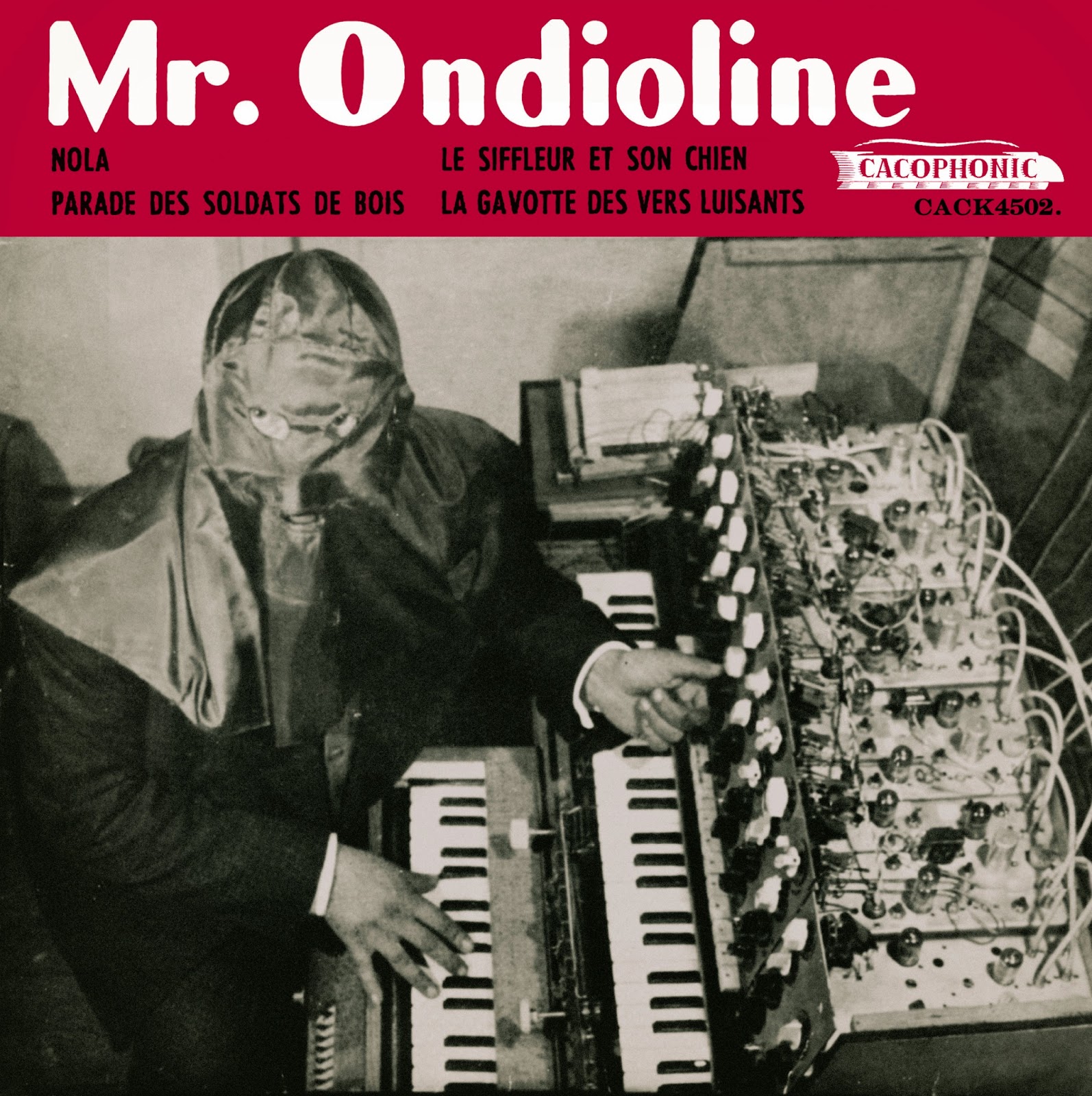
Also, before Perrey moved to the U.S. he did release two EP’s under the adopted persona of Mr. Ondioline around 59-60 for Pacific Records. The result may have been whimsical commercial pop bent into kooky novel shapes, but it’s probably that bizarre mysterious cover that makes this 7″ EP so sort! Crazy for it’s day!
Bratman built Perrey an experimental laboratory and recording studio, where he would he invent “a new process for generating rhythms with sequences and loops”, utilising the environmental sounds of musique concrète. Like a mad scientist, he’d spend endless hours, even weeks, splicing tape, and tape recorders with scissors, piecing and “looping” together a unique fantastical take on the future.
In 1965 Perrey met Gershon Kingsley, who you could say was a like minded contemporary German American composer, and a former colleague of *John Cage, and at the time was a staff arranger at Vanguard Records. There must have been a strong and obvious connection from the get go. They both shared each others way of musically thinking, way out side and far beyond any square. And it wasn’t long before they found themselves recording together in the Vanguard studios, which normally specialized in folk, and not in avant-garde. The end result of their first collaborative effort was The In Sound from Way Out! released in 66.
 With Perrey’s tape loops, and his inventive melodies twinning together with Kingsley’s complementary arrangements and instrumentation, the album created, was filled with tunes that sounded like some kind of surreal animated cartoon from out-of-space gone berserk. And since this was decades before the advent of widespread digital technology, each tune took weeks of painstaking editing and splicing to produce. Their second and final collaborative effort came in 1967 with the release of Kaleidoscopic Vibrations: Electronic Pop Music From Way Out!, and although sounding similar in style, this release was particularly different in two ways. Firstly, most of he compositions were versions of popular songs of the day. And secondly, Perrey’s tape loops and effects were added in post-production after Kingsley’s orchestrations were recorded, a technique now commonly used by electronic artists to this day. Also the album was one of the first to use the new Moog modular synthesizer, a massive, complicated electronic instrument resembling an old-style telephone switchboard.
Kingsley continued to do his own work with the Moog, while Perrey joined with producer John Mack and arranger Dave Mullaney and their company, Laurie Productions, to compose and record, mostly for radio and television advertisements. Perrey recorded two more albums for Vanguard, The Amazing New Electronic Pop Sounds of Jean Jacques Perrey and the legendary sort after Moog Indigo in 1970.
The back cover liner notes to this far out LP read…”Without a ship Columbus could not have traversed the Atlantic, without a telescope Galileo could not have charted the solar system, and what the MOOG SYNTHESIZER opens up for the future of music is beyond dreams”. The enthusiastic proclamation would continue with…”The most amazing instrument is nothing without a mind behind it, and Jean Jacques Perrey’s mind is that of a combined musician and scientist, with a special love for what is happy and vital tin popular music. The way Paganini thought musically in terms of the violin, Perrey thinks musically in terms of the Moog”.
As you’ve probably guessed, there were some pretty great spaced out tracks laid down on this 12″ slab, and as expected from Perrey, cosmically twisted, fun and swinging. There’s the great opener Soul City that every space mod must have played on their Weltron 2007 while preparing a Martini, and also the dark and slinky Cat In The Night. But the real track here, that took Perrey to a new level of greatness, is of course E.V.A.!
Now I know this infamous track is nowadays quite well known, and not just amongst the vintage space pop fanatics, but it’s hard to believe that is was never to be officially released by Vanguard as a 7″ in the US. In fact even the UK had to wait two years for the first Moog Indigo single, and that wasn’t even EVA, but instead the loopy Gossipo Perpetuo with the title track on the flip! THANKFULLY the vanguard people over in Brazil had the sense to release it 3 years after it was recorded as a single and as featured here, a gorgeous EP picture sleeve, that actually runs at 33rpm.
This track is pretty special to me for a number of reasons. It played on the dance floor at Sounds of Seduction when I meet my wife many years ago, and it also played at our wedding and is featured on our Super 8 wedding video. It’s so smooth, it has beats, it has fuzz and Wah wah, and it even has bells…but most importantly, it has so much integrity! And while so many other Perrey recordings happily and contently sit back in that other time from the past, this unstoppable track is still soaring far ahead, smashing through electronic genres, only leaving a traces of space glitter on the occasional hip dance floor.
And so what does E.V.A. stand for? Well to tell you the truth, I don’t know, but it is a space term for extra-vehicular activity, so maybe that was a reference point?
 Perrey returned to France in 1970 and became the musical director of a ballet company. He wrote and recorded music for a television commercials and a number of French cartoons, and released several albums of this music on the Montparnasse label. He also continued to work on music for therapeutic purposes, including one project that involved recording with dolphins in the waters near Vancouver, Canada. “It was remarkable,” Perrey says. “If you played sounds of a certain frequency, the dolphins began to swim in perfect circles.”
Perrey’s influence would reverberate for years – The In Sound from Way Out! inspired a tribute from the Beastie Boys, who borrowed both the album’s title and cover art for their own album 30 years later. But sadly, none of this translated into personal fortune. Perrey did not own the publishing rights to his music when it was licensed to Disney, while Stanley Kubrick was able to incorporate some of Perrey’s sound effects into 2001: A Space Odyssey for next to nothing. Perrey says: “Jean Cocteau told me, ‘Thirty years after I die, you will retire a rich man.’ Well, Cocteau died in 1963 and I haven’t been able to retire yet.”
I highly recommend this video interview by Richard Lawson from 2004!
An RL Music Interview with Jean-Jacques Perrey.
Also great Perrey references here…
Space Age Pop!
The godfather of techno!
iCrates
*John Cage, who was one of the leading figures of the post-war avant-garde, and is perhaps best known for his 1952 composition 4′33″, which is performed in the absence of deliberate sound. Musicians who present the work do nothing aside from being present for the duration specified by the title. The content of the composition is not “four minutes and 33 seconds of silence,” as is sometimes assumed, but rather the sounds of the environment heard by the audience during the performance.
*Photo credit to Marco Zanoni
Jacqueline Taïeb – 7 heures du matin
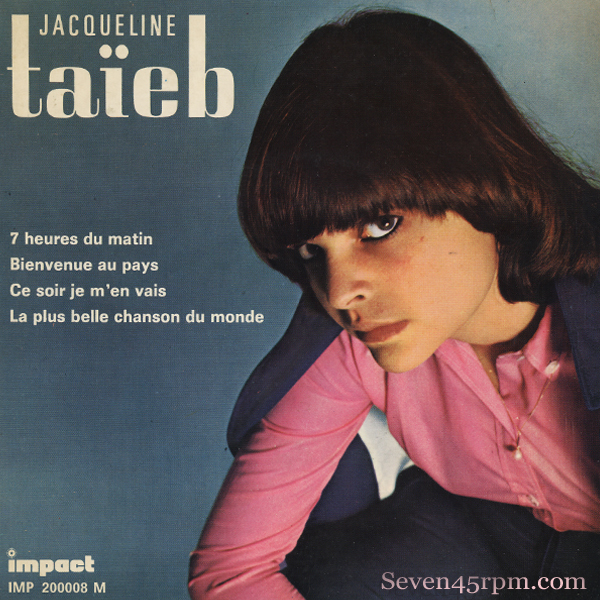
 Impact IMP 200008 M France 1967
Track 1 – 7 heures du matin Track 2 – Ce Soir Je M’en Vais
Born 1948 in Carthage, Tunisia, the young Taïeb arrived in France with her parents at age eight. Her father gifted her with a guitar at 12 (like every good dad should do) which she must have really connected with, because soon she would be composing her own songs. It wasn’t long before a talent scout would discover her while singing with friends. It was ’66, and what an exciting time it must have been for the big eyes of 18 year old singer-songwriter, scoring a contract with the record label Impact, and then being quickly whisked away off to London for her first recording sessions.
1967 saw a string of 7″ releases for the then 19 year old Jacqueline, but it’s this debut EP release (in January) that she is most well worshiped for. All four songs on the EP were composed by the young singer herself, which you have to remember for that time, was quite rare, as most female singers were expected to perform songs that had been written for them, or perhaps covers of other popular high selling hits.
Though the lead track, the almighty ye ye classic 7 heures du matin, was only a small hit at the time, it has gone on to become considered a classic of the French girl pop genre. It is the story of a young student waking up too early, at 7am, on a Monday morning, struggling with the thoughts of what the day will throw at her. She fantasizes about her boy crush Paul McCartney, helping her complete her homework, while tormenting on which sweater to wear for the day. Obviously a girl who is after trouble, the rebellious girl even considers playing her Elvis record loudly just to upset the neighbors. I mean really…how cute is that!?
It’s a simple song, but a huge dance floor monster! With it’s Steppin’ Stone garage power chords and it’s rebellious Elvis meets The Who attitude, it’s freakin’ impossible not to adore this one! And obviously very high in demand in the collectors circle. This track really brings back some great memories of the Sounds Of Seduction nights we once were fortunate to encounter here in Sydney in the 90’s, hosted by the great Jay Katz, (a friend who is responsible for introducing me to so much great lost European dance and film music of the sixties). And this song was also the trigger to the beginnings of my Ye ye obsession!
Update! A few years back I managed to get my hands on the elusive Australian issue of this masterpiece, with both 7AM and the flip side, which translates to Tonight I’m Going Home, sung in English! And finally getting a chance to upload. I love both these English renditions, even as a purist to the French originals! This issue has a catalogue date set to 1968.


W & G – WG-S-8124 Australia 1968
Side A – 7 am.
Side B – Tonight I’m Going Home
More Jacqueline Taieb 7″s to come as well a whole lot more Ye Ye!!!
Sylvie Vartan – Ne T’en Vas Pas

 RCA Victor 86.019 France Year 1963
Prolific French ye ye singer Sylvie Vartan, who is actually Bulgarian, really does a nice swinging beat cover of the classic Comin’ Home Baby. Although it was originally recorded by the Bob Dorough Quartet in 1961 on Two Feet in the Gutter (Epic BA 17021) and composed by Ben Tucker (Bailey’s Pianist), it’s the ultra cool and hip Mel Torme version that most people know and love. Bob Dorough of School House Rock Fame added lyrics to the song and the vocal version became a Top 40 hit for the American jazz man, but I find Vartan’s more obscure version which was released in ’63, even more exciting!
Sylvie started her professional singing career while still at school, in her late teens, firstly with the hit song “Panne d’essence” (1961) alongside French rocker Frankie Jordan. Dubbed by journalists as “la collégienne du twist” (the twisting schoolgirl) she quickly started attracting a lot of attention, and it was only a matter of time that this young self confessed jazz/rock n’ roll fanatic, got signed up and began her illustrious recording career. In 1963, Paul Anka offered her “I’m watching”, her first international hit (Japan, Korea) which is the opening B side track of this EP. It’s adorably sweet and quirky with her broken English vocals, and holds a pretty respectful beat! That same year her dreams of being an aspiring actress came true, starring in the movie D’où viens-tu, Johnny? alongside french rock legend Johnny Hallyday, who she toured with in France and ended up marrying in 1965. Six of her thirty-one songs released in 1962/1963 became top 20 European hits and she became the darling of teen magazines and TV, so suffice to say this was an exciting and pivotal moment in her early career!
So back to Ne T’en Vas Pas! The back beat is strong and mean, as it should be, although I do wish it was pushed up in the mix a bit more as with the driving bass (you dj’s will be doing just that on your mixer) and I love the high energy modish Hammond solo. I have to say I always find French female vocal translations of standards or other, so much more attractive and desirable (this is not open for debate!) and Vartan’s approach on this makes it so ultra sexy and worthy! As far as I can tell, it doesn’t look like this recording was ever released on any other 7″ format other than the picture RCA EP. Maybe some foreign presses were released? Not too difficult to find and highly recommended!

 Also check out Sergio Mendes’ great Latin instrumental version of Comin’ home baby (Atlantic 45 2572) and Vartan’s great “Gimme some lovin'” cover Donne Moi Ton Amour!
France Gall – ZOZOI (French and Italian versions)
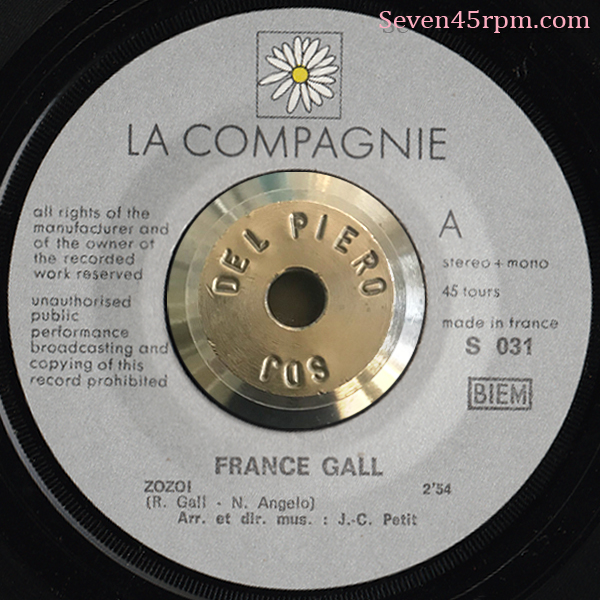

La Compaigne S-103 France Released 1970
Track A – Zozoi
Born Isabelle Genevieve Marie Anne Gall 09.10.1947
I discovered this french “chic” many years ago searching through some record stores in Paris, during my honeymoon. I couldn’t play my purchases until we returned back home, here in Australia, on the other side of the world, but when I finally did, I was hooked on her…and still am to this day! What an amazing talent!
So much can be said about Gall, it’s fair to say the queen of the “ye ye” genre, but she is so much more. Having musical success from the age of 16, and then soon collaborating with the legendary genius Serge Gainsbourg, and married to the late and great Michel Berger, this lady, while quite prolific and mainstream, proved to be quite a power house vocalists, with a versatility that ranged from playful innocent teen pop, to scatty jazz and then some. Way too much to talk about in regards to this amazing woman here, but let’s just say her 60’s career was a bumpy ride. Although winning some worthy successful hits, a few of her recordings were marred with controversy and bad taste (thanks to Mr. Gainsbourg), not helping the young innocent and naive artist, and resulted in poor sales. But having said that, there is no Gall recording I don’t love, and I will have to do a special feature on her and her career some time soon.

So let’s talk ZOZOI! Easily the most sought after 45 of hers and rightly so. Released on La Compaigne, a new label for Gall, this is a contrast to her early sixties sweet pop and “yeye” recordings. Here, she is really turning on the seductive and steamy vocal chords in this latin bossa bonanza. Penned by her father-lyricist Robert Gall, recorded with the Brazilian master Pianist Cesar Camargo Mariano and his Sambalanço Trio, this is definitely new ground for her and is she just loving it. According to musicaltaste.com, while the band recorded in Brazil, the vocals were overdubbed later in France. Not an easy one to find in today’s market, but even rarer is the fantastico Italian vocal version, and I mean RARE! Sadly, I don’t have it, but really want it, so if you have a spare copy, I’ll be happy to take it! Released in 1970, it’s a must have! It’s French, it’s Latin, it’s Brazilian, it’s Tropicalia, and with that great horn section and that tempo, it’s a hot sweet release from Gall!
Music credits also go to Nelson Angelo.
EDIT UPDATE – Italian Version
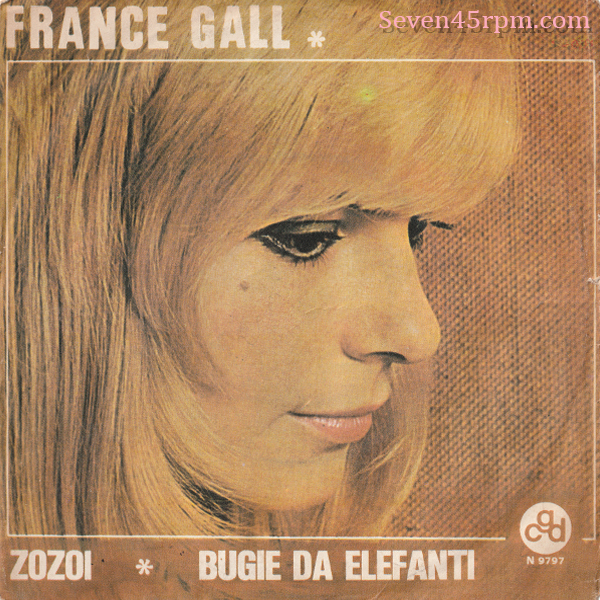

CGD – N 9797 Italy Released 1970
Track A – Zozoi (Italian version)
Finally updating this post with the Italian version, that I managed to get my hands on, quite a few years ago. Sadly since the original post, France has left us, passing on January 7, 2018, at the age of 70. This one hit me hard.
 Seven45rpm
Recent Comments