
Vetty – Nicolas

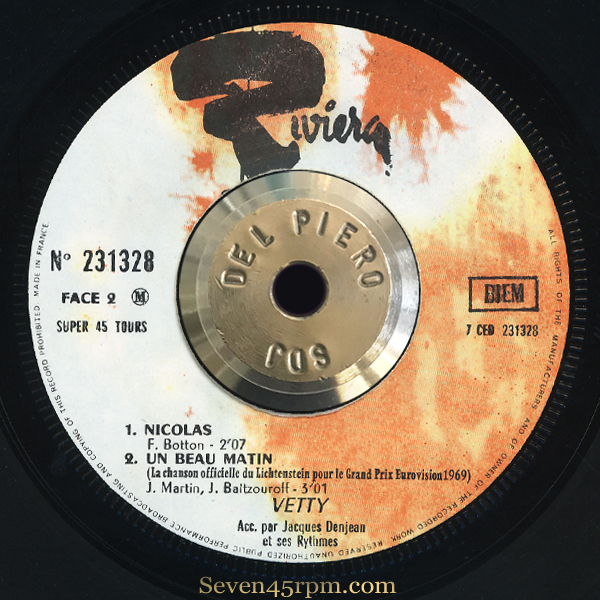
Riviera 231328 France Released 1969
Track B1 – Nicholas
Well here’s a favourite french 7″ that fits into a few categories. It’s beat ye’ ye’, it’s groovy French pop, it’s got a funk kick and it could definitely be filed under oddities. This is all I could find out about the mysterious Vetty that is behind this big rare french monster 45!
Yvette Levis was born in 1941 in La Croix Rousse, a small city high on the hill that shares the same name, in Lyon, France. In 1962 she was spending time in Switzerland and had a connection (possibly working) with La Chaux-de-Fond, in an establishment run by Jacques Marjo: La Boule d’Or, a few kilometres south of the French border. It is said that she started acting before any musical ventures, but I have no information as when and where this took place, in these earlier years.
In January 1966 she landed in Paris and took part in a game show, “Le Palmarès des Chansons” which was broadcast every week from 1965 to 1968 on the first French channel on television. On each show, a renowned singer is invited and young artists must perform one of this singer’s hits, or a potential new hit song, unknown to the general public. The winners were determined using a “computer machine”, where all the punched cards from the viewers where fed into and sorted automatically (this added a technical and modern side to the show). Some of the big french artists to appear on the show included Serge Gainsbourg ,Jacques Dutronc, Sheila ,Sylvie Vartan, Johnny Hallyday and Francoise Hardy. It is here, on this popular TV show, where Vetty was noticed and scored a three week opener for Gilbert Bécaud at the Olympia. Vetty then was able to jump onto another tour with a big name attached, the pop star Claude François, that really would have focused her in an even brighter spotlight.
In 1969, she recorded her only solo release, a 4-track EP titled “Vetty” through Riviera. On it’s release, the better known track was the opener “Johnny (Si Tu Viens À Saint-Étienne)”, co written by TV – radio host, comedian Jacques Martin. I am not an expert by any means with the French language, but I feel like it’s a call out to idol Johnny Hallyday from the fan girl. “Johnny if you come to Saint-Etienneuh, for one evening, I want to be yours”. A quirky and fun tune, but c’mon the real reason to sought this EP out is because of NICOLAS! My goodness what a track! This is as good as go go beat gets, and Vetty’s unique vocal, makes this such a stand alone track. Yes her odd vocal style, somehow fits this dance floor mover, and because of it’s peculiarity and distinctiveness, it actually demands attention! I don’t play this out much, but when I do, it turns heads and is responsive!
(Emma) Vetty would also appear on the “Petipatapon” LP, the soundtrack to a musical french show played at Bobino (Paris), April 1967. Recorded in 1968, the album would also feature Jacques Martin and chanson Catherine Franck, who sang the beautiful track Plus La Même (He’s My Little Devil).
So what happened to Vetty? I believe she found plentiful work through voice acting with children’s TV shows, and have read that she was the voice of the main character of the series “The Universe of M. Touchatou” from 1968 to 1970. She also toured with Nana Mouskouri in 1970, and for a time, worked in small theatre plays, and had a movie role in the 1983 film Sandy.
This is a prized 7″ and feel lucky to have found a copy a long time ago. Like I said, it doesn’t go into my dj box too often, but whenever I do play it, I’m just reminded how bizarre, great and gigantic this little Vetty treasure is!
– DJ del Piero
Mieko Hirota – On A Sorrowful Day


Columbia – P-65 Released 1969
Track B – あなたがいなくても On A Sorrowful Day
Here’s another gem from Japan, from perhaps a lesser known singer (well on our shores at least) which will always appeal more to me, but a track and artist I felt I needed to share. The singer was called Meiko Hirotota, had the nickname of Mico (also spelled Miko), and in Japan was very prolific and successful, releasing fourteen albums on Columbia between 1968 and 1977, (and a career totaling 35 albums) and was known in her country as “The Queen Of Pop”.
This will be another short and brief post, as I cannot find a lot about Hirota, which is surprising, considering her success in Japan throughout the late sixties, seventies and eighties. I’m really just trying to string together a few facts I have found out, here and there, into some kind of summary. So please reach out for any more info or helpful links! I would be most appreciative.
Hirota was born in Setagaya, Tokyo, on Feb. 05, 1947. She grew up listening to pop and jazz, and is believed to have started singing at US Occupation camps in Tachikawa, from the age of 7. Her brother who performed Hawaiian music, helped her with music and also learning the English language by teaching her nursery rhymes, while she was in Elementary school. By the time Hirota was 14, she had her first single release through Toshiba Records, in 1961. A cover version of Helen Shapario’s “Don’t Treat Me Like A Child. She would be releasing a lot of covers from the western world, in this early pop era of her career, following with “Vacation”, a Connie Francis’s cover, which in 1962, became a big hit for Toshiba and Hirato. 1962 would also see the release of her first LP, and she’d end up releasing around 35 albums in her time. Music critic Hisao Murata argues, “As a means of overcoming the problem of the Western rhythm, melody line and the language’s ability to communicate as a Japanese language, it is Mieko Hirota who invented English-like Japanese”. Hirota released around 25 singles through Toshiba in the space of 4 years, but in October 1964 she left the Toshiba music industry and moved to Nippon Columbia.

The world was changing it’s sound, and Hirota was maturing in her field, and developing more of a Jazz direction. Hirota recalls it was all because of a chance meeting in 1964, with jazz promoter extraordinaire George Wein on the Japanese Shinkansen bullet train, who convinced her that she had the range to explore Jazz. * In July 1965, Hirota performed with the Billy Taylor Trio at the American Newport Jazz Festival. This was a massive achievement to play at such a revered event, who’s line up also included so many esteemed musicians and groups such as John Coltrane Quartet, Thelonious Monk Quartet, Muddy Waters Blues Band, Dizzy Gilllepse Quintet, Drave Brubeck Quartet, Herbie Mann Octet, and the list goes on. Alongside Billy Taylor on piano, Hirota would have Grady Tate on drums and Ben Tucker on Bass. **
Her first Columbia LP release in 1966, was “Miko In New York” accompanied by the Billy Taylor Trio. There’s some beautiful work here from Hirota, covering some great standards including Torme’s “I’m Coming Home Baby”, and apparently the first Japanese woman to cover bobby Hebb’s Sunny. Hirota would then release a bunch of live albums, including “Exciting R&B Vol.1 and Vol.2” which mostly were covers, but with more zest and live energy (The live version of “I’m Coming Home Baby on Vol.2 is pretty great).
Hirota’s featured single from 1969, “On A Sorrowful Day” is her “swingiest” beat dancer release for sure. Far more fun and I’m sure hip to what was charting at the time of the late sixties in Japan. Lot’s of go go action with this one, with that great kinky beat and swinging horns. I have to say, as is common with the genre, to my ears there’s some similarities here, to other songs from the popular artists of that scene, which is something I actually love about this sound. The opening verses have very similar phrasing to Jun Mayuzumi’s “You And The Sun” and Segawa Mieko’s “Asa Ga Kurumaeni”, but the flavour here is more sultry coming from Hirota. In her huge catalogue of music, this is a groovy track that is more to my taste for sure, and somewhat overlooked I feel.
Hirota would keep releasing music for a very long time, and continued to have a huge fan base in her home country. She also worked a lot in the commercial world with diverse promoting from Japanese beer to coffee brands. And she will always be lovingly known as the voice to the theme song, “Leo no Uta”, for the animated television series Kimba the White Lion. Hirota died on July 21, 2020, at the age of 73 following a fall.


Research and referencing…
Maki Asakawa – Chicchana Toki Kara
Express Compact ETP-4277 Japan 1970

 Track 1 – B2 Chiccana Toki Kara
Track 2 – A1 Yoru Ga Aketara
Maki Asakawa was a born in Ishikawa Prefecture, January 27, 1942. After graduating high school she worked as a civil servant for a short time before moving to Tokyo to pursue a far more inspirational career in music. She started by playing at United States military bases and cabarets, where she refined her style, which she says was largely influenced by Blues queens such as Billie Holiday and Mahalia Jackson.
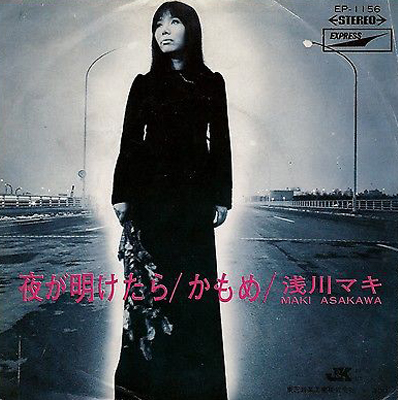 In 1967 Asakawa made her debut recording, releasing Tokyo Banka with B side Amen Jiro on Victor. In 1968, Asakawa got her big break when she appeared for three days running at the Shinjuku underground theater known as Sasoriza, a project of underground playwright Shuji Terayama. She soon signed with Toshiba, and by the next year had released the very, VERY cool and slick Yo ga aketara (At the Break of Dawn) and Kamome (Gull) on Toshiba’s subsidiary Express label.
1970 saw this featured Asakawa release, which has as the B2 track, Chicchana Toki Kara. This wonderful, yet not easy to find EP, has to be my favourite from Maki, with it’s big beat drive, high energy horns and cinematic production. Every time I play this I get comments as to how hasn’t Tarantino used this track for one of his movies. It’s 70’s sex, has a good amount of sting, and would be the ideal punch for a strong femme fatale introduction. And having the slow swinging Yo Ga Aketara as the opening track makes this 7″ a real delight (that distant train at the end…I mean really, what a way to see out such a cool track). Just the thought of seeing this performed in a dark underground club of Tokyo by Maki and that time just does my head in. The smoke, the black, the neons and the distant traffic outside…not too difficult to visualize. But this wasn’t just a time for Asakawa’s musical exploration.
In 1971, Asakawa made her big screen debut when she played the stairway prostitute in Shuji Terayama’s experimental Throw Away Your Books, Rally in the Streets. It was the first film for poet-playwright Terayama, and it was about an angst-ridden teen who hits the streets after dealing with his dysfunctional family. This hard to find movie has a strong underground following due to it’s non-linear Avant-Garde vision and amazing pre-punk psychedelic soundtrack. Asakawa’s recording of Nemuru No ga kowai is included amongst the tracks, and can also be found on her 1971 Maki II album, which by the way also include covers of Gin House Blues and The House Of The Rising Sun. That great LP also happens to include the incredible psychedelic Govinda (there should be a link below)…such a stand out Asakawa composition! The next year in ’72, Asakawa would release Blue Spirit Blues, and again here her voice somehow feels so right within the warm minor chords.
 In 1973 Asakawa would this time hit the small screen on the dark Japanese TV Series Kyôfu Gekijô Umbalance. From what I can put together, she appeared in season 1 episode 7, and I’m almost certain the link below is the clip from that episode, where she plays herself singing Yo Ga Aketara, on a cinema screen in a dark seedy theater, and with the dark seedy characters to match.
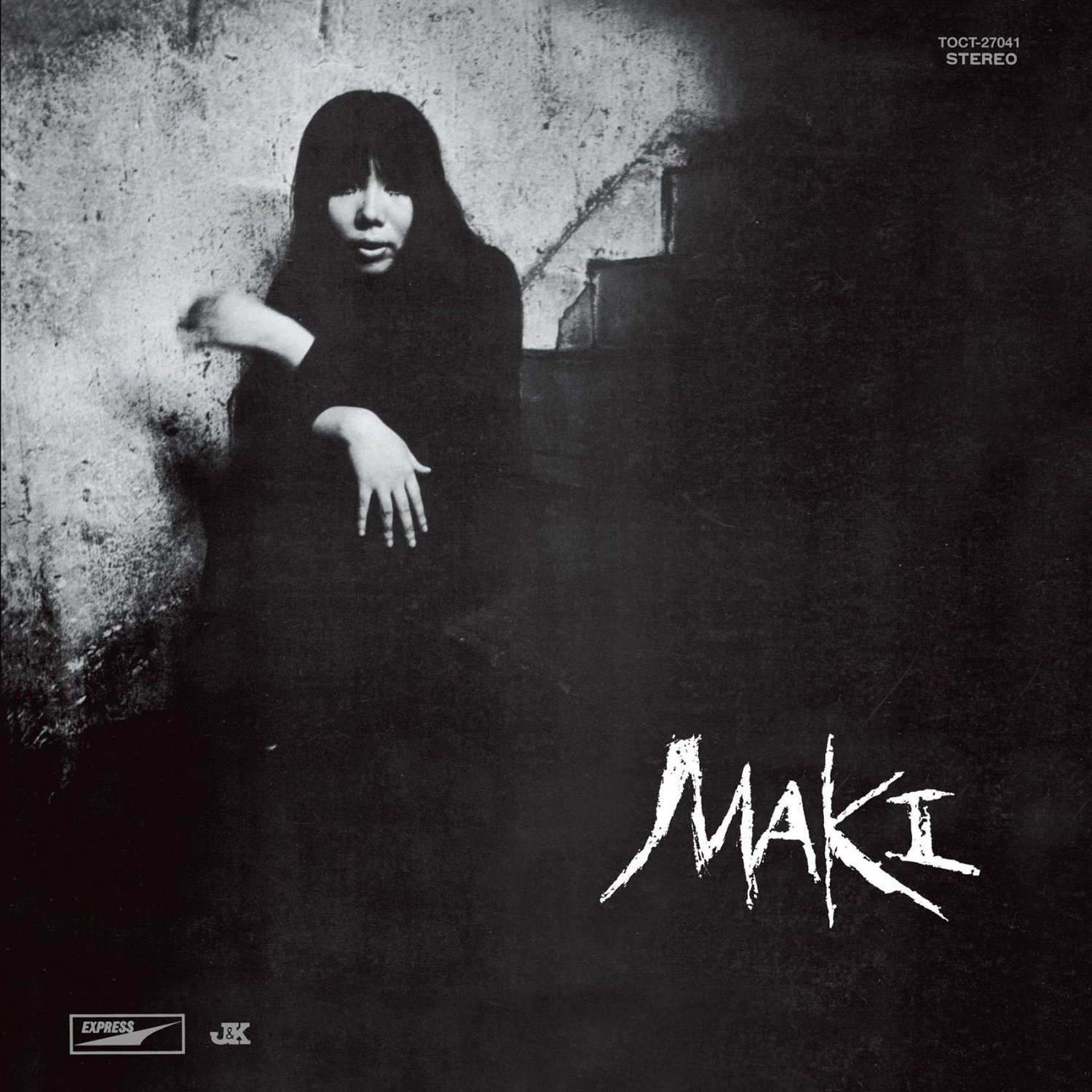 Over the next 30 or so years, Asakawa recorded quite a lot of records, but it wasn’t all dark moody blues and folk jazz. I discovered the Catnap album through a favourite blog, Interstellar Medium – Foriegn Lavish Sounds, which you should hit up, for a far more detailed look into the great album. Released in 1982, it’s a colourful, bold yet smooth collision of electronic jazz funk post punk plus, and for myself, it was so exciting to discover this side of Asakawa. The opening track Kurai Me Wo Shita Joyuu and also Shinkyoku B are real high lights, if I was forced to choose. This album holds up to quite high to today’s very standard standards in my opinion.
As Maki Asakwa grew older, she never stopped performing live. Just before an appearance on January 15-17, 2010 where she had a concert in Nagoya, she died of heart failure before the show could go on. She was 67.
References and inspirations…
Brigitte Bardot – Harley Davidson / Contact

 Disc AZ – AZ 10 346 France Dec. 1967
Track 1 – Harley Davidson Track 2 – Contact
Brigitte Anne-Marie Bardot was born in Paris on 28 September 1934. Daughter to a very strict homemaker mother, Anne-Marie “Toty” Bardot and a wealthy industrialist Louis Bardot, she grew up in a middle-class Roman Catholic observant home, with her younger sister, Marie-Jeanne.
It was particularly tough for the young girls growing up with incredibly harsh, stringent parents. At one point in her young life, after an innocent playful incident, which lead to an accidental breakage of an expensive Chinese lamp, Brigitte was told by her parents, they would from that day on, disown her as a daughter, as she was to address them only in a formal way, as a stranger would. This alienated her for the rest of her life. Inwardly, Brigitte dreamed of escaping her rigid monitored world….and she would hunger for that missing love.
Her socially ambitious mother pushed her daughters to do well not only at school, but also at ballet. Brigitte had an adoration towards for dance, and progressed particularly well, however her younger sister, Marie-Jeanne didn’t share that passion, and eventually gave up the lessons and did not tell her mother. Brigitte worked hard with determined concentration, and in 1947, was accepted to the Conservatoire de Paris.
 Gifted with ridiculous amounts of beauty, the young starlet was noticed during her ballet studies at 14, and was approached with offers of modelling, a direction her mother encouraged her daughter to follow. Soon she would have her first modelling experience in a fashion show in 1949. In the same year, she modeled for a fashion magazine Jardin des Modes and soon the stunning 15 year old appeared on the cover of the french edition of Elle magazine in March 1950.
Director and screenwriter Marc Allégret was captivated by this image of beauty, and ordered his assistant, who was a young upcoming rebel film director named Roger Vadim, to go out and find her. He tracked her down and Allégret quickly offered Bardot the opportunity to audition for Les lauriers sont coupés. There’s conflicting stories whether Bardot landed the role or not, but the film was cancelled, and it is certain that this opportunity made her consider becoming an actress. Vadim became immediately smitten by her pouty sensuality…Brigitte fell madly in love with this bad boy…she had never meet anyone like him before, and in 1952 the 22 year old became her husband. Her parents were infuriated, but funnily enough, the two newly weds had to spend their honeymoon night at her parents home, as they had no where else to stay. They were forced to sleep in separate rooms, and Bardot was not even permitted to kiss her new husband goodnight. But Bardot wasn’t too bothered…”we had our wedding night a long time ago”.
A new path had been laid out for Bardot, leading away from her early ballet desires…now it was a different stage and spotlight calling her name. 1952 saw the start of her acting career, and she would appear in obscure films, generally lightweight romantic dramas, some historical, in which she was cast typically as “Ingenue” or “Siren”, often appearing nude. But in ’57 she really became world-famous with the release of the Vadim’s controversial film Et Dieu créa la femme (And God Created Woman).
 Vadim’s now infamous film was certainly the vehicle that launched Bardot into the public spotlight, immediately creating her “sex kitten” persona, making her an overnight sensation. When the film was released in the US, it pushed the boundaries of the representation of sexuality in American cinema, and most available prints of the film were heavily edited to conform with the prevailing censorial standards of 1957. The film was also condemned by the Catholic League of Decency. Bosley Crowther, the film critic for The New York Times, wrote, “Bardot moves herself in a fashion that fully accentuates her charms. She is undeniably a creation of superlative craftsmanship”.
A proper English TV journalist asked the vivacious but innocent Bardot about these sexy roles she was becoming famous for, “Do you really like doing these kind of films, or would you want to be a serious actor?”. B.B. replies “On no, I prefer this kind of films…I will be a serious actor when I get older”.
Vadim and Bardot separated in ’56 amidst rumors that Bardot was having an affair with her And God Created Woman co-star Jean-Louis Trintignant, but remained friends for the rest of Vadim’s life. He would later direct her in The Night Heaven Fell, and Don Juan, or If Don Juan Were a Woman.
Bardot would continue to follow her acting demands playing some very famous roles in new wave cinema. She later starred in Jean-Luc Godard’s 1963 masterpiece Le Mépris (Contempt) and Masculin Féminin in 66. Bardot was nominated for a BAFTA Award for Best Actress in a Leading Role for her part in Louis Malle’s 1965 film Viva Maria! Although she was in high demand in Hollywood, she continued to declined offers of filming in the US…she detested the way Marilyn Monroe was treated, a woman who she so much adored, and she didn’t have an enjoyable experience previously there. Eventually, Hollywood would accept her terms and they would have to come to France to film her, where she had a cameo in Hello Brigitte (which also starred Billy Mumy from Lost In Space fame, who apparently scored the first American on-screen kiss from the french beauty).
 Bardot was appearing on record covers long before she first sang a note, and it’s pretty obvious the marketing strategy was aimed to appeal to the male audiences. She was plastered on covers for soundtracks to films she’s appeared in, unofficial tributes and promo records and of course, to her own musical efforts. Virtually everything Bardot-related is sort after, with collectors rarely distinguishing between albums merely depicting her likeness and ones on which she sings. But while there’s definitely a desirable kitsch and kookie wonderment about her recordings, I find that there’s a further unique beauty there, behind her stunning looks, that drew me in a long time ago, and which I have always obsessed over, for some time.
Bardot’s first 7″ vocal release was on the lullaby Sidonie, (delicate guitar work by Bardot) which was the first track on the Vie privée (A very private affair) EP in ’62, a film directed by Louis Malle which she herself starred in, alongside Marcello Mastroianni. This track was included alongside three instrumentals on a French EP issued by Barclay as well as a US single on MGM. An early version of “Sidonie” also appeared in the autumn of 1961 as part of issue 23 of ‘Sonorama’, the innovtive 7″-sized playable magazine which incorporated several flexidiscs to accompany the features. It’s such an adorable track…innocent, so gentle and so sweet!I love this side of Bardot!
Bardot had now signed to Philips, and the next year she would have two more Ep releases, Invitango and the great L’Appareil À Sous. The title track, penned by Gainsbourg (who was still concentrating on writing for other artists at this stage of his career), is a favourite upbeat dance floor spinner for me…1.24 mins. of french hip twisting mayhem! Her self titled debut album followed which was made available in two versions – a superb deluxe edition with a gatefold sleeve and a poster, and a standard single-sleeve album. The album contained a mix of styles and tempos, and included the beautifully strummed El Cuchipe sung in Spanish, and Everybody Loves My Baby sung in English.
The following couple of years she would continue to release fun pop french hits including Moi Je Joue (taken form her 64′ lp B.B) Bubble Gum in ’65, and the ever so dreamy Le Soleil in ’66, which had the fab off beat Gang Gang on the EP flip (these tracks were arranged by the British musical director Charles Blackwell, perhaps best-known for his work with Joe Meek in the early 60s).
 In 1967, Gainsbourg was having some kind of an affair with Bardot, who was going through a difficult time with current husband, German businessman Gunter Sachs. One night in particular, Gainsbourg, who often was nervous around Bardot, drunk with his infatuation…and probably something more, made an ass of himself. And he was sure that this time, there was no hope in hell that Bardot would ever fall back into his arms. But Bardot’s request, as an apology, was that Gainsbourg write her the most beautiful love song he could imagine. That night he wrote two songs, Bonnie and Clyde, and also Je t’aime…moi non plus. They soon recorded an arrangement at a Paris studio in a two-hour session in a small glass booth, however, news of the recording reached the press and an angry Mr. Sachs! Bardot pleaded with Gainsbourg not to release it. He protested that “The music is very pure. For the first time in my life, I write a love song and it’s taken badly”.
But in 1969, Gainsbourg recorded a version with his new lover, Jane Birkin. The single had a plain cover, with the words “Interdit aux moins de 21 ans” (forbidden to those under 21), and would end up being banned in several countries owing to its sexual content. In the UK, it was released on Fontana Records, but, after reaching number 2, it was withdrawn for sale. Gainsbourg arranged a deal with Major Minor Records and on re-release it reached number one, the first banned number one single in the UK and the first single in a foreign language to top the charts. It stayed on the UK chart for 31 weeks. Bardot may have regretted not releasing her version, but she did give permission for a release of her Gainsbourg recording in 1986. With a slight re-edit, it was virtually ignored by the public, who were perfectly happy with the existing Jane Birkin version.
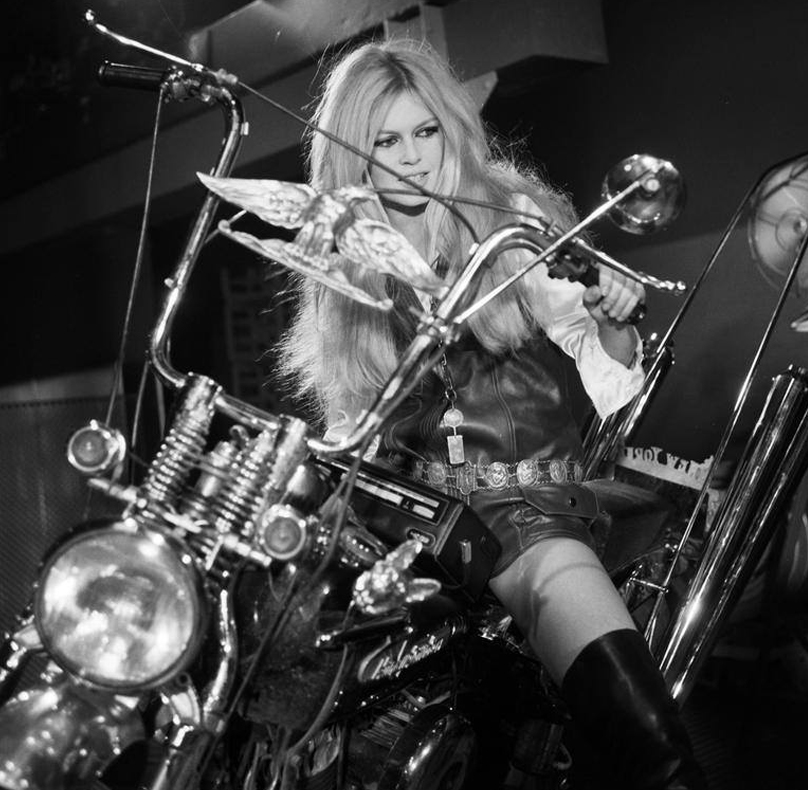 On New Year’s Eve 1967, French TV broadcast a special colour programme devoted to B.B. called Le Bardot Show. Filmed over several months between November and December, the 60 minute show was years before its time, and it effectively consisted of a collection of video-clips, which made an incredible impression on the French public. And this when audiences would first hear…and SEE, Bardot’s Harley Davidson. Phew! I can only imagine the thoughts that were going through both male and females minds when they first shared this moment. Yeah, she had the look, the big wild blonde waves, the tiny leather shorts and high boots, and her signature dark eyeliner, but the way she sang this, is just so defiant and…well…so Bardot (can’t think of any other way to describe it). I don’t need anyone…on a Harley Davidson…I no longer recognize anyone….on a Harley Davidson…I press the starter…and here is where I leave the earth…maybe I’ll go to heaven…but at top speed on a train from hell!
 These songs were released on the soundtrack LP, Brigitte Bardot Show in ’68. Adding to the sexual appeal, Bardot was pictured on the sleeve of the LP (and the spin-off EP) virtually naked, but carefully masked by a layer of wrapping-paper. Fans declared the design a masterpiece. The flip to this iconic track is Contact, and I have to say that this track I find even more desirable, but I’m a sucker for 60’s psychedelic spaced out minimalist sitar flavored dance floor grooves! And I’ll never forget the first time I laid eyes on the film clip of Contact, with Bardot draped in Paco Rabanne!
Bardot retired in 1973, aged just 39, withdrew to her beloved Madrague, her retreat in St Tropez where she could dedicate herself to animals and a barefoot Mediterranean life. She would only leave her home to protest about animal rights (and make some ill-advised comments about immigration). Bardot’s passion for animals could be traced back to her childhood, a time when she transferred affection she missed from home, to whatever 4 legged creatures she could find. In 1986, she established the Brigitte Bardot Foundation for the Welfare and Protection of Animals, and would constantly meet with the French President and other world leaders to protest any case of cruelty towards animals. Bardot has never resorted to any cosmetic surgery, (as so many of her contemporaries have) and has retained her authenticity.
I know many of us were bitten by the BB phenomenon many years ago, but it’s always great to get these records out again and play them out, especially to the “hip kids”, that for some reason are new to her. Her songs always bring back fond memories of great times, and they can still get the punters dancing…and smiling! I think she was an amazing woman with a whole lot more going on than meets the eye! And still is quite beautiful.
Recommended reading and references…
Jacqueline Taïeb – 7 heures du matin
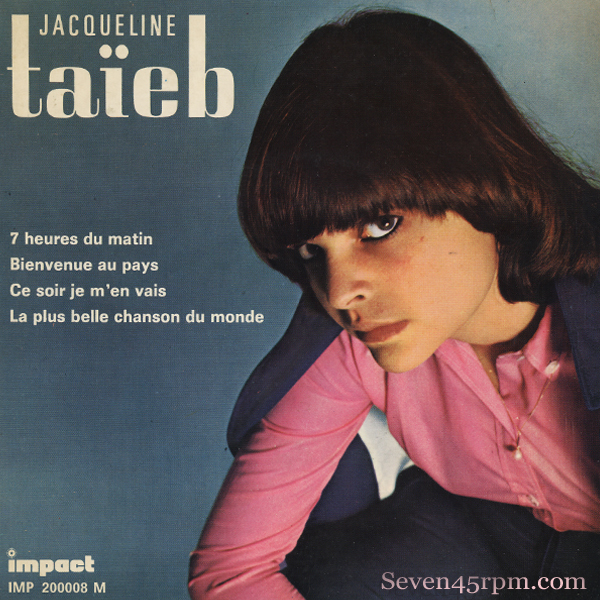
 Impact IMP 200008 M France 1967
Track 1 – 7 heures du matin Track 2 – Ce Soir Je M’en Vais
Born 1948 in Carthage, Tunisia, the young Taïeb arrived in France with her parents at age eight. Her father gifted her with a guitar at 12 (like every good dad should do) which she must have really connected with, because soon she would be composing her own songs. It wasn’t long before a talent scout would discover her while singing with friends. It was ’66, and what an exciting time it must have been for the big eyes of 18 year old singer-songwriter, scoring a contract with the record label Impact, and then being quickly whisked away off to London for her first recording sessions.
1967 saw a string of 7″ releases for the then 19 year old Jacqueline, but it’s this debut EP release (in January) that she is most well worshiped for. All four songs on the EP were composed by the young singer herself, which you have to remember for that time, was quite rare, as most female singers were expected to perform songs that had been written for them, or perhaps covers of other popular high selling hits.
Though the lead track, the almighty ye ye classic 7 heures du matin, was only a small hit at the time, it has gone on to become considered a classic of the French girl pop genre. It is the story of a young student waking up too early, at 7am, on a Monday morning, struggling with the thoughts of what the day will throw at her. She fantasizes about her boy crush Paul McCartney, helping her complete her homework, while tormenting on which sweater to wear for the day. Obviously a girl who is after trouble, the rebellious girl even considers playing her Elvis record loudly just to upset the neighbors. I mean really…how cute is that!?
It’s a simple song, but a huge dance floor monster! With it’s Steppin’ Stone garage power chords and it’s rebellious Elvis meets The Who attitude, it’s freakin’ impossible not to adore this one! And obviously very high in demand in the collectors circle. This track really brings back some great memories of the Sounds Of Seduction nights we once were fortunate to encounter here in Sydney in the 90’s, hosted by the great Jay Katz, (a friend who is responsible for introducing me to so much great lost European dance and film music of the sixties). And this song was also the trigger to the beginnings of my Ye ye obsession!
Update! A few years back I managed to get my hands on the elusive Australian issue of this masterpiece, with both 7AM and the flip side, which translates to Tonight I’m Going Home, sung in English! And finally getting a chance to upload. I love both these English renditions, even as a purist to the French originals! This issue has a catalogue date set to 1968.


W & G – WG-S-8124 Australia 1968
Side A – 7 am.
Side B – Tonight I’m Going Home
More Jacqueline Taieb 7″s to come as well a whole lot more Ye Ye!!!
Sylvie Vartan – Ne T’en Vas Pas

 RCA Victor 86.019 France Year 1963
Prolific French ye ye singer Sylvie Vartan, who is actually Bulgarian, really does a nice swinging beat cover of the classic Comin’ Home Baby. Although it was originally recorded by the Bob Dorough Quartet in 1961 on Two Feet in the Gutter (Epic BA 17021) and composed by Ben Tucker (Bailey’s Pianist), it’s the ultra cool and hip Mel Torme version that most people know and love. Bob Dorough of School House Rock Fame added lyrics to the song and the vocal version became a Top 40 hit for the American jazz man, but I find Vartan’s more obscure version which was released in ’63, even more exciting!
Sylvie started her professional singing career while still at school, in her late teens, firstly with the hit song “Panne d’essence” (1961) alongside French rocker Frankie Jordan. Dubbed by journalists as “la collégienne du twist” (the twisting schoolgirl) she quickly started attracting a lot of attention, and it was only a matter of time that this young self confessed jazz/rock n’ roll fanatic, got signed up and began her illustrious recording career. In 1963, Paul Anka offered her “I’m watching”, her first international hit (Japan, Korea) which is the opening B side track of this EP. It’s adorably sweet and quirky with her broken English vocals, and holds a pretty respectful beat! That same year her dreams of being an aspiring actress came true, starring in the movie D’où viens-tu, Johnny? alongside french rock legend Johnny Hallyday, who she toured with in France and ended up marrying in 1965. Six of her thirty-one songs released in 1962/1963 became top 20 European hits and she became the darling of teen magazines and TV, so suffice to say this was an exciting and pivotal moment in her early career!
So back to Ne T’en Vas Pas! The back beat is strong and mean, as it should be, although I do wish it was pushed up in the mix a bit more as with the driving bass (you dj’s will be doing just that on your mixer) and I love the high energy modish Hammond solo. I have to say I always find French female vocal translations of standards or other, so much more attractive and desirable (this is not open for debate!) and Vartan’s approach on this makes it so ultra sexy and worthy! As far as I can tell, it doesn’t look like this recording was ever released on any other 7″ format other than the picture RCA EP. Maybe some foreign presses were released? Not too difficult to find and highly recommended!

 Also check out Sergio Mendes’ great Latin instrumental version of Comin’ home baby (Atlantic 45 2572) and Vartan’s great “Gimme some lovin'” cover Donne Moi Ton Amour!
France Gall – ZOZOI (French and Italian versions)
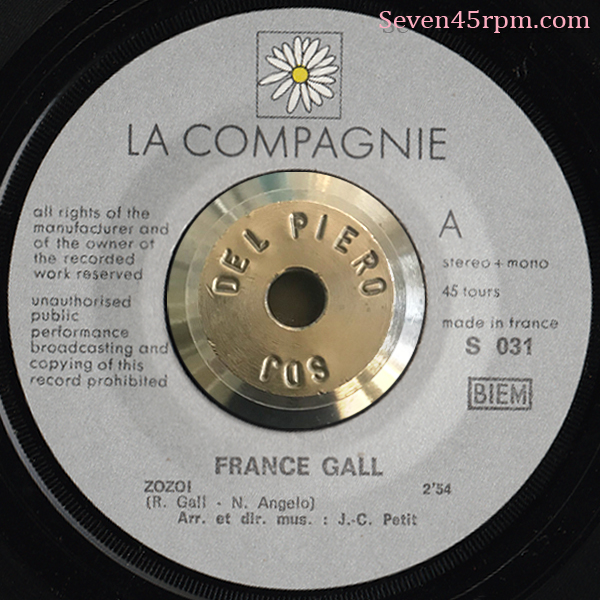

La Compaigne S-103 France Released 1970
Track A – Zozoi
Born Isabelle Genevieve Marie Anne Gall 09.10.1947
I discovered this french “chic” many years ago searching through some record stores in Paris, during my honeymoon. I couldn’t play my purchases until we returned back home, here in Australia, on the other side of the world, but when I finally did, I was hooked on her…and still am to this day! What an amazing talent!
So much can be said about Gall, it’s fair to say the queen of the “ye ye” genre, but she is so much more. Having musical success from the age of 16, and then soon collaborating with the legendary genius Serge Gainsbourg, and married to the late and great Michel Berger, this lady, while quite prolific and mainstream, proved to be quite a power house vocalists, with a versatility that ranged from playful innocent teen pop, to scatty jazz and then some. Way too much to talk about in regards to this amazing woman here, but let’s just say her 60’s career was a bumpy ride. Although winning some worthy successful hits, a few of her recordings were marred with controversy and bad taste (thanks to Mr. Gainsbourg), not helping the young innocent and naive artist, and resulted in poor sales. But having said that, there is no Gall recording I don’t love, and I will have to do a special feature on her and her career some time soon.

So let’s talk ZOZOI! Easily the most sought after 45 of hers and rightly so. Released on La Compaigne, a new label for Gall, this is a contrast to her early sixties sweet pop and “yeye” recordings. Here, she is really turning on the seductive and steamy vocal chords in this latin bossa bonanza. Penned by her father-lyricist Robert Gall, recorded with the Brazilian master Pianist Cesar Camargo Mariano and his Sambalanço Trio, this is definitely new ground for her and is she just loving it. According to musicaltaste.com, while the band recorded in Brazil, the vocals were overdubbed later in France. Not an easy one to find in today’s market, but even rarer is the fantastico Italian vocal version, and I mean RARE! Sadly, I don’t have it, but really want it, so if you have a spare copy, I’ll be happy to take it! Released in 1970, it’s a must have! It’s French, it’s Latin, it’s Brazilian, it’s Tropicalia, and with that great horn section and that tempo, it’s a hot sweet release from Gall!
Music credits also go to Nelson Angelo.
EDIT UPDATE – Italian Version
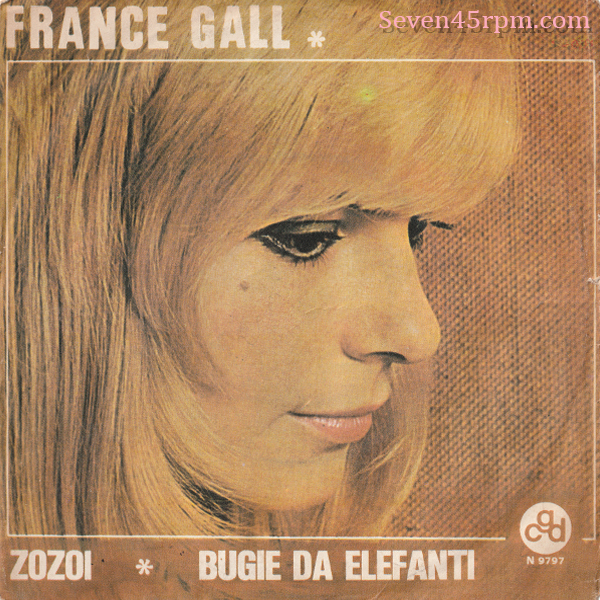

CGD – N 9797 Italy Released 1970
Track A – Zozoi (Italian version)
Finally updating this post with the Italian version, that I managed to get my hands on, quite a few years ago. Sadly since the original post, France has left us, passing on January 7, 2018, at the age of 70. This one hit me hard.
 Seven45rpm
Recent Comments