A home for the children of the 7" 45 revolution!

Latest

Marie Knight – Come On Baby (Hold My Hand)

MarieKnight_Seven45rpm_02MarieKnight_Seven45rpm_01Okeh 4-7147  US Year 1962 Marie Roach was born June 1, 1925, in Sanford, Florida, and grew up in Newark. At the sweet little age of 5, she impressed the congregation at her parents church by singing the gospel song Doing All the Good We Can, and of course later became a soloist in her church’s youth choir.

In 1939, the young lady first toured with Evangelist Frances Robinson, touring the national gospel circuit (she married preacher Albert Knight in ’41 but divorced later).

In 1946, she made her first recordings as a member of The Sunset Four (aka Sunset Jubilee Singers) for Signature and Haven (these labels would merge, but became defunct at the end of 1960 after being purchased earlier in the year by Roulette Records), and released a mighty fine handful of spiritual releases.

The now legendary guitar playing Sister Rosetta Tharpe, who was a major recording artist on the Decca Records label, and who many would say, brought gospel music to a broad audience, first heard Knight sing at a Mahalia Jackson concert in New York in 1946. Tharpe recognized “something special” in Marie’s contralto voice, and two weeks later, she showed up at Knight’s house in Newark, N.J., to invite her to go on the road with her.

Tharpe and Knight toured through the late ’40s, appearing in clubs, arenas, churches and auditoriums, sometimes acting out the parts of “the Saint and the Sinner”, with Tharpe as the saint and Knight as the sinner.

Together they had plenty of successes, including Up Above My Head, credited jointly to both singers, and reached # 6 on the US R&B at the end of 1948. The great Didn’t It Rain also did well and Knight’s solo version of Gospel Train reached # 9 on the R&B chart in 1949.
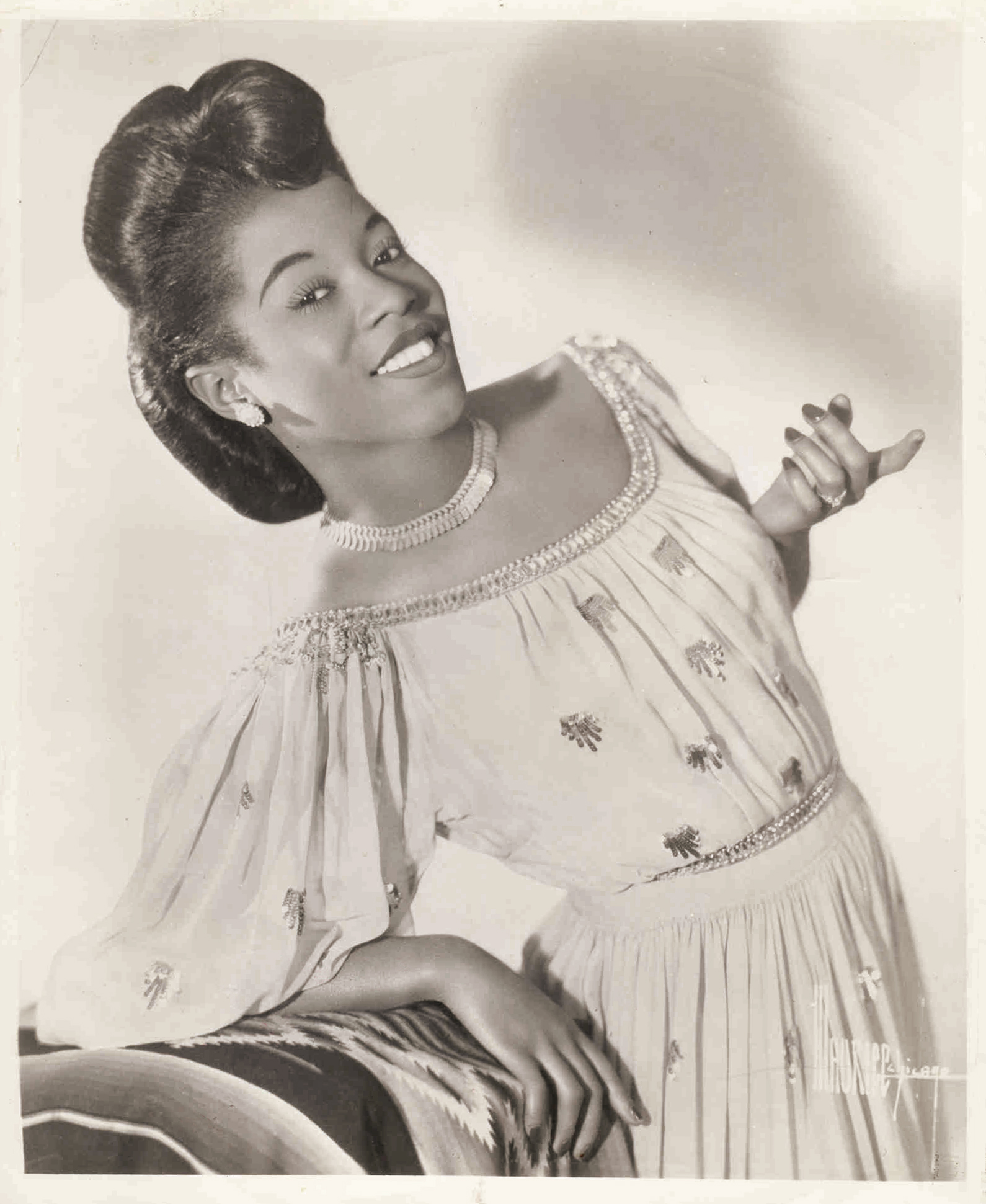
MarieKnight-Seven45rpmKnight left Tharpe to go solo around 1951, and released further more gospel recordings on Decca. But around April 1954, Marie Knight makes a change as she records straight ahead R & B songs I Know Every Move You Make and You Got A Way Of Making Love. These Rhythm & Blues tunes may have turned away a great many of Knight’s gospel fans, but she continues this move with a release during July of This Old Soul Of Mine and I Tell It Wherever I Go, and a November release of Trouble In Mind and What More Can I Do.

Both Knight and Tharpe’s friendship has stayed very strong and close, and in ’55, they get back into the recording studio together and release Stand and Storm on Decca, and together they score a two week stand at Chicago’s Black Orchid. In October, Knight lands a part of the lineup of the “Lucky Seven Blues Tour” along with Earl King, Little Willie John and other greats! Soon after the tour is over, she signs on for another all star touring show called the Rock ‘n’ Roll Jubilee which kicks off at L.A.’s Shrine Auditorium and again features star players including B.B. King, the classy Shirley Gunter, and sax cat Hal Singer.

In the spring of ’56, Knight follows her close friend Tharpe, from Decca to Mercury Records. While a couple more gospel releases sprouted once again, Knight decides to release another R&B beauty Grasshopper Baby (flip to Look At Me).  In march of 1957 Mercury brings out the doo-wopping Am I Reaching For The Moon? and I’m The Little Fooler. In ’59, Knight and Tharpe record together again, and release Shadrack on Decca, which has to be one of my top picks from their almighty strong partnership!

1961 saw the release of the Knight bomb To Be Loved By You on Addit…you need to hear this if you don’t know it…amazing! That same year she recorded Come Tomorrow, released on Okeh, a tune which became much more famous after it was covered four years later by British rockers Manfred Mann.

And in ’62, she hits us with this…Come On Baby (hold my hand), again on the Okeh label. Quite slinky for Miss Knight, and you can’t help but feel this kinda tune has been waiting to burst out from her for some time. Another heart felt sound about love, but much more personal here than say spiritual. Not a lot can be found about this Roy Glover arranged session, and why this track is very rarely mentioned when reading up on Knight is a mystery to me, but it is well respected in the R&B community and on many collector’s want list for good reason.

Knight recorded and released a bunch more 45’s with various labels up til about 65, then slowly faded away from the scene.  Her ripping version of Cry Me a River reached # 35 on the U.S. Billboard R&B charts in ’65, and was a powerful stamp to close an important chapter.

Knight remained friends with Tharpe, and helped arrange her funeral in 1973. In 1975, having given up performing secular music, she recorded another gospel album, Marie Knight: Today.

In 2002, Knight made a comeback in the gospel world, recording for a tribute album to Tharpe. She also released a full-length album, Let Us Get Together, on her manager’s label in 2007. She died in Harlem of complications from Pneumonia on August 30, 2009, but her legacy will live on…no doubt about it!
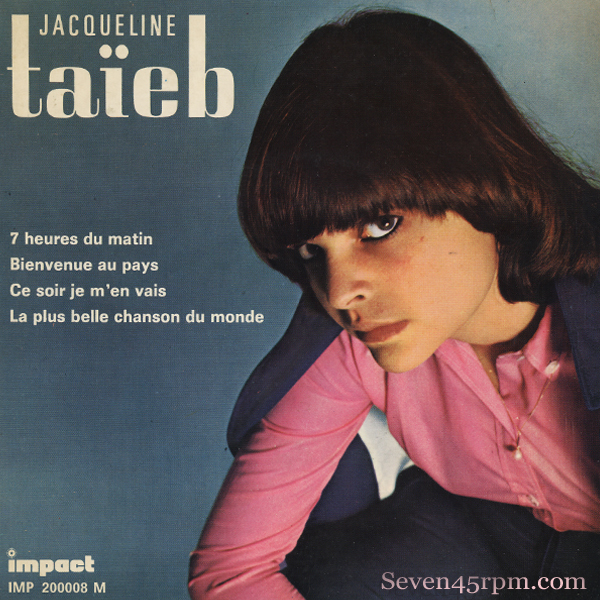
Jacqueline Taïeb – 7 heures du matin

JacquelineTaïeb_Seven45rpm_02JacquelineTaïeb_Seven45rpm_01Impact IMP 200008 M France 1967

Track 1 – 7 heures du matin  Track 2 – Ce Soir Je M’en Vais

Born 1948 in Carthage, Tunisia, the young Taïeb arrived in France with her parents at age eight. Her father gifted her with a guitar at 12 (like every good dad should do) which she must have really connected with, because soon she would be composing her own songs. It wasn’t long before a talent scout would discover her while singing with friends. It was ’66, and what an exciting time it must have been for the big eyes of 18 year old singer-songwriter, scoring a contract with the record label Impact, and then being quickly whisked away off to London for her first recording sessions.

1967 saw a string of 7″ releases for the then 19 year old Jacqueline, but it’s this debut EP release (in January) that she is most well worshiped for. All four songs on the EP were composed by the young singer herself, which you have to remember for that time, was quite rare, as most female singers were expected to perform songs that had been written for them, or perhaps covers of other popular high selling hits.

Though the lead track, the almighty ye ye classic 7 heures du matin, was only a small hit at the time, it has gone on to become considered a classic of the French girl pop genre. It is the story of a young student waking up too early, at 7am, on a Monday morning, struggling with the thoughts of what the day will throw at her. She fantasizes about her boy crush Paul McCartney, helping her complete her homework, while tormenting on which sweater to wear for the day. Obviously a girl who is after trouble, the rebellious girl even considers playing her Elvis record loudly just to upset the neighbors. I mean really…how cute is that!?

It’s a simple song, but a huge dance floor monster! With it’s Steppin’ Stone garage power chords and it’s rebellious Elvis meets The Who attitude, it’s freakin’ impossible not to adore this one! And obviously very high in demand in the collectors circle. This track really brings back some great memories of the Sounds Of Seduction nights we once were fortunate to encounter here in Sydney in the 90’s, hosted by the great Jay Katz, (a friend who is responsible for introducing me to so much great lost European dance and film music of the sixties). And this song was also the trigger to the beginnings of my Ye ye obsession!

Update! A few years back I managed to get my hands on the elusive Australian issue of this masterpiece, with both 7AM and the flip side, which translates to Tonight I’m Going Home, sung in English! And finally getting a chance to upload. I love both these English renditions, even as a purist to the French originals! This issue has a catalogue date set to 1968.

JacquelineTaiebAus_Seven45rpm_01JacquelineTaiebAus_Seven45rpm_02


W & G ‎– WG-S-8124 Australia 1968

Side A – 7 am.

Side B – Tonight I’m Going Home

More Jacqueline Taieb 7″s to come as well a whole lot more Ye Ye!!!

Ann Sexton – You’ve Been Gone Too Long

AnnSexton_Seven45rpm_02AnnSexton_Seven45rpm_01Seventy 7 Records 77-104 US Year 1972

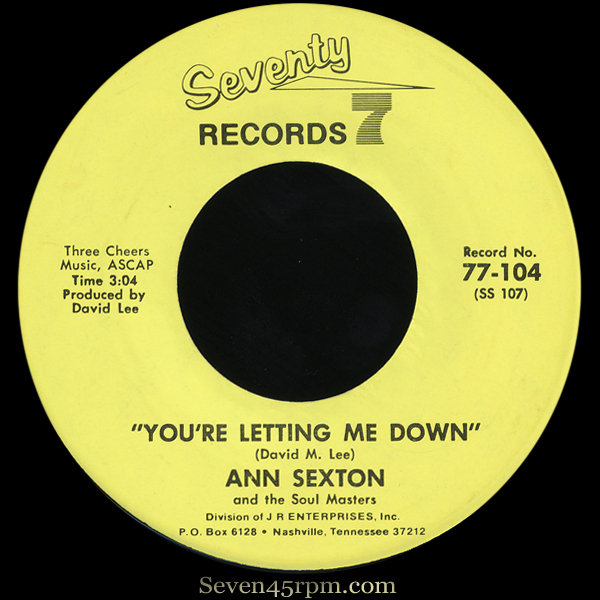
Track 1 – You’ve Been Gone Too Long   Track 2 – You’re Letting Me Down AnnSexton_Seven45rpm_03Mary Ann Sexton was born In Greenville, South Carolina and was yet another child raised by a family heavily influenced by gospel music (a time it seems when heavenly angels were certainly handing out some great voices to their young followers). Her path was always going to be singing amongst her church choir, but she was also open to talents shows on the side, which by no surprise ,she won more than a few times.

In 1967, Ann had her first recording experience as a featured singer on Elijah and the Ebonies’ I Confess on Gitana (credited as Mary Sexton). A beautiful soul ballad that’s hard to come by, and a track that really demonstrates the beginnings of her talent…a teasing taste of things to come from Sexton. The Ebonies’ Tenor and Alto sax player, Melvin Burton (who gained notoriety as a youth playing for Mosses Dillard), must have shared a certain spark with Ann, falling in love, they married soon after and started their own group, Ann Sexton and the Masters of Soul.

Soon song writer David Lee would discover the dynamic soul group while performing at a club in North Carolina in 1970. He had the small label Impel at the time and had to have them on board, so he penned the ballad You’re Letting Me Down, and also with the coloration of Ann and Melvin, what must be the most incredible soul B side ever…You’ve Been Gone Too Long. I’m not evening going to try and explain the purity and greatness of this track. If you don’t feel it, then there’s nothing I can do to help you…although I’ve never know anyone not to love this track. And the A side is a little monster ballad too.

AnnSexton_Seven45rpm_04Now I usually strive with all my might, to sort first pressings whenever I can, but this red Impel 1971 pressing has eluded me for some time. It rarely surfaces around the collectors market although a little while back, a handful did show up briefly. And it is rumored that this was due to a freak find someone was fortunate to discover…a box of mint jukebox 45’s, including a nice handful of these pressings. While they did prove to be way over my budget, maybe it’s a regret I may now have to live with.

The Impel release gave Ann the recognition she needed and soon after, was signed to Nashville’s soul DJ and label owner John Richbourg’s Seventy Seven Records. In 72, this killer double sider was thankfully re-released, (Richbourg must have realised how deserving and worthy these two great compositions would be for his label) but even this first Seventy Seven pressing for Sexton isn’t an easy one to find. There is an alternate label press also, with a later more graphic, brighter label, and while I do believe it is a slightly later press, I’m not sure what the time frame between each pressing is (anyone out there know?)

1972-74 were busy years for Sexton, releasing five 7’s, including the must have You’re Losing Me (penned by Ann and Melvin) flipped with the great You’re Gonna Miss Me. Recording in Nashville and Memphis, she also released her first album Loving You, Loving Me produced by Lee and Richbourg (Ann and Melvin penned six of the songs)….to this day, a much sorted LP.

1977 saw the release of Ann’s 2nd studio album The Beginnings (Sound Stage 7)… now a classic album with some beautiful ballads like Be Serious and I Want To Be Loved, but it also included the very danceable You Can’t Lose With The Stuff I Use and the soulie I Had A Fight With Love. Unfortunately there was only one single release from the album, I’m His Wife.

After her second album, Ann decided to leave the music industry and relocate to New York. Looking to escape the stressful politics of the music industry, she embraced a career change. Her desire to help the community inspired her to become a school teacher.

I am pleased to report that today, Sexton has been rediscovered, and due to popular demand, she is now on the occasion performing back on the stage, where she can once again share that incredibly beautiful voice. But I believe Ann has never needed a stage to shine, she has warmed many turntables and dance floors around the world for many years, whether she has been aware of it or not.

Ann Sexton’s Official Website

The Miller Sisters – The Hully Gully Reel

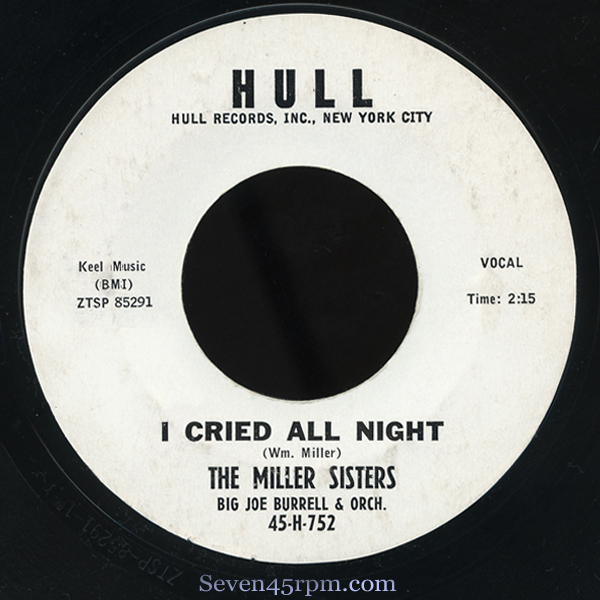
MillerSisters_Seven45rpm_01 MillerSisters_Seven45rpm_02HULL Records Inc. 45-H-752 US Year 1962

As I’m researching this fabulous piece of R&B dance floor femme gem, I quickly discover that there is actually a lot of conflicting and confusing information (again!) out there, regarding this 5 pc. Miller Sisters vocal group and Sun’s Rockabilly sibling partnership that were around at a similar time, with the same name. Two completely different groups yet both so brilliant. I will be posting on the Elsie Jo and Mildred Miller sisters soon I promise!

The Miller Sisters (from Long Island, NY) are Jeanette, Maxine, Nina, Sandy and Vernel, and were the talented daughters of music entrepreneur William Miller, A&R director for Hull Records.

They first recorded Hippity Ha with the adorable flip Until You’re Mine for Herald back in 1955, the same year they also scored a starring role in Fritz Pollar’s R&B picture Rockin’ the Blues, which also included the Harptones, Hurricanes, Wanderers and the great Lula Reed.

In ’56, after releasing Guess Who / How Am I To Know on Ember, they moved to Hull Records, which was the label former Herald Records executive Blanche (Bea) Kaslin’s established along with Billy Dawn and Mr. Miller (apparently Kaslin had just had enough of seeing artists being mistreated, not paid appropriately, and being taken advantage of with contracts). The label had some great R&B success with their very first release from The Heartbeats Crazy For You / Rockin-‘n-Rollin-‘n-Rhythm-‘n-Blues-‘n in ’55. While the sisters were at Herald records, their father obtained their release from an exclusive contract that they held with the label and would thereafter freelance for Hull, ACME, Onyx, Riverside, Roulette, Capri and others.

Millersisters-Seven45rpmMoving forward to ’61, and it was hully gully fever that was scuffing the dance floors, and the Glodis release Pop Your Finger (flip to You Got To Reap What You Sow) certainly would have been getting some heavy rotations around the dance halls.

1962 brought some crackers for the girls, firstly Rayna’s superb release Dance Little Sister (flipped with I Miss You So), and this is the stuff that just thrills me. Slow and swinging, but heavy on the rhythm, and brutally charming vocals with more sass than one can handle. Then on Riverside, the dizzyingly beautiful ballad Tell Him (flipped with Dance Close).

But the year also brought out this beast…The Hully Gully Reel! It’s a mass of rhythm delivered by a thundering steam train. A good one to drop when the dance floor is all warmed up and salivating. Feels very Eddie Bo…it’s got that empowering rhythm, but it’s the legendary Big Joe Burrell with his big Sax driving the orchestration with full pelt. Burrell would work with the Sisters on tour and other recordings for a big part of their career, and it’s obvious a match made in heaven. If 2.15 minutes of non stop frantic hully gullying rocks your boat, then you’re getting you money’s worth here on this 45! Not for the faint hearted! And by the way, how good is that electric organ?! It’s on fire!

In ’64, Big Joe and the ladies struck again with Cooncha – Hey You which they recorded in Quebec for Capri in ’64, supposedly while on tour together…driving stuff! (Their father was credited as “Pop Miller” on the label). The Sisters weren’t done though as far as killer 45’s go. A much more soulful I’m Telling It Like It Is on GMC from ’65 is also very desirable!

The Miller Sisters recorded around 22 singles for various labels, and as is the case with this one, some are not easy to find. I feel very fortunate to have my hands on this one, and have made an oath to share it on as many dance floors as I can!

Discography : (as far as I can make out from Goldmine and other sources)
1955 – Hipetty Ha / Until you’r mine (Herald 455)
1956 – Guess Who / How am i to know (Ember 1004)
1956 – Please Don’t Leave / Do You Wanna Go (Hull 718)
1957 – Sugar Candy / My Own (Onyx 507)
1957 – Let’s Start Anew / The Flip Skip (Acme 111)
1957 – You Made Me A Promise / Crazy Billboard Song (Acme 717)
1958 – Let’s Start Anew / The Flip Skip (Acme 721)
1960 – Oh Lover / Remember that (Miller 1140)
1960 – Pony Dance / Give me some old-Fashioned love (Miller 1141)
1960 – Just Wait And See / Black Pepper (Instrumental) (Hull 736)
1961 – You got to reap what you sow / Pop your finger (Glodis 1003)
1962 – I miss you so / Dance little sister (Rayna 5001)
1962 – Walk on / Oh Why (Rayna 5004)
1962 – Roll Back The Rug (And Twist) / Don’t You Forget (Hull 750)
1962 – Cried All Night / Hully Gully Reel (Hull 752)
1962 – Dance Close / Tell him (Riverside 4535)
1963 – Baby your Baby / Silly girl (Rolette 4491)
1964 – Cooncha / Feel good (Stardust 3001)
1964 – Cooncha / Hey You (Capri 950) Quebec
1965 – Looking over my life / Si Senor (Yorktown 75)
1965 – Your Love / Please Don’t Say Goodbye Dear (GMC 10003)
1965 – I’m telling it like it is / Until you comme home, I’ll walk alone (GMC 10006)

New Holidays – Maybe So, Maybe No

NewHolidays_Seven45rpm_02 NewHolidays_Seven45rpm_01Soulhawk Records USA Cat.# 1008 Year 1969

I thought researching this extremely beautiful and soulful New Holidays composition (and one of my top ten I must add) was either going to be fairly easy (such an outstanding recording from them…surely credit and facts should be well documented)…or quite difficult, (other than collector’s of fine soul records, it’s existence is fairly unknown).

But after only a few hours of researching, did I realise that the information on the “Holidays” was so mixed up and jumbled, and to make any sense of it all may just prove to be too overwhelming! THANKFULLY, good ol’ Soul Detroit has saved me again! Well in fact researcher Graham Finch is responsible for exposing what must have been an incredibly difficult ordeal, to sort through facts, lies and myths, that makes up the real story behind the Holidays!

And even with all the facts …it’s still a real brain trip to decipher, so I’m going to try and map out the path that will eventually get us to this one great song, with Holland at the wheel!

The New Holidays are James Holland, Jack Holland and Maurice Wise (and possibly Joe Billingslea).

The Fresando’s – James Holland first recorded with the The Fresando’s in 1957 with the release I Mean Really on the Star label. The absolutely astounding flip Your Last Goodbye holds up a writing credit to Leo Parks (so-called manager at the time) but the truth is, it was chiefly penned by lead singer Aaron Little. The harmony group really shines here, up along side Eddie Bartell and his Dukes of Rhythm minimalist accompaniment.

The Five Masters -The Fresando’s record wasn’t a hit and in 1958 the five singers changed their name to The Five Masters and hooked up with Robert West, one of the first of Detroit’s recording pioneers to taste success – most notably with The Falcons. Their next release was We Are Like One  (flipped with Cheap Skate) on the Bumble Bee label, and although it was the Master’s who were responsible for writing this beautiful song, this time it was new manager Clyde Clemons, that took the credit. Their Bumble Bee disc failed to create much of a buzz, and in September ’59, the teenagers enlisted in the army, separating to different corners of the globe, from France to Korea and to even Alaska. When they arrived back to Detroit in ‘62, things had changed and it was the dawn of a new era, for music and the group.

The Four Hollidays – Once James Holland and the Barksdale brothers returned to Detroit from their military service, they immediately set about resurrecting their musical careers. They were joined by Johnny Mitchell, a friend of theirs who just had recorded with The Majestics for the local Chex label. They decided to call themselves The Four Hollidays.

Detroit now offered more opportunities than when The Five Masters had disbanded in ‘59, with the success of Motown Records, however there seemed to be some unfair play going on around town, leaving artists with no money regardless of their sucessful recordings, so the decision was to instead head to Chicago and audition for Vee Jay Records. It was the great Andre Williams who introduced them to Lenny Luffman, who signed them up to Markie.

The Four Hollidays first released the dance-fad song Grandma Bird in ’62, but it was the great flip Step By Step that became the seller, especially in Chicago where popular WYNR radio jock “Wild Child” Dick Kemp dubbed it the “47th Street Stomp”. This was reference to the street in Chicago’s Near South Side where Black American’s had created a vibrant community. It was also where Markie Records was based.

The follow up was in September ‘63 with I’ll Walk Right Out The Door (which seem to exist only as promotional copies), and although the group did their best to push the great tune, it didn’t do as well as their previous hit. Thankfully the success of Step kept them going on the club circuit for quite some time.

The 4 Hollidays – The group headed back to Detroit and scored a session at United Sound where they recorded Deep Down I My Heart with Jimmy leading, and He Can’t Love You in ’64. It was the maiden 45 for The Master Recording Company, but the fledgling company wasn’t really set up to properly promote and distribute the disc and consequently sales never materialized.

Jimmy and the Barksdale brothers now decided they should take charge of their recordings and start a business. Johnny Mitchell left the group to team up with the re-formed Majestics , James Shorter was recruited as the new fourth Holliday. Somehow they managed to pull together the $200 they needed to pay the studio and musicians, and recorded Set Me On My Feet Right / Happy Young Man but without hardheaded promotion and slick marketing, the company wasn’t able to push the first and what proved to be last 45 on the Holliday label.

By spring ‘65, The Four Hollidays had shrunk to one member: Holland. The two Barksdale brothers had taken regular jobs and James Shorter had signed with Lou Beatty’s La Beat Records. Jimmy decided to head back to Chicago, an soon recorded with Andre Williams the upbeat Baby Don’t Leave Me on Blue Rock (with a rippa’ punchy female-led intro’ and backing). Unfortunately this release didn’t take off and again only seems to have been pressed as a promotional 45.

It’s 1969, James returned to Detroit and formed a new group of “Holidays” with younger brother Jack, and Maurice Wise and the trio got a deal with LeBaron Taylor’s fast-fading Solid Hitbound Productions. He teamed up with George Clinton (who had already left LeBaron for Westbound Records and now had renamed himself and band, Funkadelic) and together penned  All That Is Required Is You. It was released on LeBaron’s Revilot label that same year. Now do not get confused with the The Holidays that had the previous two releases on the label…Holland’s group had nothing to do with that, and eventually the courts decided that due to the earlier success of Holland’s group, he would win the lawsuit that would allow ownership of the title.

Finally, in ’69, Holland hooked up with the mighty songwriting partnership duo Richard “Popcorn” Wylie and Tony Hester, and recorded the unbelievable Maybe So Maybe No. The flip side If I Only Knew, is a version of a song that Jimmy ‘Soul’ Clark had a recorded a year earlier. Note that on the Westbound release, you will find My Baby Ain’t No Plaything on the flip, Popcorn could sense the potential for a the hit and decided to put a stronger B-side which is actually not at all the New Holidays, but was in fact sung by a different group that included Bobby Martin, Herschel Hunter (both former Martiniques from the early 1960s), and guy named Fletcher, and Willie Harvey.

For some reason or another, the Westbound or Soul Hawk release didn’t takeoff…and I’ll never understand why!

So a journey of amazing talents and more than a fair share mighty fine bad luck and missed opportunities.

The Holiday story goes even further on, and the holes I’ve avoided are sometimes creators! But I highly recommend reading the full (?) breakdown of the compositions, band members and “sidestreets” here at Soulful Detroit!

Meco – Star Wars Title Theme

MecoStarwars_Seven45rpm_02 MecoStarwars_Seven45rpm_01RCA Victor ‎– Aus Cat# 102975 1977

Track 1 – Star Wars Title Theme

Track 2 – Funk

Okay, so I may need to explain something here. I’ve just had a very significant birthday (a number which really relates to this blog content) and thought I really should post something that is quite special to me, for this momentous occasion. Star Wars was one of the biggest and influential things to happen to me as a young kid. It inspired me, it strengthened my imagination, and it let me dream…and it also introduced me to the 7″ record.

Meco’s take on the Star Wars Theme was the first 45 I ever owned! I remember vividly when my papa wanted to reward me for scoring a rare soccer goal…I asked if we to go to that little record shop in Beverly Hills to see if they had the music to that science fiction movie which all us young boys were going space nuts over! At the time I didn’t realise (or care) that the version I had in my hands, wasn’t actually the original John Williams score, but in fact a “dance” take by an Italian named Domenico Monardo.

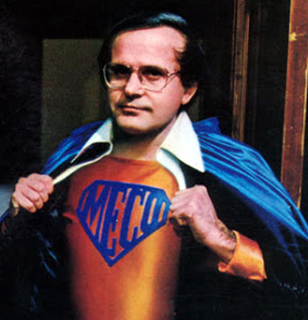
Meco was born on November 29th, 1939 in Johnsonburg, Pennsylvania, and had a passion for building model ships and science fiction movies. He got his first musical education from his father who played the Valve trombone in a small Italian band. Although at 9, Meco wanted to play the drums, his father convinced him that the trombone was the right instrument, which he stayed with (he did however opt for the Slide Trombone, troublesome as it was for the small-statured boy to extend the slide fully at first). He joined the high school band while still attending grammar school and at 17, won a scholarship to the Eastman School of Music in Rochester, New York which provided him with some solid classical & jazz skills. There, together with his two friends Chuck Mangione and Ron Carter, he started the Eastman School of Music Jazz Band. He attended West Point, where he played in the Cadet Band, and learned about arranging from an Army sergeant.

Meco workemeco_Seven45rpmd from 1965 to 1974 as a studio player and arranger, and also earned a nice living arranging commercials, however his breakthrough arrived in 1974 when he co-produced the Gloria Gaynor’s smash Never Can Say Goodbye, followed by the Carol Douglas’ Doctor’s Orders. Having aligned himself with Broadway arranger Harold Wheeler and producer Tony Bongiovi, Meco was now on his way to producing several early disco hits.

On May 25th, 1977, Meco, along with many hundred others, lined up at the New York City theatre for the the opening day screening of this new science fiction film starring Mark Hamill, Carrie Fisher and Harrison Ford. He was amazed by the film and loved the score (he went back to see it eleven times in all), but he couldn’t help but feel there was an opportunity for a commercial hit combining Williams’ dramatic score along with the other big phenomenon of the time, disco!

MecoJapStarwars_Seven45rpmHe conceived of a 15-minute disco treatment of several themes in the movie, including the music played by the Cantina Band in the bar on Tatooine, and also really wanted to include R2-D2 sound effects. He called Jimmy Ienner at Millennium Records and Neil Bogart at Casablanca Records and explained his idea. Based on the tremendous success of  Star Wars, Bogart and Ienner agreed to Meco’s idea without hearing any of the music. Meco was thinking grand and hired 75 musicians to play on the track, which was just unheard of for a pop production, (all credited on the lp sleeve) and played trombone and keyboards himself. The complete composition was released as part of an album, Star Wars And Other Galactic Funk, and on a 12″ single. The original main title theme by The London Symphony Orchestra was released by 20th Century Records and entered the Hot 100 on July 9th, 1977, less than two months after the film opened. It raced up to #10 on the charts, however Meco’s electro-disco medley, which debuted on the chart on August 6th, 1977, raced past it to go to #1 the week of October 1st, 1977 where it stayed for two weeks and received endless airplay.

So on the flip of this 7″ we have the percussive track simply titled Funk. It actually holds up okay, Mandingo-esque, some nice horns and rhythms, and quite odd to find it here on this B side. Obviously this 7″ got released in every corner of the globe, but I have to say it’s the Italians that scored the best cover artwork, which is a simpler stylised version of that fab album cover art.

A few years later the Italian was eager to do it all again with the release of the SW sequel, however Meco Plays Music From The Empire Strikes Back was a different sounding album. Disco was out and the new sound was rock-oriented instead. First Harold Wheeler was replaced by Lance Quinn, who was a guitarist on the previous Meco releases, giving the arrangements a totally different sound. And this time it was going to be released on RSO Records instead of  Millennium/Casablanca Records and importantly, it was endorsed by George Lucas which meant he could finally use the very real sound effects.

And then things started to get even weirder! With the success of the album,  Lucas gave the green light for Christmas In The Stars (The Star Wars Christmas Album). Once again on RSO Records, this time Harold Wheeler was back with his arrangements. Lucas not only allowed the use of special effects of R2D2, but also the voice of Anthony Daniels as leading vocals for C-3PO. There was also a vocalist that appeared on a track by the name of John Bongiovi, who had not yet achieved fame as Jon Bon Jovi. The great album cover is by Ralph McQuarrie, the designer who made most of the artwork for the “Star Wars” trilogy.

And then in 83, we got the Ewok Celebration, which was to be Meco’s last movie-based album. The album features other film and television themes as well as sax and lyricon solos by, dare I say,  Kenny G! The Ewok Celebration Theme  includes a rap by C-3PO (performed by Duke Bootee).

So yes, in hindsight, Meco’ Star Wars Title Theme is simply disco with lasers and beep boops, not a genre I really go crazy over these days, but I have to remind you, the impact this movie and it’s soundtrack had on me, would shape the person I was growing into (I even joined the school band after see Star Wars just to learn the cornet, hoping I could play the main theme). And to play so many memorable soundtrack moments including the Cantina “movement” all within 3.28 seconds was just fantastic. As a kid with a Star Wars obsession, it was pefect! I would play it over and over again, reliving the exciting space adventures Lucas had implanted into me, which will last a life time.

Referencing http://www.discomuseum.net/BioMeco.html

Darondo – Didn’t I

Music City USA Cat#45-894 Year 1972

Upon learning of the recent loss of the great and mighty Darondo, I thought it an appropriate time to praise what I think, is one of the most beautiful and soulful songs you will ever hear in your lifetime, by this unknown master.

Born October 5, 1946, William Daron Pulliam was raised in Berkeley, California, where his mother bought him his first guitar when he was around eight. When Darondo hit his later teens, he and a bunch of high-school friends formed The Witnesses, who became the house band for a strict early night “teenage nightclub” in Albany called the Lucky 13 Club. He fell in love with the R&B and rock that was popular at the time, but it wasn’t until he picked up Kenny Burrell’s 1963 album Midnight Blue that he found his niche. “I learned guitar from listening to Kenny Burrell,” Darondo says. “Him and Wes Montgomery. I got my chords from them. Kenny Burrell was cold“.

Darondo may have trained to be an electrician in his twenties, perhaps doubting his abilities to reach a professional music career, but obviously there was a light within him that needed to rise up and out into the world…and indeed, there certainly was an incredible and important voice that needed to be heard.

His friends may have treated his determination for releasing his own record with skepticism, however he insisted “I’m going to show you suckers something. I don’t care if I have to do it myself; I’m going to put this thing out.”

Darondo’s big break came when he met experienced jazz pianist Al Tanner, who was impressed with Darondo’s style and suggested that he should go into the studio. That session produced the great “Darondo Pulliam” two-sider, I Want Your Love So Bad, flipped with the mover How I Got Over, on Leroy Smith’s Ocampo label. Although the song didn’t exactly light up the charts, it caught the attention of Ray Dobard, who owned the record label Music City.

Darondo and Tanner recorded nearly an entire LP in one session at Dobard’s studio. The session produced the fat funk Black Power anthem Let My People Go and the killer jam Legs, but it was the soul pouring “Didn’t I” that became Darondo’s 7″ release in ’72. Local radio put the song into heavy rotation, and the single went on to sell 35,000 copies. Unfortunately, no LP ever came out of that session. “We did about ten tracks,” says Darondo. “I think [Dobard] stole the records. I don’t know what happened to those songs, I don’t know what he did with it.”

But in ’74, there was a third and final single to come out from those sessions, his rarest 7″, recorded for the uber-obscure Af-Fa World imprint (Let My People Go/Legs). By this time, Darondo’s voice had matured, settling in with a refined falsetto that harkened to his years listening to and singing gospel, or what he calls, “spiritual things.” “Spiritual and rhythm and blues—it’s two different things,” he explains. “If you can sing a spiritual thing, you can mostly sing anything, because you are hitting so many more…high pretty notes.”

During his early-’70s run, Darondo opened up for James Brown, became a close acquaintance with Sly, and by all accounts, lived the high life. He’d purchased his signature Rolls Royce from a “cold” car dealer. “This Rolls had racing lights,” he recalls. “It had a bar in the back …I put all the scanners and other mess up in it, so that if the police pulled up behind you, you could hear everything they say. It was too cold. At that time, I had mink coats, diamond rings. I stayed sharp.”

darondo_Seven45rpm_02While it may have seemed Darondo was living a little too well for a fledgling regional star, it is rumoured he had other sources of income, as a successful pimp, though it’s a topic he himself refused to speak about, neither confirming nor denying, though he did elliptically refer to it as his “fast life” days. “When people see something, they’re going to think one way or they’re going to think another way,” he muses. “When they saw a chauffeur driving me around in a Rolls, they said, ‘That boy is a pimp.’ I made money, but I was working. I had a job … I was a janitor. I drove up [to the hospital] in the back of my Rolls with my mink coat on … and I’d take the elevator down and change in [the janitor’s locker].”

But back to Didn’t I. It only takes one listen to this haunting, down-tempo breakup ballad to realise that there is something pretty special happening here. And to tell you the truth, I actually don’t play this very often, even in the company of no one else but me and my dog…and it’s a 45 that’s never left the house. Darondo’s wiry falsetto, his lonely guitar chords and understated, melancholic orchestration makes it all just too personal and devastatingly beautiful. I don’t know really what else to say, only that this composition deserves respect. This means if I’m going to play this record, I’m doing nothing else but sitting back with your eyes closed and my soul wide open.

Ubiquity Records put together 2006’s Let My People Go, a collection of reissued classics and unearthed demos. The album won praise in the national press, and Darondo after so many years away in another life, was once again performing live shows. “I never imagined this,” he told SF Weekly in 2007 about his return to the stage.

Darondo died of heart failure on Sunday June 9, 2013.

Be sure to read the following references from Sam Chennault and Oliver Wang.

-Piero

Wax Poetics   

SFWeekly


Bobby Bland – Honey Child

BobbyBland_Seven45rpm_01GPC_245722_Bobby_BLANDDUKE USA cat# 433 (promo)  Year 1964 Robert Calvin “Bobby” Bland was born January 27, 1930, in the small town of Rosemark, Tennessee, later moving to Memphis with his mother in 1947. He worked at a garage during the week and sang spirituals on weekends, singing with local gospel groups including, amongst others The Miniatures. He began frequenting the city’s famous Beale Street where he became associated with a like minded bunch  of aspiring musicians, who were referred to as the Beale Streeters (although they never used that name themselves), which included such future blues stars as Johnny Ace, B.B. King, Junior Parker, and Rosco Gordon .

Between 1951-52 he recorded four 7″s for Chess, produced by Sam Phillips, alongside Rosco Gordon and as The Bobby Blues Band. While the results of those recordings were not a huge success to say the least, that didn’t stop local DJ David Mattis from cutting Bland on a couple of 1952 singles for his fledgling Duke logo. That same year Bobby was drafted to serve his country, he went off  to war, and had to put his career on hold.

When the singer returned in 1954, he found that the Memphis he once knew was no more. Sun Records had found its fair haired boy, Rock and Roll was breaking down the old barriers between “race” and “pop,” and Duke Records had been sold to entrepreneur Don Robey, owner of Peacock Records in Houston, while several of his former associates, including Johnny Ace, were enjoying considerable success. But Bobby’s talent and maturity as a vocalist had exceeded even more in just those last years, and now Duke was ready to push Bland full steam ahead, with It’s My Life, Baby, Woke Up Screaming and Time Out all released in ’55. Bobby’s first national hit, which went to number 1 on the R&B charts, is the driving Farther Up the Road, which was released in 57′, and burns almighty with the insistent guitar riffing contributed by Pat Hare, another vicious picker who would eventually die in prison after murdering his girlfriend and a cop. In ’61 the beautiful I Pity The Fool and the great soul number Turn On Your Love Light also did well for Bobby and deservedly so.

Bland spent the latter half of the Fifties maturing into a masterful singer and assured entertainer. From 1957 to 1961 he played the chitlin’ circuit with Junior Parker and his band, the Blue Flames. But in 1961 Bland broke with Parker, went out on his own, and rose to his greatest popularity.

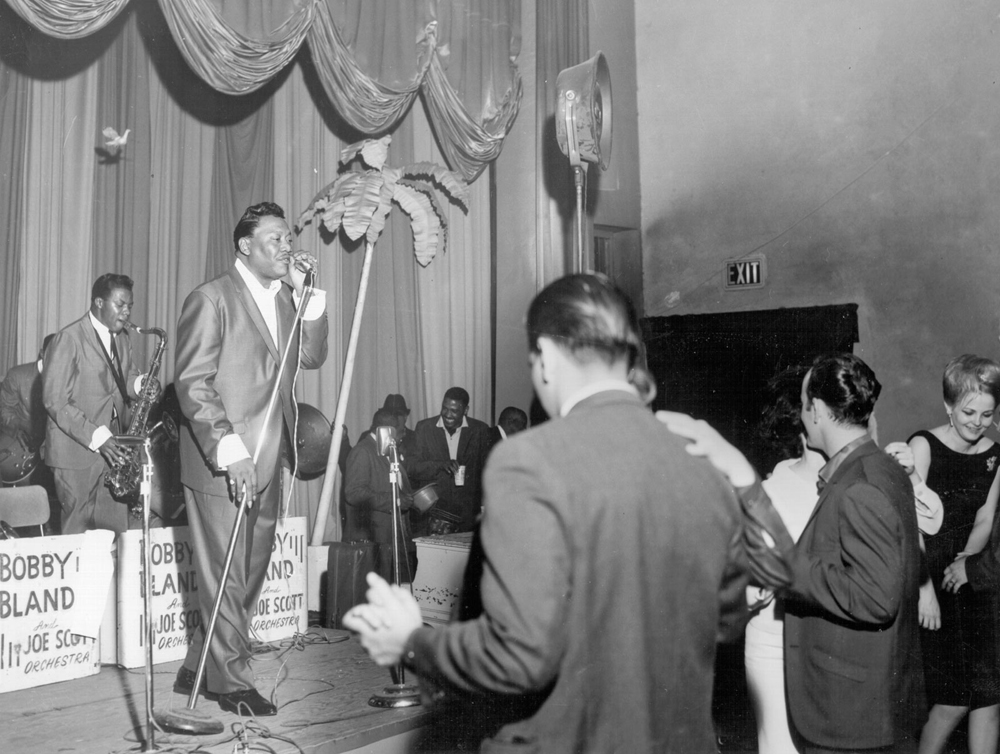
And now we jump to 1964, Honey Child, easily my pick of the crop from such a expansive field of BB soul jewels. And why this flip to Ain´t Nothing You Can Do is so over looked, I will never know! His distinctive silky smooth vocal style slides perfectly into the slinky, swinging rhythms, and it really pulls you in. And in a sudden, the sheer beauty of it all gets pretty overwhelming and inescapable. Adorable and modest guitar phrasing from Wayne Bennett complements the sometimes rampant yet soulful horns which I’m assuming only the great Joe Scott (trumpeter, band leader and Don Robey’s chief talent scout) could be responsible for holding this dance floor gem all together!

Bobby-bland_seven45rpm_03Bobby was sometimes referred to as the “Lion of the Blues”, and without a guitar, harmonica, or any other instrument to fall back upon, all he had to offer was his magnificent, charismatic voice. A voice unmatched in my opinion. With his captivating live performances (and a legion of female fans who deemed him a sex symbol even late into his career) he helped bring the blues out of Delta juke joints and into urban clubs and theaters. Bland’s records mostly sold on the R&B market and he had 23 Top Ten hits on the Billboard R&B charts and in the 1996 Top R&B book by Joel Whitburn, Bland was rated the #13 all-time best selling artist. I believe he is still performing to this day!

Note: I originally posted this entry back in early June 2013. He died on June 23, just 2 weeks later, at his home in Germantown, Tennessee, after what family members described as “an ongoing illness”. He was 83. After his death, his son told news media that Bland had recently discovered that musician James Cotton was his half-brother.

The Stovall Sisters – Hang On In There

StovallSisters_Seven45rpm_02StovallSisters_Seven45rpm_01Reprise Records USA Cat#1028 Year 1971

The Stovall Sisters may have come from a strong gospel upbringing, but this thumpin’ delivery is a hymn praising winged angels with halos of fiery funk!

Born in Kentucky and raised in Indianapolis, Indiana, sisters Nettie, Lillian, and Rejoyce, were three of ten children of James and Della Stovall. Their mother was keen to lay down a musical path for her children, by kick-starting their singing voices from around the age of two, and as they grew up, they would tour the roads of the Midwest and South with the family gospel groups.

The first family group was known as the Four Loving Sisters (the name was later changed to the Valley Wonders) and consisted of the four eldest sisters, Billie, Dorothy, Frances, and Georgia. Prior to joining the Valley Wonders, Wayne, Nettie, Lillian, and Joyce performed in a separate family act known as God’s Little Wonders for as long as their childhood held out. When they grew too big to persist as ‘Little Wonders they inherited the mantle of the Valley Wonders from the four older sisters whose careers had succumbed to marriages. Della managed and negotiated recording contracts for them, who also recorded as The Stovall Family (accompanied by two brothers).

In 1964 the family moved to Oakland where the already seasoned performers finished high school and began worrying about economic survival. They continued to sing in church but the Stovall sisters had to support themselves with weekday jobs. During this period they broadened their repertoire to include rock ‘n’ roll and rhythm and blues which gained them entrance to Oakland area night clubs, sometimes under the name of Sister Three.

In 1968 the three girls decided to go for it, a full time professional rock n’ roll career. Their initial step in this direction was naive but direct. According to Lillian “We put an ad in the Oakland Tribune – Three black girls looking for a Caucasian band to sing with”. The only serious response was from a man named William Tuckway. “He came right in and sat on the floor like we’d be knowing him for years”. Tuckway would soon co-produced their debut album on Reprise along with Erik Jacobsen.

Stovall_Sisters_Seven45rpmHang On In There is the funk standout on their sole Warner/Reprise gospel/R&B crossover album and I’m so damn thankful that it was issued on a beautiful and loud 45. It looks like it was only released as a promo two same-sided track, in mono and stereo. It’s a big groove song…and a wildly uptempo-ed  journey! The band is hot, tight and super sharp…going from album credits-Bass: Doug Killmer, Drums: Bill Meeker, Guitar: Dennis Geyer and on Horns: Ron Stallings, John Wilmeth, Hart McNee, David Ginsburg and Neil Kantor. Too good not to share and deserves far more attention than it gets!

The three sisters maintained a successful career as studio professionals and touring backup singers for an impressive list of well-known artists that include The Staple Singers, Bobby Womack, Ray Charles & The Blind Boys, BB King, Big Mama Thornton, Etta James, Jackie Wilson, Joe Tex, Parliament-Funkadelic and briefly performed as the Ikettes with Ike & Tina Turner, 1967.

The Stovall Sisters would go on to record unreleased tracks for an album with Earth, Wind & Fire’s Philip Bailey and Maurice White but would disband before its release. The Stovall Sisters currently reside in Oakland, Calif.

Recommended reading Opal Louis Nations

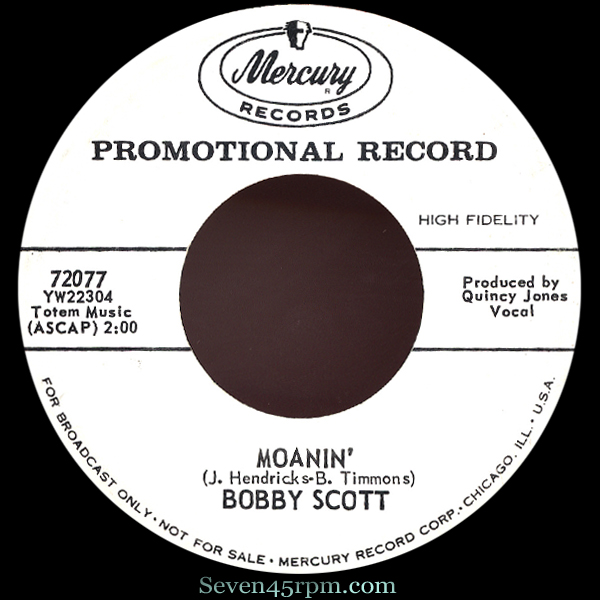
Bobby Scott – Moanin’

BobbyScottMoanin_Seven45rpm_01BobbyScottMoanin_Seven45rpm_02Mercury USA 7″, Cat# 72077, 1962

Hip cat Bobby Scott (born Robert William Scott, in 1937, Mt. Pleasant, New York) is one of those mysterious lost and shadowed artists that really deserves to be pushed into the brightest spotlight, and for those of you out there that love your RnB snappy and snazzy and don’t know this one…well, you should!

Scott was a gifted music prodigy, one who could play piano, double bass, cello, vibraphone, accordion, clarinet, and of course knew how to use his voice box just fine! He studied under Edvard Moritz at the La Follette School of Music at the age of eight, and then in 1949 studied composition with Edvard Moritz, a former pupil of Claude Debussyand, and was working professionally at 11.

It was the early 50’s and despite his early classical training, Scott followed his teen callings towards jazz and played with small bands led by the great Louis Prima and Gene Krupa and cut some tracks for Verve Records with a few of these great small groups.

At 16, he started recording for several other record labels including Bethlehem, Savoy, and ABC, who in 1956, released the hit “Chain Gang” written by Sol Quasha and Hank Yakus, which peaked at #13 on the U.S. Billboard Hot 100!

In 1960, Scott began teaching music theory and harmony and returned to his studies under Moritz. He also signed with Atlantic, releasing a trio of albums under his own name, and started working with other artists, notably Bobby Darin, who he would become a very dear friend to.

That same year, Bobby Scott wrote the title theme for the Broadway version of Shelagh Delaney’s 1958 British play “A Taste Of Honey”, which was exotically made famous by pianist Martin Denny. The instrumental tune was soon given lyrics and was stylishly recorded by the beautiful Julie London, and also Sarah Vaughan, Bobby Darin and by some band called The Beatles. All these versions are quite unique to each other, and I’m sure Mr.Scott must have been pretty chuffed with every interpretation.

Bobby’s big hit won him a Grammy in 1962, but thanks to Herb Alpert’s US Top 10 take, 3 more were added to the list 3 years later. It has been covered so many times by so many great artists but it’s Martin Denny’s 69′ Exotic Moog version I find the most intriguing.

Around 1962, Scott entered one of the few stable periods of his career, taking on as staff producer at Mercury records and working extensively with Quincy Jones. There he would output four albums including the vocal release When the Feeling Hits You, which also happens to be the flip of this killer 45!

Moanin’ first appeared on the self titled Art Blakey and the Jazz Messengers album, recorded in 1958, and was written by pianist Bobby Timmons. Soon after, the composition was given lyrics by Jon Hendricks, who is considered one of the originators of “Vocalese”, and was taken up by Lambert, Hendricks & Ross who released a really super smooth vocal version on Columbia, which even sounds better with a Martini or two!

But it’s Scott’s version that blows the stripey socks off! His mod take is tempting from the first few seconds the open piano chords call. It’s jazz, but it cops a big whack with a broken bottle of rock ‘n’roll, and that mix is  deliriously delightful! And again, here we get some extra topping, quite a lot actually, with some killing twang! One of my favourite guitar jigs to dance to, it’s relentless, stabbing and stabbing, but the blade is blunt and dirty. You step to the left, then side step to the right, but it just keeps on gettin’! On his return, Bobby is a slight crazed, and disheveled, then we see him fade into a dark lane far too quickly…and we’re left wondering if that all really just happened?!

Bobby Scott continued to compose up until the mid to late 70’s, but recorded a final farewell album For Sentimental Reasons in 89′. He died only 18 months after, succumbing to lung cancer on November 5, 1990 at the age of 53 in New York City. He was as a top-flight pianist, composer and arranger who was so important to the jazz world, but with a release like this one, for a brief moment, he was the king of snap jazz n’ pop!

Referencing and recommended reading…..

JazzWax   JazzTimes  Dick Haymes

Seven45rpm

A home for the children of the 7" 45 revolution!

THE LOST WORLD, KATOOMBA

Music on Vinyl & Cocktails in the Blue Mountains

interstellar medium

foreign lavish sounds

EDEN’S ISLAND

A Website About Songwriter/Poet Eden Ahbez

socialpsychol

Reviews, articles, rants & ramblings on the darker side of the media fringe

Dj Undertaker & dj Morticia

Vinyl 45's - from 50's twang to 60's trash

retro latte

The World According to Pop Culture

Piero Sgro

Images of randomness, beauty, strangers, lost things and curiosities.