A home for the children of the 7" 45 revolution!

Latest

Nina Simone – Come On Back, Jack

NinaSimoneJack_Seven45rpm_02NinaSimone_Seven45rpm_01Colpix CP 614  US Year  1960

“She earned the moniker ‘High Priestess of Soul’ for she could weave a spell so seductive and hypnotic that the listener lost track of time and space as they became absorbed in the moment.” Official ninasimone.com.

As we all know, she was arguably one of the most important and influential women of the soul, blues and jazz genre, and I think the only real place to start a 45 collective journey is at the beginning. And it was in the early 60’s, a time when Nina was singing some of her most intimate and bluesy compositions of her career, when this little fiery monster surfaced amongst it all!

But first a little bit about Eunice Kathleen Waymon. She was born in Tryon, North Carolina on February 21st, 1933, the sixth child to a Methodist minister mother and a handyman and preacher father, and started playing piano by ear at the age of three. Her parents taught her right from wrong, to carry herself with dignity, and to work hard, which would in time mold her into the incredibly strong woman she grew up to be. She played piano in her mother’s church, displaying remarkable talent early in her life, but didn’t sing at that time.

Able to play virtually anything by ear, she was soon studying classical music with an Englishwoman named Muriel Mazzanovich, and quickly developed a lifelong love of Bach, Chopin, Brahms and Beethoven. After graduating from her high school, her local community raised money for a scholarship to study at Julliard in New York City before applying to the prestigious Curtis Institute of Music in Philadelphia. Eunice’s hopes for a career as a pioneering African American classical pianist were dashed when the school denied her admission. To the end, she herself would claim that racism was the reason she did not attend.

To survive, she began teaching music to local students, and also began singing in bars, which Eunice’s mother would refer that practice as “working in the fires of hell”. But quickly she attracted club goers up and down the East Coast with her unique jazz-blues renditions of Gershwin, Porter and Rodgers standards. And then Eunice Waymon became Nina Simone, taking the nickname “Nina” meaning “little one” in Spanish and “Simone” after the actress Simone Signoret.

At the age of 24, Nina came to the attention of Syd Nathan, owner of the Ohio-based King Records, and was signed to his Jazz imprint, Bethlehem Records. While at first Nathan had insisted on choosing songs for her debut set, he eventually relented and allowed Nina to delve in the repertoire she had been performing at clubs and was well known for. What I think is one of her most outstanding jazz compositions on Bethlehem is the B sided African Mailman released in 1960, and one you really need to check out!

Nina’s stay with Bethlehem Records was short lived and in 1959, after moving to New York City, she was signed by Joyce Selznik, the eastern talent scout for Colpix Records, a division of Columbia Pictures, founded in 1958. Her stay with Colpix resulted in some incredible recordings, including 9 albums, and some mighty fine 45’s including Forbidden Fruit and her beautiful version of I Got It Bad. 

Produced by big band legend Stu Phillips, Come On Back, Jack is Nina’s response to Ray Charles dance floor bomb Hit The Road Jack, (written by rhythm and bluesman Percy Mayfield) which was released that same year! But while it does share a similar riff and beat, I have to say it’s Nina’s jam that has got Jack running the fastest and packs as much, if not more, dance floor impact. Unavailable on LP, this is a prized diamond hidden amongst so many jewels in Nina’s treasure trove that’s worth hunting for!

Finally, this post is only a very small chapter of this remarkable woman’s life and her recording career, but please stay tuned for future Simone posts here, as there’s certainly a few more 45’s that deserve to be spotlighted!

To find out so much more on this incredible woman’s highly influential life and music visit ninasimone.com.
And also….I Put A Spell On You: The Autobiography Of Nina Simone

EXPLOSIONS – Hip Drop

Gold Cup 0005 A US Year 1970

So my first of what willExplosions_Seven45rpm_01 be without a doubt, many Eddie Bo and related posts, is this fab piece of New Orleans lady funk mastered by the genius himself.

As a lot of Bo’s ventures go, it’s difficult to find specifics and particulars with so many scattered productions, and while I can’t tell you much about the Explosions in detail, what has come to light is that it was a teenage Juanita Brooks singing up front on Hip Drop!

Bo, who is responsible for such beastly funk jams as Hook and Sling, Pass the Hatchet and the irresistible Every Dog Got His Day, to name but only a very few, produced, wrote and released this gem on his own label Gold Cup in 1970. That same year he also released Check your Bucket on another imprint Bo Sound, and wasn’t a stranger to “going it alone” for publishing and producing by that time.

There were only two other releases on Gold Cup, which happen to be the only other three recordings that Explosions ever released, the elusive Jockey Ride and Garden of Four Trees flipped with Teach Me. Brooks was in fact mis-credited on the latter label when it was actually Marilyn Barbarin who sung up front on Four Trees, although apparently she was never an actual member of the Explosions. Obviously she is freakin’ amazing on that track!

Hip Drop is so damn funky and really should come with a booty shaking warning! And to make things even better, it’s a “2 parter”, so you get to come back for seconds. It’s perfectly raw as you’d expect from these great early 70’s Bo recordings, and cooks up with just the right amount of fat, dirt and “sassytude” (see what I did there…clever huh)!

Juanita Brooks, who came from a musical family, was also a great gospel and jazz singer and later performed for many years in stage and theater in New Orleans and off Broadway. Sadly she passed away at the age of 55 in September 2009. Eddie Bo died 6 months earlier on March 18, of a heart attack. But let us rejoice for this fist full of funk they both hit us hard with all those years ago which still gives the floor a good beatin’. And every time I drop it, I can always expect to get at least one punter asking “what the hell was that”!

Now some highly recommended “must read” sites for info and dedications…

Funky15corners       HomeOfTheGroove

The Kane Triplets – Theme from “Mission: Impossible”

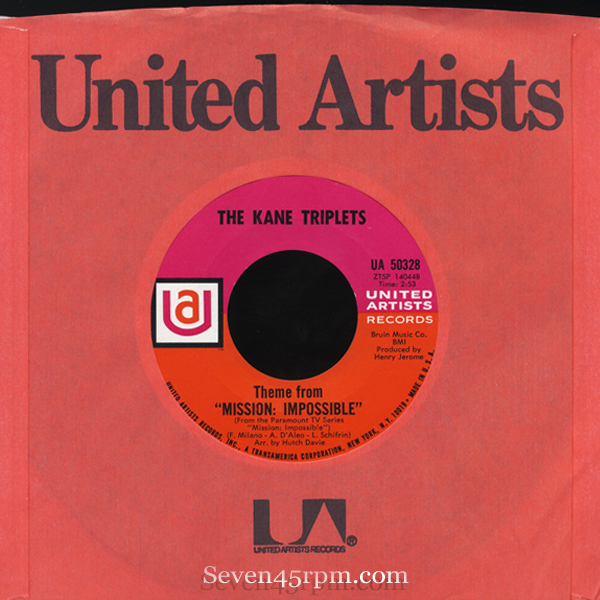
KaneTriplets_Seven45rpm_02KaneTriplets_Seven45rpm_01United Artists 50328  US Year 1968 The Kane Triplets were a three piece vocal sensation made up of the sweet identical triplets Lucille, Jeanne and Maureen Kane, and started their professional show business career very early in life. As children, they were discovered by the McGuire Sisters after performing on the Arthur Godfrey Talent Scout Show, and were asked to join with them in their act on the road and on several television shows. As you can imagine, these little ladies must have been so overly cute and wholesome, but from the footage that you can track down on the net, you cannot deny them of their harmony abilities!Reaction to the girls was amazing! The triplets established their own act and with their growing success, worked in very renowned venues throughout the country, and making Vegas their second home. They even got to work with huge celebrities like Tony Bennett, Andy Williams, Sergio Mendes, Smokey Robinson and the Temptations

The ladies released a few 45’s but it was in 1968 when this little monster was unleashed to the world! Easily their most stinKaneTriplets01_Seven45rpmging and thrilling recording, which really does give justice to Lalo Schifrin’s original 66′ master piece. While writing credits go to Fred Milano and Angelo D’Aleo of The Belmonts, I can’t tell you if this was in fact the first vocal release, but it’s by far the best I’ve heard. The fact that these now adorably blossomed but still innocent looking ladies are behind this big composition and production makes it even more tastier!

KaneTriplets02Seven45rpmThe Kane Triplets were in show business for more than 20 years and made dozens of television appearances, but sadly another sad ending to this story learning that Jeanne Kane was found murdered at a Staten Island (New York City) commuter rail station parking lot, murdered by her ex-husband and retired sergeant John Galtieri in 2007. But on a nicer note, this song always get a great reaction on the dance floor when played and will keep these three little sisters shining on together for many more years.


The Pussycats – I Want Your Love

ThePussycats_Seven45rpm_02ThePussycats_Seven45rpm_03Columbia 4-43272 US Year 1965

Track 1 – I Want Your Love Track 2 – The Rider

One of my top tens here and it just kills me that I cannot find out any real information on these garage grrls and this killer recording! It’s looking like this mighty four piece girl group may have only ever laid down four studio tracks in their career, including this release with The Rider on the flip, and also You Can’t Stop Loving Me (Columbia 4-43587), which I’m guessing was released that same year. You also get the strange and delightful  Dressed In Black on that flip, made popular by The Shangrilas in ’66 on Red Bird.

Pussycats_Seven45rpmI Want Your Love, written by Tony Michaels, has all you could possibly want in my opinion. Opening with a dangerous blues riffing companionship with overdrive guitar and bar piano, insert seductive vocal “Hey you…. come here” and before you know it, you’re in the widow’s web. The first verse is playful and desperate, and the backing doo-wops and harmonies are starting to spin you in a spiral. We are now only 30 seconds in and the guitar gets dirtier and the build up, like a steep roller coaster climb, is making you nervous. You’re pretty much trapped by now, and can’t help feeling like that little mouse that kitty just won’t let die…all in the name of selfish pleasure perhaps. This track ticks all the boxes for me! It’s raw and driving, like good garage should be. It’s got great horns and pace, stomping percussion and stinging guitar, and of course those femme fatale vocals….innocent yet sultry, and even soulful! Great production from Michaels and killer arrangement by Artie Butler!

The Rider is more down tempo but still just as charming and has more of that Spector sound that I can’t get enough of! All four Pussycats recordings also came out as an EP (Portugal) through CBS in ’66 with a killer pic sleeve (above) with all band members. As always, I would love to know more about these elusive ladies and their recordings.

Darrow Fletcher – What Good Am I Without You

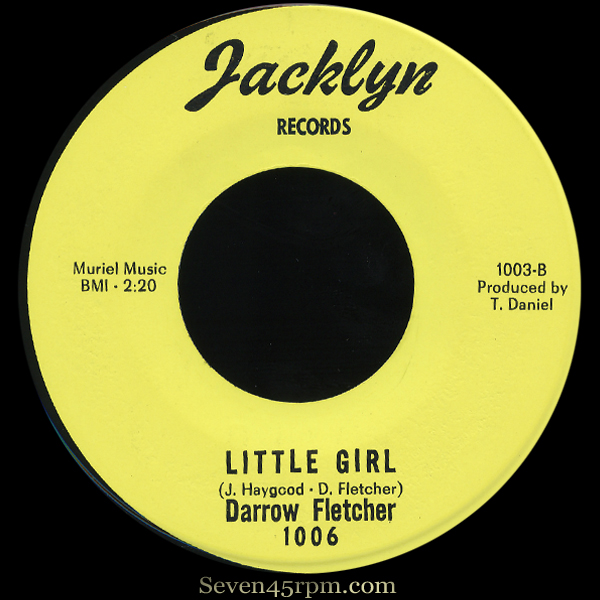
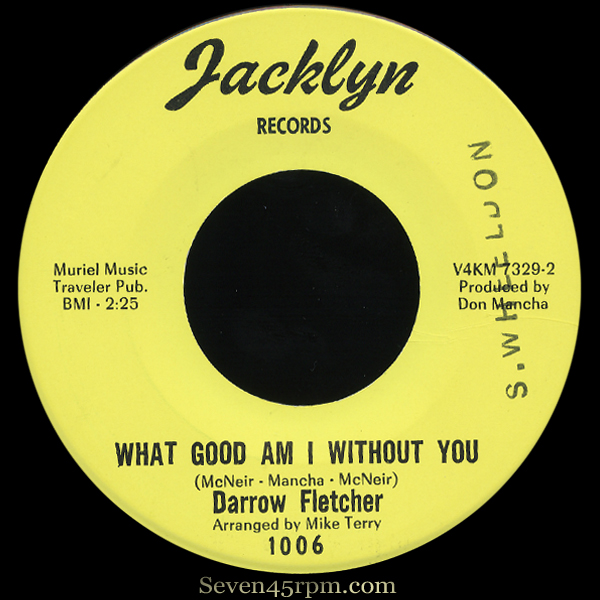
DarrowFletcher_Seven45rpm_02 DarrowFletcher_Seven45rpm_01Jacklyn Records 1006 US Year 1967The first time I heard Darrow Fletcher, which was a few years ago now, was one of those life changing experiences. An instant connection and a desire for his records and his sound. A man with an active 7″ soul catalogue, however somehow still quite unknown and mysterious as far as main stream popularity goes. Wasn’t really too sure what to present for my first DF post, but why not go with one of his very best on Jackyln. But first a little history on this great man, and the best place for that lesson is to dig over at Soul Source.

Darrow, born 23 January 1951, moved with his family to Chicago when he was 3, from the Detroit suburb of Inkster. It seems even as a young 6 year old, he was never uncertain about his stage and singing destiny. His love and enthusiasm for song and performance was a gift he must have truly accepted without any hesitance. Whilst he was a freshman in high school in December, 1965, he recorded “The Pain Gets A Little Deeper”, written by himself and producer Ted Daniels, and cut with the help of his stepfather-motivated business man, Johnny Haygood. Is this really the voice and heart of a young 14 year old school kid !? An impressive debut to say the very least! The record was leased to Groovy, a small New York label owned by Sam and George Goldner and Kal Rudman. They got the record on the national R&B charts for seven weeks in early 1966, and was also released on London in the UK.

Soon Darrow was touring the “chitlin” circuit, playing venues like The Apollo, The Uptown and the Regal, where, in July ’66 he shared the bill with B B King, Lee Dorsey and Stevie Wonder. Following three not so successful  follow-ups on Groovy, Darrow’s stepfather formed Jacklyn Records in 1966, named after one of his daughters.  Darrow cut three singles on Jacklyn, “Sitting There That Night” scored immediately, 2,500 sales for the record in Chicago alone. Darrow co wrote it with his stepfather, and is also providing one of the sweetest guitar solos here, still at the age of 14! The flip “What Have I Got Now” is an insanely beautifully tempo-ed  soul track and makes that a 7″ monster must have!

What Good Am I Without You was penned by Don Mancha and produced and arranged by horn player Mike Terry a year later. Again, this is a very big song and arrangement. The pace is high, just as the heart is beating. The strings and backing vocals are stuffed with passion and the chorus is an out pour! To tell you the truth, I’m really not sure if it can ever get better than this! The flip’s Little Girl is a sweet ballad Darrow co-wrote again with his stepfather.

I think it’s fair to say that Darrow had two very distinctive periods to his career. The first part were the records he made in Chicago between 1965 and 1970, and then the handful of singles cut in Los Angeles in the 70s, which had quite a different more modern soul feel, which I’ll dig deeper into in related future posts. But I love them all. There’s an honesty in his voice that I find so compelling and desirable and I hold him up high in praise as one of my all time favourite artists.

A must read is this recent enlightening interview by Boxy from Soul Source…Darrow Fletcher – The Interview – The Full Story

Sly and the Family Stone – Underdog

SlyStone_Seven45rpm_02 slystone_Seven45rpm_01Epic 5-9951 US Year 1967

Track 1 Underdog Track 2 Bad Risk

Sylvester Stewart was born in Dallas, Texas, in March of 1944 & began his recording career at the very early age of four as a vocalist on the gospel tune On the Battlefield for My Lord. In the 50’s, his family moved to the San Francisco area where he & his brother Freddie learned to play various instruments & made music under the name the Stewart Four. Stewart also played & sang with doo-wop groups & in high school sang with a group called the Viscanes, appearing on their record Yellow Moon, & at sixteen made a solo record called Long Time Away which gained him some modest fame.

Stone studied music composition, theory, & trumpet at Vallejo Junior College in the early 60’s & began playing in several groups on the Bay Area scene. Around ’64 he had become a disc jockey at the R&B station KSOL, & his radio appearances led to a job producing records for Autumn Records. There he worked with a number of San Franciscan garage & psychedelic bands & he himself recorded three 7’s titled Buttermilk PT1-2 & Temptation Walk PT1-2, both in 65, & also the unusual surf track I Just Learned To Swim in ’64 flipped with Scat Swim, which is a personal fav’ that I’ll have to share sometime in the future…it’s a little insane!

As a DJ he gained notoriety as one of the more eccentric voices on radio, blending sound effects with public service announcements & mixing soul singles with rock & roll records by Bob Dylan & the Beatles, & was generally considered the top R & B commentator in the area.

In ’66 Stewart’s current band The Stoners split, & it was saxophonist Jerry Martini who approached Stewart, who was content at the time with his DJ gig, into fronting a new band. Along with Martini, Stewart enlisted brother Freddie as guitarist & his sister Rosie to play piano, with the addition of bassist Larry Graham & drummer Greg Errico & ex-Stoners trumpet player Cynthia Robinson. Stewart changed his name to Sly Stone, & the Family Stone was born.

The band quickly attracted the attention of Columbia Records A&R executive David Kapralik & soon signed with Columbia, releasing its debut LP, A Whole New Thing, in 1967 on the Columbia subsidiary Epic Records. The album didn’t fare particularly well, but my only explanation for that could possibly be only because of the lack of radio hits, & definitely not the lack of fat funk! The opening track on that Lp, Underdog is a killer & the debut album’s only 7″ release which, I suspect, was a promo only (please correct me if I’m wrong!). I myself think this is the most desirable & important Sly 45 to have! It’s an epic tune, with big vocals, snappy rap versing & the sharpest percussion. I’m just not sure the world was ready for this!

But it didn’t take long for the Family to hit it big, which they certainly did with the almighty (& much more radio friendly) US. and UK. Top 10 smash Dance To The Music, from their follow up LP of the same name. Even Sly admits he wasn’t ready for what was about to hit them!

In ’69, Sly released the album ‘Stand’ which included the next big follow up hit Everyday People. A big album, with some big songs, also including I Want To Take You Higher & my personal fav’ from the album, the title track Stand!
This album went on to sell two million copies.

Underdog was also released on a french picture sleeve as a B side to Dance To The Music, but it’s this bad boy you want with the baddest Bad Risk on the flip!

It must be noted that Sly & the Family Stone did release a mysterious 7″ with the titles I Ain’t Got Nobody & Otis Redding’s I Can’t Turn You Loose on the flip, on a small San Francisco-based Loadstone label. This is said to be the first “Family” 7″, however the dates I’m getting on this release are all over the place ranging from 67 to 72. The track also appeared on their ’68 LP.

The Family Stone are credited as one of the first racially integrated bands in music history, belting their message of peace, love & social consciousness through a string of hit anthems. Their music fused R&B, soul, pop, jazz, & an emerging genre soon to be dubbed funk! Sly developed a formula for the band’s recordings, which would still promote his visions of peace, brotherly love, and anti-racism while appealing to a wider audience. And his new fused sound  not only worked in selling records, but influenced the entire music industry. When “Dance to the Music” became a Top 10 pop hit, soul producers and labels immediately began appropriating the new “Psychedelic soul” sound. By the end of 1968,  The Temptations  had gone psychedelic, and  The Impressions  and  Four Tops  would join them within the space of two years.

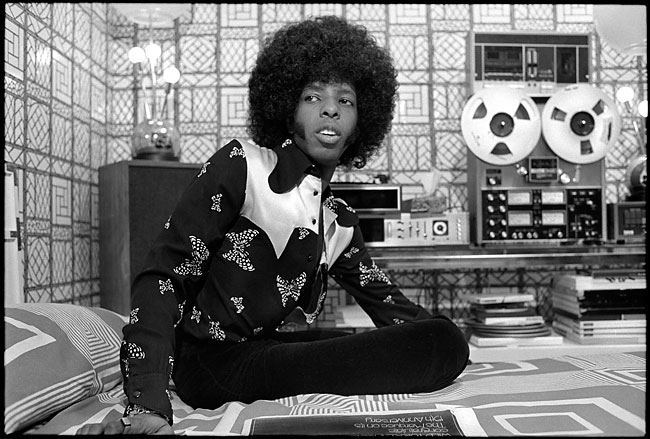
Sly-stone_Seven45rpmSadly Sly eventually fell down the spiral with his constant drug addictions over some many years. While he still may have that spark in his eyes, & that beautiful energy in his aura, he clearly has paid a price for those early years of fame. He was inducted into the Rock & Roll Hall Of Fame in 1993, & is the recipient of the 2002 R&B Foundation Pioneer Award.

Referencing and recommendations…

www.slystonemusic     www.soulwalking

www.answers  la timesblogs

Documentary – Sly & the Family Stone “Coming back for more”  (I would love to see this!)

Documentary -Sly Stone: Portrait of a Legend

Dee Dee Warwick – You’re No Good

DeeDeeWarwick_Seven45rpmdeedeewarwick_01_Seven45rpm

Jubilee 45-5459 US Year 1963

Track 1 – You’re No Good Track 2 – Don’t Call Me Anymore

If there’s ever a 7″ that deserves an A for “attitude”, then this is it!

Jersey gal Delia Mae “Dee Dee” Warwick (sister of Dionne Warwick, niece of Cissy Houston and cousin of Whitney Houston) brings us this dizzying monster two-sider from way back in the early 60’s on Jubilee.

A young Dee Dee sang with her sister and their aunt in the New Hope Baptist Church Choir in Newark, New Jersey. Eventually the three women formed the gospel trio the Gospelaires, and at a performance with the Drinkard Singers at the Apollo Theater in 1959, the Warwick sisters were recruited by a record producer for session work and, along with Doris Troy, subsequently became a prolific New York City area session singing team.

Dee Dee began her solo career in 1963 cutting You’re No Good, produced by Jerry Leiber and Mike Stoller, then in ’64 on the Tiger Label, releasing the lovely ballad Don’t Think My Baby’s Coming Back, before signing with Mercury in 65.

Vee-Jay’s head a&r man Calvin Carter found You’re No Good while visiting  New York City in search of material for his label’s roster and he originally intended to cut it with Dee Dee, but as he recalls, “when I went to rehearsal with the tune, it was so negative, I said, ‘Hey, guys don’t talk negative about girls, because girls are the record buyers. No, I better pass on that.’ So I gave the song to Betty Everett”. Still uncertain as to why there’s an exception when Betty sings it however, maybe it was her more “acceptable” feminine approach she gave it?

Dee Dee’s delivery and conviction is nasty on this little gem. The tempo is scathing, the backing vocals are damn sassy! The song hits you in the head like on old piece of hard timber….she’s letting you know! And just as you think you can’t take anymore, you soon discover the rusty nail in the form of some serious fuzz tone delivered by a short but intimidating guitar rant.

While this tune proved to be much more successful for Everett, which she released only 2 months later in November, (the single peaked at number fifty-one on the Hot 100, and at number five on “Cashbox’s R&B Locations” chart), I’m definitely a lot more infatuated with this dirty raw punchier version of Dee Dee’s from what I like to call her “early punk” R&B days. I don’t wish to ever take anything away from Betty’s take, which really is something special (it may start off quite sweet and slick, but it builds up and gets swinging, and she does finally get a bit worked up towards the end).

There’s only one thing better than a two-sider, and as in this case, two tracks that you could say relate to each other in subject (another great example is Ann Sexton’s You’re Losing Me flipped with You’re Gonna Miss Me). The flip Don’t Call Me Any More is simply great and again, hard hitting, and makes this 7″ release quite an interesting one, when in a time most soul songs were about love and sorrow in relationships, and not so much about attitude and angst.

DeeDeeWarwick_03_Seven45rpmDeeDeeWarwick_02_Seven45rpm

On a sad note…
The more I research about these wonderful artist’s that gave us these incredible songs, too often I find that there’s another darker side to their story. Dee Dee Warwick struggled with narcotics addiction for many years and was in failing health for some time. Her sister was with her when she died on October 18, 2008 in a nursing home in Essex County, New Jersey, aged 66.

Other Dee Dee recommendations!

Dee Dee Warwick – Foolish Fool – Mercury 72880 Year 1969
Dee Dee Warwick – Cold Night In Georgia – Atlantic 2091-057 Year 1971

The Gayletts – Son Of A Preacher Man

Gayletts_01_Seven45rpm Gayletts_02_Seven45rpmSteady Records S 126 – Hourglass HG 005 Year 1969

The Gayletts formed in 1967 in Jamaica consisting of Merle Clemonson, Beryl Lawson and the legendary Judy Mowatt, but sadly broke up in 1970 when Lawson and Clemonson left for America. While it’s difficult to tell you much more about this lovely short lived reggae soul formation, they did leave us a handful of 7″s including this smashing Dusty tune, Son of a Preacher Man, the adorable Silent River Runs Deep, and another great cover, Brenda Lee’s Here Comes That Feeling.

Judy Mowatt of course did go on to become quite the prominent reggae queen there after. In the earlier 70’s she wrote tracks for Wailers’ front man Bunny Livingston, but got her big break in ’74 when she joined up with Bob Marley & The Wailers’ backing vocal trio the I Threes, along with Rita Marley and Marcia Griffiths. Mowatt continued to record for decades after, including a spree of gospel albums between 1998-02.

Preacher was arranged by Ken Lazurus, who once sang for Byron Lee And The Dragonaires, and was released on Steady Records and also on Hourglass the same year . The flip That’s How Strong My Love Is, is a very loving slow ballad with 2.37 mins. of the sweetest harmonies.

The Gayletts is that perfect explosion you get when you mix up a nice dash of doo wop, a big clump of rock steady and a generous sprinkle of heart and soul, and then stirred with the most beautiful rhythm. I find this track so uplifting and a hard one to beat when it comes to female soul groups!

Ernie K. Doe – Here Come The Girls

ErnieKDoe_01_Seven45rpmErnieKDoe_02_Seven45rpmJanus Records J-167 US Year 1973

Just criminal that this here dance floor monster was not the hit it deserved to be back in ’73 for K-Doe!!

Born in New Orleans on February 22, 1936, Ernest Kador Jr.’s first public singing was in church choirs at the age of nine, and went on to sing with such spiritual groups as the Golden Choir Jubilees and the Divine Traveler. Not able to resist the pull of doo wop and R&B, he advanced his career by briefly singing with The Flamingos and the Moonglows in Chicago in the early fifties.

K-Doe began hanging out at the famed Dew Drop Inn and other New Orleans clubs like the Sho-Bar, and also sang briefly with a local group, The Blue Diamonds, with whom he recorded on the Savoy label. As a solo artist he signed with Herald and Specialty and released a few hits, but it was the release of Mother-In-Law in ’61 on Minit that gave him his first real taste of sucess! It reached number one on Billboard‘s R&B chart during May of 1961, and it was the young 23 year old songwriter/producer Allen Toussaint who arranged the song, with backing vocals by the great Benny Spellma. Ironically, K-Doe abandoned Mother-in-Law during rehearsal because it had not gone well. However, as Toussaint recollected in K-Doe’s obituary in the New Orleans Times-Picayune: “It found its way back out of the trash can and into my hands, so we could try again. I’m so glad we did.” Mother-In-Law was one of the biggest records to come out of New Orleans in the 60’s, selling in the millions!

The now successful and flamboyant K-Doe went on to release a string of great tracks there after, include Dancing Man, Popeye Joe, the self penned Te-Ta-Te-Ta-Ta, and one I highly recommend A Certain Girl, which was very nicely covered by The Yardbirds in ’64 with a truly big sound.

It’s 1973…K-Doe is on a new label Janus, and teams up once again with Toussaint, but this time releasing something a lot more funkier than ever before (well it was the 70’s!). Releasing a brilliant self titled LP, with Toussaint’s session hipsters, The Meters as his recording band, and it’s the dynamite Here Come The Girls that gets the single release (the flip being A Long Way Back From Home). The moment the distinctive military intro kicks in, you are forced to attention, and quickly that melodic verse sweeps you in. Driven with that tight rhythmic Meters strumming, along with that catchy bridge and chorus, you soon realise that this is more the funk that’s definitely derived from good R&B and soul roots! It’s snappy, tight and the pace is perfect!

Although this mighty tune may not have reached the success or attention of his hey day 61′ classic, or whether it even made the charts at all at the time, it’s hard to believe that it wasn’t the soundtrack to plenty of dance floor lovers of the time. It just must have been! While the great man is no longer with us, the good news is today, it’s a tune certainly on many dj’s set lists (or wish lists), and still gets a whole lot of people jivin’ 40 years later! Emperor Ernie K-Doe at his Mother-In-Law Lounge; New OrleansErnieKDoe_03_Seven45rpm

Lots of info online on this great artist and here’s some I referenced and recommend!

Official Ernie.K.Doe

Funky16Corners

Enotes

Sylvie Vartan – Ne T’en Vas Pas

SylvieVartan_02-Seven45rpmSylvieVartan_01-Seven45rpmRCA Victor 86.019 France Year 1963

Prolific French ye ye singer Sylvie Vartan, who is actually Bulgarian, really does a nice swinging beat cover of the classic Comin’ Home Baby. Although it was originally recorded by the Bob Dorough Quartet in 1961 on Two Feet in the Gutter (Epic BA 17021) and composed by Ben Tucker (Bailey’s Pianist), it’s the ultra cool and hip Mel Torme version that most people know and love. Bob Dorough of School House Rock Fame added lyrics to the song and the vocal version became a Top 40 hit for the American jazz man, but I find Vartan’s more obscure version which was released in ’63, even more exciting!

Sylvie started her professional singing career while still at school, in her late teens, firstly with the hit song “Panne d’essence” (1961) alongside French rocker Frankie Jordan. Dubbed by journalists as “la collégienne du twist” (the twisting schoolgirl) she quickly started attracting a lot of attention, and it was only a matter of time that this young self confessed jazz/rock n’ roll fanatic, got signed up and began her illustrious recording career. In 1963, Paul Anka offered her “I’m watching”, her first international hit (Japan, Korea) which is the opening B side track of this EP. It’s adorably sweet and quirky with her broken English vocals, and holds a pretty respectful beat! That same year her dreams of being an aspiring actress came true, starring in the movie D’où viens-tu, Johnny? alongside french rock legend Johnny Hallyday, who she toured with in France and ended up marrying in 1965. Six of her thirty-one songs released in 1962/1963 became top 20 European hits and she became the darling of teen magazines and TV, so suffice to say this was an exciting and pivotal moment in her early career!

So back to Ne T’en Vas Pas! The back beat is strong and mean, as it should be, although I do wish it was pushed up in the mix a bit more as with the driving bass (you dj’s will be doing just that on your mixer) and I love the high energy modish Hammond solo. I have to say I always find French female vocal translations of standards or other, so much more attractive and desirable (this is not open for debate!) and Vartan’s approach on this makes it so ultra sexy and worthy! As far as I can tell, it doesn’t look like this recording was ever released on any other 7″ format other than the picture RCA EP. Maybe some foreign presses were released? Not too difficult to find and highly recommended!

SylvieVartan_04-Seven45rpmSylvieVartan_03-Seven45rpmAlso check out Sergio Mendes’ great Latin instrumental version of Comin’ home baby (Atlantic 45 2572) and Vartan’s great “Gimme some lovin'” cover Donne Moi Ton Amour!

Seven45rpm

A home for the children of the 7" 45 revolution!

THE LOST WORLD, KATOOMBA

Music on Vinyl & Cocktails in the Blue Mountains

interstellar medium

foreign lavish sounds

EDEN’S ISLAND

A Website About Songwriter/Poet Eden Ahbez

socialpsychol

Reviews, articles, rants & ramblings on the darker side of the media fringe

Dj Undertaker & dj Morticia

Vinyl 45's - from 50's twang to 60's trash

retro latte

The World According to Pop Culture

Piero Sgro

Images of randomness, beauty, strangers, lost things and curiosities.