
The Fabulous Usha Iyer & The Flintstones


The Trip – His Master’s Voice – NE. 1005 India Released 1969
Blues Train – His Master’s Voice – NE 1006 India Released 1969
I’ve decided to feature two 7’s this time around, as this some what lost and elusive coupling from Usha Iyer, who these days is more commonly known as Usha Uthup, should not be separated. Obviously I’m still hanging on to that recent India experience, that happily refuses to leave from beneath my skin.
Usha Iyer was born on November 8th, 1947, into a Tamil brahmin family that hailed from Tamil Nadu and Kerala, in Madras (now Chennai). She has three sisters, all of whom are singers, and two brothers, herself being the the fifth of six children. As a child, she lived in the police quarters at Lovelane in Byculla in Bombay and attended a local school (her father Sami Iyer, later became the police commissioner of Bombay). When she was in music classes at school, she was a bit of a musical misfit, because “she didn’t fit in” with a voice like hers. But thankfully her music teacher did see something, and recognised her passion and determination, and would encourage her with simple instruments like clappers and the triangle.

Even though she was not formally trained in music, she grew up in an atmosphere of music. Her parents used to listen to a wide range from Western classical to Hindustani and Carnatic. “Along with Beethoven and Mozart, we listened to Bade Ghulam Ali, Bhimsen Joshi, Kumar Gandharva, K.C. De, Pankaj Mullick, Manna De, Shyamal Mitra M. S. Subbulakshmi, and a host of other great classical and modern masters,” reminisces Usha to The Tribune India. Her next door neighbour was S.M.A. Pathan, who was then the deputy commissioner of police. His daughter, Jamila, inspired Usha to learn Hindi, wear salwar kameez and take up Indian classical music. This fusion approach helped her to pioneer her unique brand of Indian pop in the 70s. Her first public singing occurred when she was nine. Her sisters who were already exploring a music career, took her to a musician called Hamir Sayani who gave her an opportunity to sing on the Ovaltine Music Hour in Radio Ceylon. She sang a number called Mockingbird Hill, and several more appearances followed through in her teenage years. A 20 year old Usha started singing in a small nightclub in Chennai called Nine Gem, which was in the basement of the Safire Theater complex . Her performance was so well received that the owner of the nightclub asked her to stay on for a week. She also began singing in Calcutta at night clubs such as Talk of the Town, now known as Not Just Jazz By The Bay, and the infamous Trincas.
Trincas – In 1969, when performing at nightclubs and restaurants was considered taboo, Usha became the highest-paid crooner in Chennai, Kolkata and New Delhi. But in the beginning it was nervous times for Usha. Trincas, originally a Tea Room owned by the eponymous Mr Trincas, was converted into a nightclub in 1959, an run by Om Prakash Puri and Ellis Joshua. It went on to become the launch pad for many acts of the Indian live music scene. The hip club was more in trend with Anglo-Indians, fair-skinned and blonde haired glamours, so when Usha asked if she was allowed to perform in her sari, she was relieved to get managements full support. On 1 October 1969, some of the stereotypes surrounding female nightclub singers in India were shattered. That is when a young Usha Iyer took the spotlight at the crowded restaurant, wearing her sari and her hair lit up in flowers, and singing Little Willie John’s Fever. The first reaction of the crowd was one of disbelief, but they quickly fell in love with her and the club and patrons accepted her whole-heartedly! Also in those days, female singers in bars had to get a permit from Lalbazar, the police headquarters, with strict guidelines forbidding interaction with guests or soliciting. It basically meant that she wasn’t allowed to socailise with guests or sit at their tables. However Usha did break the rule once, and that was the moment she found her husband Jani.
This early recording period of Usha Iyer is very difficult to track, with even her official website failing to mention anything about these “Flintstones” recordings. I can tell you that in 1968, Usha recorded what was supposedly her first 45, released on the His Master’s Voice label (45-N.79858), where she was labelled as just Usha. Hecke Kingdom, who cut a distinctive figure on the Bombay jazz stage in the 1950s and ’60s with his enormous baritone saxophone, recorded the sessions with his Jazz Quartet. The two compositions were covers, the first was Hank Williams Jambalaya and then flipped with The Kingston Trio’s Green Back Dollar, and are apparently the only tracks he recorded on vinyl during his whole career.

Now it seems there was a popular “house” band at Trincas that went by the name of The Flintstones, and by the sounds of it, they were very impressionable and were a group that really left quite a heavy stamp on the face of the late 60’s-early 70’s Indian rock music scene. As this is also the time that Usha was playing at Trincas, I have to assume that this is the same band that appears on these two featured 7″ records. Apparently this cult band were the big deal, could consistently pack out the venue and could get some pretty wild dancers in action. There must have been some pretty crazy nights there on Park Street, with other psychedelic rock acts also appearing such The Combustibles, The Savages, The Fentones, The Playboys and other bands with names like Black Cactus, The Urge and The Hurricanes.
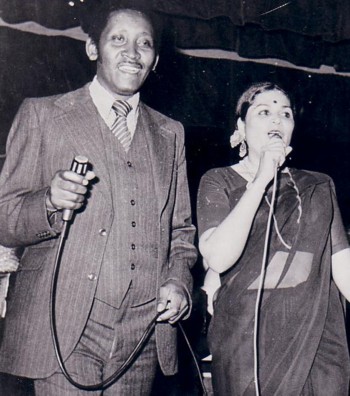
From what I can work out, band members of The Flintstones were Eddy Ranger (lead vocals), Noel Martin (bass), Claton Saunders, Rhett May, and possibly Gautam Chatterjee, who was also playing at Trincas with another band, The Urge. It was the seventeen year old Clayton Saunders, who it seems was a musical genius from a young age, formed this band that took India by storm. Not long after this lively Indian rock spell, he would move over to my home country of Australia, and became successful with the country bands Hotspurs and Stoney Creek. At the tender age of 11, Saunders became the youngest talent to perform regularly on All India Radio’s renowned program The Children’s Hour. Rhett May also left the band and headed for Australia, and was in a band called Lucifer in the 1970s, and he is still quite active in the music scene releasing records today. Noel Martin still to this day, plays at Trincas, with his band Sweet Agitation, which was formed in 1984. I did track down evidence of another Flintstones 45 which was released in 1968, again on the HMV label (45 POPV 8085), with the tracks titled Be Mine and Happy By My Side, a mover credited to Clayton Saunders, that one could believe to have come from a Beatles track list, from their more raw early days.
The Caluatta Telegraph reported in 2008,”After 1972, the band’s popularity and also that of other live bands waned because of two reasons: anglo-Indians were leaving Calcutta and the popularity of the first discotheque in Calcutta, In & Out in Park Hotel. For a cover charge of merely Rs 10, patrons could hear DJs play the celestial music of Jethro Tull, ELP, Yes and Grateful Dead. These records were hardly heard in Calcutta then. No one would any longer pay to hear the cover versions”.

Thankfully someone back then did have the sense to bring Usha and The Flintstones into the studio, to lay down a handful of tracks. Today we can gratefully be transported back and experience if but a taste of those exciting vibrant times of that particular period of Indian psychedelia. On the first single, the A sided The Trip is absolute killer material from both Usha and the band. With it’s psychedelic brilliance, hard hitting break beats, snappy mod blues guitar work, and Usha’s beautiful acidic jazz vocals, it’s raw, dirty and dope, and for me, it feels like bathing in the richest soil of the Indian earth! As the only credit on the label is to Usha, again I have to assume the lyrics are hers. She sing’s of a faraway trip, leaving someone that was obviously close to her, behind, and whether it’s spiritual or literal, we don’t really have to know. For me this has to be her biggest tune, and to finally find it on a lost record that is about journey, is quite a trip. The flip to this big track is a cover of Tommy Roe’s 1960 number 1 hit song Dizzy, which for me is a bit too pop and doesn’t really suit the band’s dangerous edge. On the other hand, Blues Train, the second single featured here, we’re back on track, enjoying another dark journey with the brilliant combo. Like very many blues songs, this song is about loss, and this time it’s a tale of a dear soul to the story teller, that has taken their life. Usha sings of her desire to do what needs to be done, so they can be together again…”Every time I hear a train, I’ll be on the railway line, hang myself on a telegraph pole, then I’ll be with you body and soul. I know what to do, I’ve got to be with you tonight”. This moment of brilliance is tastefully complemented with the A-sided Summertime, which can be proudly added to the many amazing interpretations that exist, of Gershwin’s 1934 masterpiece.
In around 1974, Usha was invited by the legendary Goan composer Chris Perry to record an album of Konkani songs. Perry had just had a professional bust up with the ever so popular “Goan nightingale” Lorna Cordeiro, and was looking for a female vocalist who could fill that prodigious void. With compositions already to go, Perry approached her one day when Uthup was singing with the trumpet player at the Ritz near Eros cinema. The outcome was a successful record release comprising five Konkani songs performed by Usha including Meu Amor, Beautiful and the desirable Paka Paka.
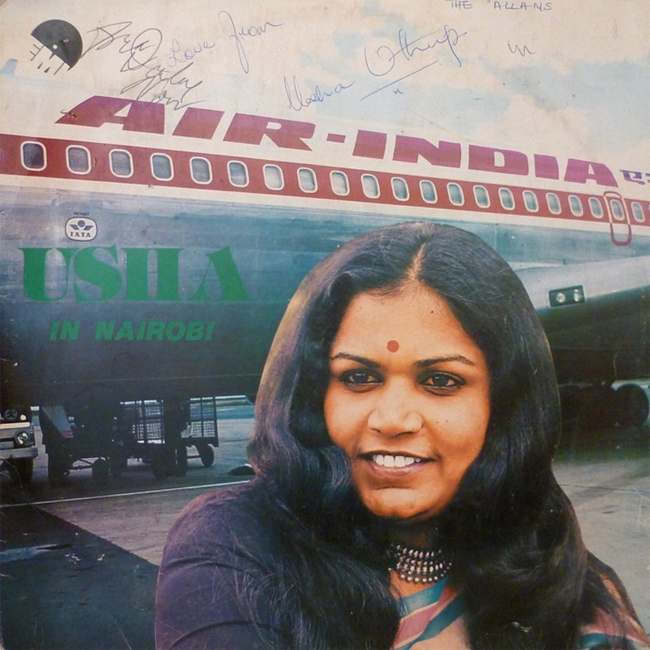
If we want to talk about some of Usha’s LP releases, an interesting record that needs to be mentioned here, is the album she recorded with producer Nabil Sansool while touring in Nairobi, Kenya in 1978. Titled Usha In Nairobi, this album is infamous and sort because of one particular killer version of Fever that Usha lays down! It a crazy good, spacey trip hop-drum n’ bass version way ahead of it’s time, and perhaps one of the best versions I have ever heard of that fine tune. The band involved is said to have gone by the name of The Fellini Five, with the line up including Fausto La Venia on drums, Pino Solitro on guitar, Massimo Sperduti on keyboards and on percussion was Fausto La Venia. The songs Malaika and Kirie Kirio, were released as a Kenya 7″ from this recording on EMI. Earlier in 1969, Usha also released an alternate version of Fever, on her jazzy Scotch And Soda LP (Odeon SMOCE 2006) along with other versions fine standards including Sunny and A Taste Of Honey. Bombay’s finest beat band, The Savages provide accompaniment on Midnight Hour and also on a cracking version of California Dreaming, while on all other tracks, The Ronnie Menezes Quartet are her support. Now don’t get confused with the other Fever track she recorded with Bappi Lahiri for the film Love In Goa a few years later in ’83.

Segwaying into some of her film scores, Usha was quite big within the Bollywood circuit, which I’m only going to briefly touch on here. This particular road started back in the early 70’s in Dehli when she sang at the Oberoi hotels. By chance, a film crew that included actor-director Shashi Kapoor, visited the nightclub, and obviously liked what they saw, because she was offered a chance to sing for an upcoming film score. As a result, her Bollywood career started with singing along side Asha Bhosle on Hare Rama Hare Krishna. Originally, she was supposed to sing Dum Maro Dum along with Lata Mangeshkar, however it seems there was some internal politics going on with others singers that didn’t allow that to happen, and as we all know the role went to Asha Bhosle (who deservedly won the 1971 Filmfare Best Female Playback Award). As mentioned on the previous R D Burman post, Usha’s incredible Listen To The Pouring Rain from the 1972 Bollywood adventure-comedy film Bombay to Goa, is classic Usha mastery!
Another big and dynamic film track from Usha is the title song for Dard Ka Rishta, named Love Is a Many-Splendored Thing. Released in 1982, and produced and directed by Sunil Dutt (and starring Smita Patil, Reena Roy and Ashok Kumar), the track is said to have been inspired by the 1955 Henry King directed film of the same title. Yet another Burman masterpiece, with killer breaks, rapid space funk keyboards and Usha leading it all with her best Shirley Bassey sass! A must have LP for all Indian soundtrack collectors!
Usha also had a platform into the disco dance scene which was sweeping the whole world at that time, although truth be told, India was a little behind by a few years. Her best for me is Auva Auva Koi Yahan Nache from Bappi Lahiri Disco Dancer masterpiece. And in true Bappi “borrowing” tradition, this time he channels The Buggles’ Video Killed the Radio Star, so wickedly! In 82, Bappi and Usha were at it again with another disco rework, this time bravely mashing up Gibson Brothers’ Que Sera Mi Vida, with dare I say it, Donna Summer’s classic, I Feel Love on the Aarman soundtrack, titled as Ramba Ho-Ho-Ho Shamba Ho-Ho-Ho. There’s a far hotter and somewhat psychedelic version of “Love” on Usha’s earlier ’78 album You Set My Heart On Fire, which you’ll get far more respect from in the dance halls. I can’t leave this disco convention without mentioning Chhupke Kaun Aya, a pretty great hair flick towards to Michael Jackson’s Don’t Stop Till You Get Enough.

Usha has performed for so many young and old adoring fans, and has sung in 13 Indian languages as well as 8 foreign languages. Her name and her distinctive big voice is attached to many famous Bollywood productions, and has also made a quite a few on screen performances. This iconic Indian star has also received numerous awards not just for her musical talents, but also for her devotion to charities and for mainly just trying to make the world a fair and better place.
Usha has continued singing unlike many of her contemporaries who have long stopped as they felt out of sync with the new age style. “I don’t like to live in the past. Nostalgia is fine”. She recently to told The Indian Express. She has given people in far flung cultures an unexpected image of an lndian woman: strong,independent, humorous, intelligent and loaded with talent. Jani and Usha who today reside in Kolkata, West Bengal, enjoy life with their daughter Anjali and son Sunny, and today Usha will occasionally appear on stage singing alongside with both her daughter and her granddaughter.
References and recommendations…
R. D. Burman – Baby, let’s dance together – Shalimar (OST)

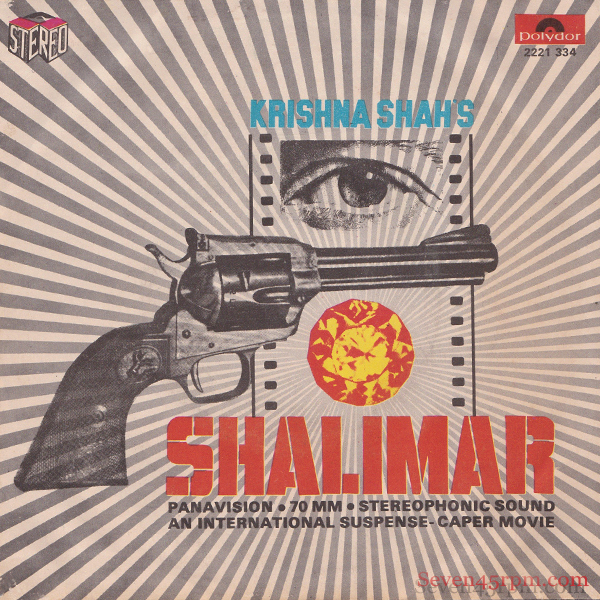 Polydor Cat# 2221 334 India 1978
Track 1- Let’s Dance Together Track 2 – Cha Cha Cha!
Rahul Dev Burman was born on June 27, 1939 in Kolkata, to the Bollywood composer/singer Sachin Dev Burman and his lyricist wife Meera Dev Burman. According to some stories, he was nicknamed Pancham da because, as a child, whenever he cried, it sounded in the fifth note (Pa), G scale, of music notation (the word Pancham means five, or fifth, in Bengali, his mother tongue). Another theory says that little Rahul received the nickname because he could cry in five different notes.
 When Burman was nine years old, he composed his first song, Aye meri topi palat ke aa, which his father used in the 1956 film Funtoosh. Sar jo tera chakraaye was included in Guru Dutt’s 1957 soundtrack for Pyaasa, and was also another father/son collaboration this time sung by Gumnaan singer Mohammed Rafi. In Mumbai, Burman learnt to play the sarod by classical musician Ali Akbar Khan and also the tabla by Samta Prasad . He also considered composer poet and a playwright, Salil Chowder as his guru. He served as an assistant to his father, and often played harmonica in his orchestras.
RD Burman’s first released film as an independent music director was Chhote Nawab (1961). Popular Bollywood comedian Mehmood was the producer and first approached Burman’s father for the music, however he had to turn down the offer, saying that he did not have any free dates available. At that very meeting, Mehmood noticed Rahul playing tabla in a back room, and signed him up as the music director for the film. Burman’s first hit movie as a film music director was Teesri Manzil (1966), which starred Shammi Kapoor, who is hailed as one of the most entertaining lead actors that Hindi cinema has ever produced, and was married to actress beauty Geeta Bali. The scored had six songs, all of which were written by Majrooh Sultanpuri, and sung by Mohammed Rafi. Four of these were duets were with his future wife and superstar Asha Bhosle (apparently they first met when she was the mother of two and he was in 10th grade having dropped out to pursue music). I advise you to search for the brilliant Hassina zulfo walli clip, where you witness some amazing set designing, which is actually quite typical in this wonderful film genre. Nasir Hussain went on to sign RD Burman and lyricist Majrooh Sultanpuri for six of his films.
 In 1971, Burman composed the music for Dev Anand’s Hare Rama Hare Krishna. Asha Bhosle won the Filmfare Best Female Playback Award for the infamous electrifying Dum Maro Dum (Take Another Toke), from this film, which was a huge hit and proved to be a seminal rock number in Hindi film music. Dev Anand did not include the complete version of Dum Maro Dum in the movie, because he was worried that the song would overshadow the film. The hit film was a star-making vehicle for the model and beauty queen, Zeenat Aman, who won over the heart’s of world audiences, in her role as the westernized hippie, Janice. [1] The film was a huge success for her, going on to win the Filmfare Best Supporting Actress Award, as well as the BFJA Award for Best Actress. She would become one of the highest paid Hindi actress between 1976-80 and appeared on every Hindi film magazine’s cover during the 1970s. Hare Rama Hare Krishna dealt with the decadence of the Hippie culture. It aimed to have an anti-drug message and also depicts some problems associated with Westernization such as divorce, and is said to be loosely based on the 1968 Richard Rush movie Psych-Out.
Bombay to Goa is a 1972 Bollywood adventure-comedy film directed by S. Ramanathan, and is actually a remake of a 1966 hit Tamil film Madras to Pondicherry. The movie is known particularly for its catchy tunes and includes Usha Iyer’s incredible Listen To The Pouring Rain which is a cool mashup of tunes such as Temptation, Fever and ends with a frenzied Be-Bop-A-Lula! In 1976, the Vijay Anand directed spy thriller, Bullet was released with yet another exciting soundtrack. This time Asha Bhosle is back providing the vocals on the trippy Peene Ke Baad Aati Hai Yaad Bhooli, again with suitable bizzaro film sets to match! Oh to be on that set when this was all happening!
 The 1978 Hollywood and Bollywood joint production film Shalimar starred Dharmendra, Shammi Kapoor, Prem Nath, Aruna Irani and once again Zeenat Aman (pictured right). Also in supporting roles in their first and only Bollywood film was, English actor Sir Rex Harrison, and American actors John Saxon and Sylvia Miles. The film was released in two versions; Hindi in India and also an English version in the US, known as Raiders of the Sacred Stone (and supposedly also as The Deadly Thief). All versions however were unsuccessful, although later gaining cult status. In this Indian crime adventure, the world’s best jewel thief invites his illustrious peers to try to steal the world’s most priceless jewel, the Shalimar ruby, from his home on a remote private island. If they fail, they will die.
The Shalimar soundtrack is packed with Burman gems! While the credibility of the film plot may be somewhat questionable, Burman’s work on the score is genuinely masterful and simply like nothing else. The Title Music has to be the number one all time opener to come from the Bollywood genre, and how I wish it was circulated on a 7”. Intense off beat jazz constructions, over operatic vocals, this masterpiece is a tip of the hat to greats like Morricone and John Barry, and I don’t say that lightly.
One of the film’s o n going musical themes, is the delightful Hum Bewafa Hargiz Na Thay, which at one time comes with a pretty extraordinary beach tribal dance scene filmed at night. And Mera Pyar Shalimar with Asha Bhosle’s dreamy vocals is pure ecstasy. Sylvia Miles who had won two Oscar nominations for Best Supporting Actress in the movies Midnight Cowboy and Farewell My Lovely, apparently snatched the role of Countess Rasmussen, from the intended Gina Lollobrigida, Italian sex symbol of the fifties and sixties. She plays a far fetched trapeze artist-master thief, who seems to have a love for doing an over excessive amount of somersaults and cart wheels that’s really ever necessary. In one scene where the countess is attempting a break in and theft of the Shalimar jewel, one of Burman’s big jazz tracks Countess’ Caper, plays over the top, doing it’s best to add drama, but really only adding even more lunacy to the moment.
 Moving on to the feature 7”, of the 2 tracks, Baby Let’s Dance Together, sung by the mysterious Kittu, is the standout for me. A laid back super chic funk oozing pure class, this song criminally only gets a brief look in during the film, as a background track to an enticing bedroom scene from Sheila Enders to S.S. Kumar, that quickly ends in an argument. Who the vocalist Kittu is, I can’t really tell you, as the only other song credit I could find from her, was for the track I Have a Crush On You from the 1980 Ek Baar Phir, film directed by Vinod Pande. The second track on offering is the quirky work out, One Two Cha Cha Cha, which actually has the responsibility of opening the film even before the aforementioned diabolical Title Music. Vocals provided by Usha Uthup, accompanied nicely with the expected Burman Moog and sitar, the opening set up brings us into a day lit seedy gambling club, with Sheila Enders approaching an eager flare filled dance floor, who she will provide a personal instructional dance routine for. What a way to open a spy thriller. That’s the way ah ha, ah ha, I like it!
Burman’s genius workings for this soundtrack did not go unnoticed, resulting with 3 Filmfare nominations…Best Music – R.D. Burman, Best Male Playback Singer – Kishore Kumar for the song Hum Bewafa Harghiz Na, and Best Female Playback Singer – Usha Uthup for One Two Cha Cha, which funnily enough ended up being won by Asha Bhosle for the Kalayanji Anandji track Yeh Mera Dil Yaar Ka Diwana from the exceptional Don score. The highly regarded LP comes in a few variants, the best in my view is the fold out cover with the intricate die-cut inserts nicely formatted with film stills. If you need to have a few important Bollywood soundtracks in your collection, this one’s on the top of the list and isn’t too difficult to find, although as with most Indian records, it pays to hold off until you can find a nice conditioned record.
 Burman would go on to release more killer soundtracks, and a handful with accompanying 7″s. Getting into some serious stuff, I want to bring up The Burning Train score. When I first heard the opening score I really struggled to believe it wasn’t a contemporary production. I love this period of Burman! Released in 1980, directed by Ravi Chopra, the film featured a huge all-star cast [2]. The plot revolves around a train named Super Express that catches fire on its inaugural run from New Delhi to Mumbai. It’s out of control, the drivers are dead, and many lives will certainly expire if somehow the burning train isn’t stopped. I’ll be a bit more elaborate on this film when the time comes (and it will) to post that particular soundtrack. But this is R.D. Burman on FIRE as the title track clearly displays, as well as the Latin flavoured Meri Nazar Hai TujhPe if you even needed more proof.
If it was one Bu rman really excelled at, it was drawing in audiences into films with exciting title tracks, and Hindi action thrillers such as the 1980 Shaan (Pride) provided the perfect platform. This film was directed by Ramesh Sippy after the super success of his previous venture, Sholay. He drew inspiration from the American Western and spaghetti western films, and took its lead from the James Bond films with fancy sets and beautiful costumes. Shaan took three years to make and it was expected to match the success of Sholay but failed to do so, however, it ran to packed houses in its re-runs and ended up making a lot of money. Eventually, it was declared to be the highest grosser of 1980 by IBOS. Once again the opening track Doston Se Pyar Kiya with the mighty Usha Uthup on vocals, is exciting and abstract, and perfectly wigged out! Thanks to Burman, the film recieved a Best Music nomination at Filmfare, this being its sole nomination. For the Bollywood Rocky film, also released in 1980, Burman gave us some killer breaks and spaced out “borrowing” with the War of the World’s inspired Aa Dekhen Jara.
In 1983, Chor Police, the directorial debut movie of Bollywood actor Amjad Khan, includes one of my all time favourite Bollywood dance numbers, Aaj Mera Dil. In yet another Bhosle-Burman classic, we have once again another killer dance sequence, this time it’s the Indian beauty Parveen Babi as Seema, drawing the audience right in with her hypnotizing moves. Audacious and daring, starting with a slow and wonderfully psychedelic intro, simple exotic moog lines are soon swooped over by spaced out guitar riffs, perfectly syncopated percussion and Asha’s “from another world” vocal lines…this is one of Burman’s best!
 Burman also made an international “non-film” album not many know about, a Latin-American-Indian monster, nowadays quite sort. Released in ‘87, Pantera was financed by his father, and as well with his friend Pete Gavankar, who wanted the aspiring musician to explore the music scene outside India. The idea at first didn’t really appeal to the reluctant Burman, for it was well known those days that producing a record usually took months in that part of the world, and he wasn’t sure he wanted to move away from his home land. In 1981, Gavankar borrowed 15 tunes from RD, who had composed them in a matter of seven days and handed the tapes to his sister Nilu, who was connected to pop groups in San Francisco. Nilu played the tunes to an upcoming musician Jose Flores who immediately liked five compositions and recorded them. Back in India, Burman heard the tracks, and it charged him up enough to go to San Francisco and record an album. It was carnival season when Pancham landed in San Fran’on June 15, 1984. The atmosphere there inspired him so much that he composed the tracks Carnival and Caminando almost immediately. One evening, they visited a disco where Burman’s and Jose’s joint collaborated In Every City was played. He recalls how all the people started dancing, and then how they all clapped at the climax. He was so moved he almost cried. All the artists on Pantera were significant musicians, and it also included vocalists from diverse backgrounds – a Japanese, a Puerto Rican and an African-American.
 Rahul Dev Burman was quite ahead of his time, and his music came with a harmony, uniqueness and an integrity. Often been credited for revolutionising Bollywood music, he successfully blended Latin sounds, cabaret, psychedelic vibes and disco and funk styles. He experimented with an array of new sounds with great execution, and developed songs that went to become massively popular with the audience. But even after 331 released movie scores, he was awarded a total of only three Filmfare Awards, one of which was awarded posthumously (for 1942: A Love Story). [3]
In 1995, Filmfare Awards constituted the Filmfare RD Burman Award for New Music Talent in his memory. Pancham da’s death in 1994, after a massive heart attack, left a void in the Indian film music industry, but even over two decades later, his lilting melodies and soulful tunes continue to inspire and influence musicians and music aficionados alike. Hindi film music is forever indebted to him.
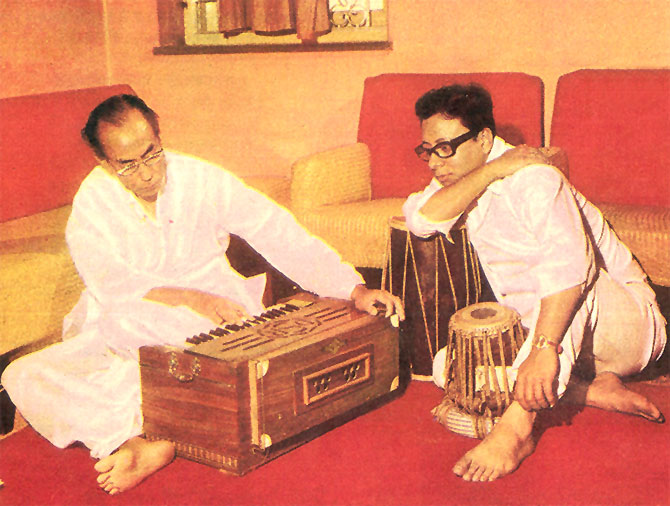
Top picture…Sachin Dev Burman with his son, Rahul Dev Burman. Image owned by Penguin India (rediff.com)
B&W picture…Hare Rama Hare Krishna Director-Actor Dev Anand with Rahul Dev Burman (thequint.com)
[1] Zeenat Aman did her schooling in Panchgani and went to University of Southern California in Los Angeles for further studies on student aid, but she could not complete her graduation. Upon her return to India, she first took up a job as a journalist for Femina and then later on moved on to modeling. One of the first few brands that she modeled for was Taj Mahal Tea in 1966. She was the second runner up in the Miss India Contest and went on to win the Miss Asia Pacific in 1970.
Dev Anand offered Zaheeda (his second heroine in Prem Pujari) the role of his sister in Hare Rama Hare Krishna. Not realizing the importance of this secondary role, Zaheeda wanted the lead female part (eventually played by Mumtaz) and she opted out. Zeenat Aman was chosen as a last-minute replacement. Her hip looks in Yaadon Ki Baaraat (1973) as the girl carrying a guitar, singing Churaliya Hai Tumne Jo Dil Ko (over Asha Bhosle’s voice) has won her more popularity and the hearts of millions of fans.
Zeenat Aman unfortunately had to deal with domestic violence in both her marriages. Sanjay Khan, her first husband, had reportedly bashed her up leaving a permanent scar on her eye, and vision problems. Her second husband Mazhar Khan also reportedly harassed the actress physically. A brave Aman dressed up as a village girl with a burnt face when she approached Raj Kapoor’s office, when he was finalising his heroine for Satyam Shivam Sundaram. He was so impressed and proud of her dedication, that he signed her right then.
[2] Dharmendra, Hema Malini, Vinod Khanna, Parveen Babi, Jeetendra, Neetu Singh, Vinod Mehra, and Danny Denzongpa.
Bappi Lahiri – Mausam Hai Gaane Ka (Gun Master G9) Surakksha O.S.T.

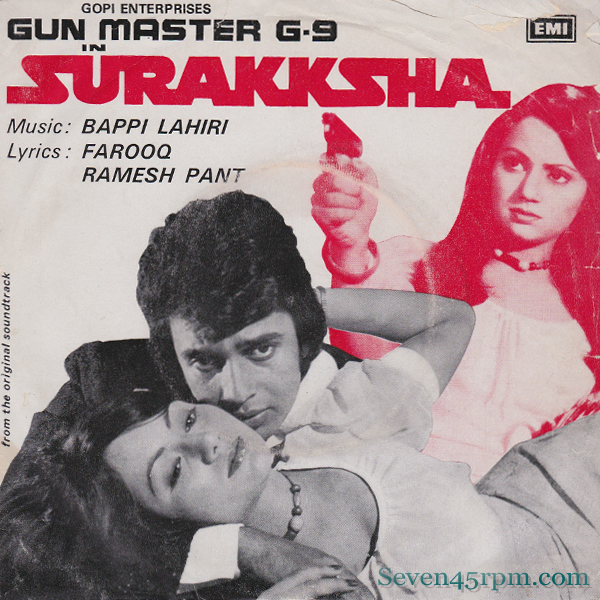 Columbia 16540 Year 1979 India
Track: Mausam Hai Gaane Ka
So I just recently returned from a short but incredible trip into country India, which I’m just refusing to let go of at the moment. The experience was one I’ll never forget because of the people I met, the things I saw, and the sounds I heard.
Somehow, in the little city known as Pushkar, a small record shop appeared, something I was not expecting to see, and a lovely man named Shashi, sat behind the counter. Now my knowledge of Indian music is very thin, especially in the Bollywood genre, which is what a lot of the shop stock consisted of. But after a few days of drop-ins, and some great recommendations from the shop keeper, I started to comprehend the realisation that there were certainly some records that needed to come back home with me! While most of my wins were marvelous, colourful outlandish soundtrack LP’s, I did also manage to bring home a few 7″s, including this one by prolific and renowned “disco king” Bappi Lahiri, that I thought I should share.
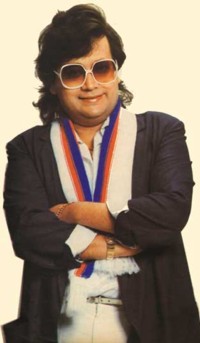 Bappi Lahiri was born in Calcutta, West Bengal in 1952 into a family with a rich tradition in classical music. His father, Aparesh Lahiri was a famous Bengali singer and his mother, Bansari Lahiri was a musician and a singer who was well-versed in classical music and Shyama Sangeet. His parents were determined to teach their only child in every aspect of music, and by the tender age of three, Bappi began to play the tabla. At the young age of 19, Bappi began his career as a music director, and received his first opportunity in a Bengali film, Daadu in 1972. The first Hindi film he composed music for was Nanha Shikari in 1973, and only 2 years later it was Tahir Husain’s Hindi film, Zakhmee that brought him to the heights of Bollywood fame, also bringing forth a new era in the Hindi film industry. Bappi rose from strength to strength, and the music for his subsequent films Chalte Chalte and Surakksha were tremendously popular, placing Bappi on the pedestal of stardom, and making him the youngest music director of his time to have attained such intense success in such a short duration.
Surakksha, which I think translates as “Protection” in Hindi, was directed by Ravikant Nagaich and released in 1979. The film stars Mithun Chakraborty as CBI Officer Gopi, Ranjeeta Kaur, Jeevan, Jagdeep, Iftekhar, and Aruna Irani. Based as a spy thriller (with the hero’s code of Gunmaster G9, as opposed to 007), it was the first of a two of such films with Chakraborty in the lead, the other being the sequel Wardat. The success of Surakksha made Chakraborty a huge commercial star.
 I have yet to watch this film in it’s entirety, so I’m just summarising the plot through other sources here. The evil Shiv Shakti Organization (SSO) intends to spread terror in India. The trouble starts when a plane manned by Captain Kapoor is attacked by a stream of deadly signals forcing the plane to land. The missing agent gets replaced by a look alike, but Officer Gopi, aka Gunmaster G-9, who was assigned by the Central Bureau of Investigation, is on to it! But there are obstacles, including Priya Varma, played by Ranjeeta Kaur, who’s out to investigate her father’s death, supposedly by Gopi, and who’s determined to seduce and enslave him. Gunmaster G-9 must also battle other women, venomous snakes, gangsters, kidnappers and even a robot-human. The fast adventures continue with wild stunts and car chases, but of course there’s always an opportunity to dance with scantily-clad girls, before there inevitable meeting with the patchy-eyed SSO chief Doctor Shiva .
 Actress Prema Narayan who plays Maggie, is quite the attractive star who has quite an established Bollywood movie career, appearing in close to seventy films. Originally an English teacher in a convent school, she later opted for a modelling career and was crowned Femina Miss India World in 1971. Besides being noticed for her acting prowess she was also appreciated for her western-style dance numbers. A fine example of those said dance moves can be witnessed during the song Tere Jaisa Pyara Koi Nahin in Hotel. She was also a regular feature in lower-grade horror films including Mangalsutra, Saat Saal Baad and Ghabrahat. Mithun Chakraborty made his acting debut with the art house drama Mrigayaa (1976), for which he won his first National Film Award for Best Actor, and to this day has appeared in more than 350 films. Most famous for his lead role as dancer Jimmy in the 1982 super-hit film Disco Dancer, he is particularly recognised as one of the best “dancing-heroes” in Bollywood with his unique “Disco and Desi” fusion-style dancing that is immensely popular among the masses. The 1981 Gunmaster sequel Wardat, was even more high action with giant locust plagues attacks (brought on by evil men who plan to black market farmer’s grains), a new hunch backed super villain called Jambola, more gadgets and even flying cars!
 The title track Mausam Hai Gaane KaAlong, includes the popular singer Annette Pinto, who would provide her voice talents on the Gunmaster sequel a few years later as well. Her dynamic voice really delivers a huge cinematic, almost Morricone-like characteristic quality to this opening titles track, and has to be the perfect introduction director Nagaich could have wished for! She went on to release many more sizzlers with other producers also, including Handsome Man from Mr. Bond in 1992 (composer-duo Anand-Milind and brother Anand Chitragupth), the hot disco Love Me Now for Hemant Bhosle and the film Barrister in 1982, and the cheeky Hello Darling with Rajesh Roshan, from the film Telephone in 1985. She also stars on the absolute incredible title track for The Burning Train from composer Rahul Dev Burman, where you feel like she’s channeling Yma Sumac! I will feature that one soon!
Surakksha also marked Bappi Lahiri’s entry as a singer, where he would provide his voice talents onto four of films compositions, including the second track on this EP, Dil Tha Akela Akela, which incredibly sounds like The Stones’ As Tears Go By! In fact throughout his career Lahiri has been accused of plagiarizing music produced by other composers without giving them any credit or royalties. I was actually surprised at first, when listening to a bunch of his records, at just how many covers he did, not realising that they were apparently original compositions. Ironically portions of his song Thoda Resham Lagta Hai were included in the song Addictive by American R&B singer Truth Hurts in 2002. Copyright holders sued Interscope Records and its parent company, Universal Music Group to the tune of more than $500 million. But lets not take any praise away from this talented producer/musican. His interpretation can sometimes be wonderful takes on well worn classics (have a listen to Meri Jaisi Mehbooba from Baadal) that can only make you squeal with delight.
 Bappi Lahiri would go on to release literally stacks and stacks of LP’s, and so far my standouts-latest discoveries include Karate, Wanted Dead or Alive, Morchha and Dance Dance…or big sounding soundtracks! Along with Biddu (who had the international breakthrough in 1974 with Kung Fu Fighting with eleven million records sold), Lahiri helped popularise disco music Indian style. The pioneer of disco beats with his refreshing, vibrant, and rhythmic music had the entire nation dancing for decades. He has also worked with renowned singers like Lata Mangeshkar and Asha Bhosle, had paved the path to fame for Alisha Chinai and Usha Uthup through his compositions, and has sung alsongside Mohammed Rafi and Kishore Kumar. In fact a barrage of popular singers have sung songs composed by Bappi Lahiri in a career spanning for 40 years in over 600 films in over 5000 songs. Bappi received an award in 1990 from the then Indian President Giani Zail Singh for the best musical score in the film Thanedaar and was invited by Ex-Prime Minister of India, H.D. Deve Gowda, to compose a song for the World Football Tournament in Calcutta.
Lahiri disappeared from the Indian film industry in the 1990s though he tried a brief comeback in the Prakash Mehra produced Dalal starring Mithun Chakraborty with the song Gutur Gutur which was a big hit although it had its share of controversies due to its suggestive lyrics. Thereafter he focused on bringing out albums with remixes of his earlier songs, and to this day appears on guest spots for popular TV shows, with the occasional film role. Lahiri is famous for his constant desire to reinvent himself and face the challenge to keep up with the rapidly changing preferences of current generations. He is the complete entertainer and superstar with his multiple talents as a singer, music director, and percussionist! I feel I have only scratched the surface of what this man has done for Bollywood music, and the damage to dance floors he is responsible for all around India.
Christy – Deep Down (Danger: Diabolik OST)


Parade PRC 5052 Italy 10 Jan 1968
TRACK : B Deep Down
For many years I’ve been a huge fan of those dark Italian cinematic soundtracks from the 60’s and 70’s, but If I had to specify a period in my life where it all started, I have to honestly say it was way back in my childhood. Growing up in the 70’s, occasionally those great spaghetti westerns were screened on the TV, if very late, on a Saturday night. And while I was most of the time permitted to sit alongside and experience these great films with my papa, I somehow doubt I would have lasted the distance at that time of night. However the dramatic opening titles definitely pulled me in, and they stuck and still are quite memorable for me today. The Good, The Bad And The Ugly was one of those films, and it so happened that my papa also owned the picture sleeve 45 (the Hugo Montenegro version) which I would play over and over.
But it wasn’t until many years later, as I was growing up and started to dig deeper into the heart and soul of music, did I start realising the great names and achievements of these composers. Nino Rota, Armando Trovajoli, Piero Umiliani, Piero Piccioni…these and many more were true masters of the genre. But there is no argument that it is Ennio Morricone who is the ruler of the castle, who stands tallest without a doubt, on that high cinematic mountain.
One of Morricone’s strongest elements of his work has to be depth and atmosphere, and in the 60’s, there was a plenty of it. Many of his compositions and film scores were immersed with very deep, haunting and many times sensual flavours. Moody female vocals would be key, and were often used as background instruments rather than lyrically. Now while this Morricone sound is famous today, and those vocals are such an important and recognisable ingredient, it’s still difficult to find out a real lot about these incredible singers, as is the case with Christy (and also Edda Dell’Orso from previous post). Luckily I have a few friends who are big fans (such as Brendan Young aka dj Diabolik) who have been able to give me a few leads to follow.

Maria Cristina Brancucci was born in Rome on April 20, 1940. In 1966 Morricone took her into the recording studio to lay down some vocal tracks for Sergio Sollima’s feature La Resa Dei Conti. It was a big spaghetti western that deserved a big opening title track, which she provided so appropriately with Run Man Run. The film falls under the subgenre called Zapata Westerns (spaghetti westerns with some political context usually concerning the Mexican revolution) and was co-written by long time Sergio Leone collaborator Sergio Donati. With Tomás Milián who plays Cuchillo and bounty hunter Jonathan Corbett, who is played by Lee Van Cleef, it is today considered as one of the best Italian Westerns ever made due to its tightly directed staged scenes and genius score. The English release, The Big Gundown, would also provide an alternate English version of “Run”, but I definitely lean more towards the more pure Italian version.

In 1967, Christy calibrated with Morricone for the spy spoof OK Connery (re-titled Operation Kid Brother for the US). The plot involves an evil criminal named Thanato, who is bent on taking over the world, using a magnetic wave generator that will cause all metal-based machinery to grind to a halt. However, the secret agent normally assigned to such tasks isn’t available, so they engage his civilian brother, Neil, who is a world class plastic surgeon, hypnotist, and lip reader, which turn out to be precisely the skills required for thwarting Thanatos. Sean Connery’s brother Neil, actually plays the role of the surgeon, and the film includes a bunch of familiar bond faces including Bernard Lee, the original M from the Bond series, and the original Moneypenny, Lois Maxwell. Former Miss Rome and Miss World 1960 runner up Daniela Bianchi, is also starring in the wild romp and she sizzles just as you would hope and expect from an Italian beauty queen!
In 1968 Christy would be called upon again for another western, Tepepa (also known as Long Live the Revolution and Blood and Guns), this time directed by Giulio Petroni. The film stars Tomas Milian as the Mexican revolutionary leader, Jesus Maria Moran a.k.a. Tepepa, and in opposing roles, Orson Welles as Colonel Cascorro, and John Steiner as Doctor Henry Price, who saves Tepepa from the firing squad in order to exact personal revenge for the death of his fiancée. Christy provides the fitting dramatic Al Messico Che Vorrei, again with Morricone at the wheel.

In the late sixties, Christy’s 7″ release Deep Down was recorded for Mario Bava’s diabolical Danger: Diabolik masterpiece. If you happen to be a fan of pop mod spy action films, then this is your movie! It’s bizarre Italian cult cinema at it’s best, and needless to say, it’s legendary with Italian genre film buffs. But even before the 1968 cinematic hero existed, the myth was well and truly alive in the form of a long running controversial pocket sized publication entitled Diabolik. It was created by former secretary, editor and model Angela Giussani, who founded the Astorina publishing house, a company that was limited to board and Western card games. Angela really studied the market and concluded that many commuters liked to read mystery novels. She imagined a magazine commuters could read during their trips, that was entertaining yet intriguing, with breathtaking action.

Inspired by Marcel Allain and Pierre Souvestre’s Fantomas, Angela and her younger sister Luciana, who had now started working with her, came up with the handsome masked criminal, who would be seen really as an anti-hero for grown-ups of both sexes. The first issue had a dark yet vibrant cover of a masked man in the background and a woman screaming in the foreground, with the subtitle “Il fumetto del brivido” (The comic book of terror). This really highlighted that the publication was aimed at an audience of grown-ups, who likely preferred noir novels, something rather unique for those times when comics were considered as light entertainment for kids. Luciana collaborated with her on the series’ stories starting from issue #13, and the exciting adventures evolved. Diabolik was soon a successful working man’s super hero which has sold more than 150 million copies since he made his first appearance.
In the Dino De Laurentiis produced feature film, John Phillip Law plays the “master sports car racer, master skin diver, master lover”, Diabolik, and the stunning Austrian Marisa Mell plays his girlfriend Eva Kant. The movie is a real trip. It’s got that great 60’s vibrant Technicolour palette, over the top action and charismatic characters, and like its De Laurentiis companion Barbarella, it’s damn sexy! (1*)

So the plot in a nut shell is. After an armored car leaves the bank with ten-million dollars, Diabolik manages to attack and steal the money, escaping with his partner. He heads back to his secret underground electronic hideout where he decides to steal the famous Aksand emerald necklace for Eva’s birthday from the Saint Just Castle. He out smarts the law, as he has done so many times before, and succeeds, but gangster Ralph Valmont finds a way to kidnap Eva and holds her up for ransom. With the ten million dollars and emerald necklace for trade, Diabolik sets off to the rescue. Eva makes her escape and Diabolik kills Valmont, but this time he is trapped and faces a shiny gold plated death. The police find Diabolik and proclaim him dead, but soon it is revealed that he has in fact faked his death through a technique taught to him by Tibetan lamas. He returns to life, however if he does not get the antidote within 12 hours, he will die. I think I’ll leave it there and keep you all hanging, so you can go out and find a copy to see how it all unfolds for the anti hero.

The film is typical of a De Laurentiis production, and while some just can’t see the beauty in this genre, tagging it as camp and cheese, I seriously love this kind of film making. For me everything works as it only could have, in that late sixties era of cinema history. And when the psychedelic spiraling open titles kick in, again we have the great Christy-Morricone collaboration with Deep Down. This time, as opposed to her previous more expressive soundtrack recordings, Christy is far more subtle with her approach. It’s actually very sensual and her vocals riding nicely up alongside the distorted whaling guitar that brands the composition. Don’t get me wrong, she stills sings with her gusto and passion, but this time it’s the whispery voice that really draws you in here. The genius of Morricone shines in this perfect collaboration. Some may find this surprising, but this Parade 1968 single featured, is the only vinyl to be officially released from this infamous underground cult film. The word on the street is that all masters and recordings of Morricone’s work for the film were destroyed in a studio fire. An “unofficial” soundtrack on Sycodelic in 2001 was released but it is believed that these recordings may have been ripped from a laser disc edition of the film, as some sound effects and dialogue are evident throughout. What you will find on this release are 3 alternate versions of Deep Down performed by Edda Dell’Orso (featured on my last post) and the incredible psychedelic Valmont’s Go Go Pad and Underwater Wah-Wa. Crazy fabulous stuff! This featured isolated Diabolik single is flipped with the unconnected Amore Amore Amore, which was produced by Piero Piccioni for Alberto Sordi’s 1967 film Un italiano in America.

Deep Down is such a great little 7″ and a bit of a shining gem in my collection, obviously because it’s an important piece of Diabolik history, but also because I just love this song so, so, so very much. It’s not too difficult to find and it plays nicely for those early cocktail sets. Deep Down was recently covered by Mike Patton on his Mondo Cane Lp, and there’s some great clips online, in particularly the live footage at the Holland Festival in Amsterdam, you may want to search. Whether fans agree if Patton gives the song it’s deserved justice or not, I don’t know, But I have to say, once those horns kick in on that live version, the hairs do rise!
In the late 60s Christy recorded more pop songs (including a great version of Quando Quando Quando) and ended up a popular Italian TV variety artist for a number of years. Today she’s now a well known voice actor, who dubbed Barbara Streisand’s voice for the Italian version of Funny Girl, and has worked on countless animated films including The Princess and the Frog, Anastasia, Bambi, Beauty and the Beast, The Three Musketeers and The Lion King 3.
(1*) The release of Barbarella and Danger: Diabolik lead to a minor trend of adaptations of comic strips that emphasized mild sado-masochism and late 1960s fetish gear. These films were followed up with Piero Vivarelli’s Satanik (1968), Bruno Corbucci’s Isabella, duchessa dei diavoli (1969) and Corrado Farina’s Baba Yaga (1973) which had a Piero Umiliani soundtrack.
Black and white photo. Angela and Luciana Giussani, the creators of the comic book Diabolik, in their studio, 27th September 1966 (photo credit unknown).
Danger: Diabolik! Trailer
Recommended reading… Anna Battista’s irenebrination
Edda Dell’Orso – Kukumbe (Le montagne della luce)
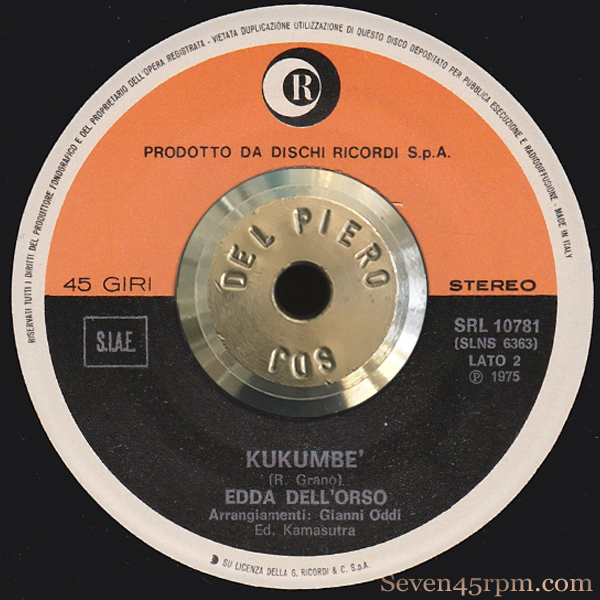
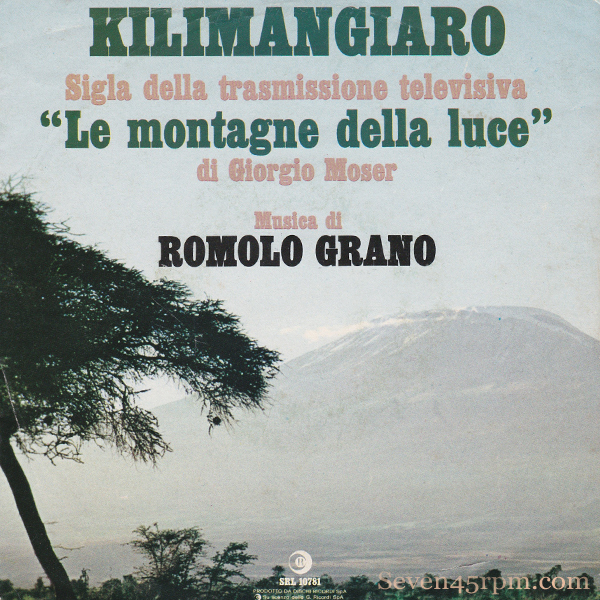
Ricordi SRL 10781 Italy 1975
Track 2 – Kukumbe (Le montagne della luce)
As that saying goes, behind every great man, there is a great lady, but there was more than one that strengthened one particular composer’s work if we’re talking about Morricone. A key element so important to his sound, Morricone would expose and you could even say, flaunt his leading ladies up front in the mix down, even if they were at the time providing background sounds or atmospheric vocals.
I’m going to parallel two posts celebrating two important women with names that are synonymous with Morricone, particularly from the 60’s and 70’s, when that era of his film scores were infamous for that beautiful sensual psychedelic and at some times haunting sound. But I also want to present other composer’s that all contributed to that now distinctive classic Italian cinematic sound if that time. This post I’ll be looking into an Edda Dell’Orsa composition she undertook for one of those other composers, and with a follow up post, I will pursue a journey into the works of Maria Cristina Brancucci, also known as Christy. As always, I wish I was able to enlighten you all with more information about Dell’Orso’s musical journey, but facts and life details are a little mysterious and not too easy to come by. However I will go through a bunch of my favourite Edda tracks and touch on some of those great composer contributions.
Edda Lucia Sabatini, was born in Genoa, Italy on February 16, 1935 and married pianist Giacomo Dell’Orso in 1958. She studied singing and piano at the National Academy of Santa Cecilia in Rome from around 1958, and in time she would possess a beautiful soprano voice with a three octave range that would stamp many now legendary composers work.

Around the mid sixties, Morricone was the first composer and conductor to use her astonishing voice for a feature film, and with immense artistry, he created unforgettable innovative vocal lines and sound effects. One of those early soundtracks was for Sergio Leone’s 1966 Il buono, il brutto, il cattivo (The Good, the Bad and the Ugly) and it includes one of the most celebrated Morricone’s themes, The Ecstasy of Gold, which is played while Tuco is frantically searching a cemetery for the grave that holds $200,000 in gold coins. This amazing piece of cinematic music has been covered from Yo Yo Ma to Metallica, but as famous as this soundtrack is today, Edda was actually was uncredited for her part. The soundtrack album was on the charts for more than a year, reaching No. 4 on the Billboard pop album chart and No. 10 on the black album chart. The main theme was also a hit for American musician Hugo Montenegro, whose rendition on the was a No. 2 Billboard pop single 2 years later in 1968.
This was an incredibly busy period for Dell’Orso recording from film to film, studio to studio. Westerns were of course very popular after the success of A Fistful Of Dollars, and the hard working Dell’Orsa kept providing the goods, including the very moving titled track C’era una volta il West (Once Upon a Time in the West) for Sergio Leone in 1968, another Morricone partnership (1*). Again in ’71, another fitting title track with the quirky Giù la testa for Leone’s Duck, You Sucker! (also known as A Fistful of Dynamite and Giù la testa), but she also worked far beyond the Italian West.

In 1967 Dell’Orso scores the opening swinging title song Seli, for the Italian science fiction film Mission Stardust (…4 …3 …2 …1 …morte), composed by Antón García Abril & Marcello Giombini. Some fans of the genre consider this offbeat film so appallingly bad that they playfully deny its very existence, however this rare soundtrack is also called a masterpiece by many jazzy lounge aficionados, which I tend to support. The next year Dell’Orsa contributes to the infamous Danger: Diabolk soundtrack, offering 3 alternate versions of Deep Down…The Shower, Eva’s Holy Dress and the tripped out, whimsical Emerald Bikini version. The title track was performed by Christy, another female legend of the Italian cinema soundtrack that Morricone liked to work with. 1969 offered up a true classic Dell’Orso-Morricone cooperative, with Metti una sera a cena for the Italian drama film of the same name, directed by Giuseppe Patroni Griffi. One of my favourites.
Dell’Orso moved into another film genre with the thriller La stagione dei sensi (Season of the Senses), bringing with her the lovely bossa styled Una Voce Allo Specchio. The title track for Giuseppe Patroni Griffi’s 1969 drama, Metti, Una Sera A Cena, is classic and rich in Dell’Orso spices, and was covered a few years later quite nicely by Milva. The 1967 chilling score for Bruno Gaburro sci-fi post-apocalyptic Ecce Homo I Sopravvissuti, which gave Morricone an alternate opportunity to get down low into the darker side of Dell’Orso’s vocal soul, and the outcome is a soundtrack which offer varied versions of Venuta dal mare throughout, that all raise the hairs. Staying on the horror theme, Dell’Orso contributed to two films by Italian shock horror director Dario Argento, the first in 1970 called L’uccello Dalle Plume di Cristallo (The Bird With Crystal Plumage), and then for Perche Si Uccidono? (Why Do They Kill Themselves), a film essay about drugs and self-destruction. For the latter 1976 film, the score was a collaboration with composer Fabio Frizzi and instrumental band Goblin (often used by Argento), under the pseudonym of Il Reale Impero Britannico.

Dell’Orso was also providing her voice for other prominent, mostly Italian composers of those times, and was also a key figure of the I Cantori Moderni choir, which was founded by Morricone’s childhood friend and composer Alessandro Alessandroni (2*)(3*). Piero Umiliani was one composer that regularly worked with Edda & I Cantori Moderni, and some of the best Dell’Orso work came from this collaboration. One of Umiliani’s most recognised tracks is Mah Na Mah Na, which he did for Svezia, Inferno E Paradiso, a 1968 pseudo-documentary about sexuality in Sweden, which ironically was later popularized by Sesame Street and The Muppet Show. Another Umiliani-Dell’Orso standout is the fuzzed up Le isole dell’ amore, for the 1970 film with the same title, which to be honest I know absolutely nothing about! Another soundtrack worth mentioning from the same year, is the impossible to find whacked out 5 Dolls for an August Moon, originally titled 5 Bambole per la Luna d’Agosto, and directed by Mario Bava (4*). Also check out the very chic Luna Di Miele, which was recorded for the documentary directed by Mino Loy and Luigi Scattini called Questo Sporco Mondo Meraviglioso, and includes whistling by Alessandro Alessandroni.
So lets now move on to the feature 7″ which was recorded for Giorgio Moser’s TV special Le Montagne Della Luce. Kilimangiaro is a beautifully produced composition with Dell’Orso’s trademark atmospheric artistry. Arranged by Gianni Oddi and composed by Romolo Grano, this track alone is well worth the effort it will take to find this rare thing. However while the titled A side was probably the selling point, it’s the magnificent B-side Kukumbe, that I think is the dynamic and most grooviest track she’s worked on. Big breaks, fender rhodes, jazzy trumpet, congas and top scat vocals by Edda, all amount up to a very sizeable and rhythmic killer production. I’ve been fortunate enough to play this on a big sound system and it was real fun! That bass drive grooves very nicely with that back beat. Now if you’re hoping that there’s a few Dell’Orso 7″s that you need to get a hold off, well in fact as far as I know there are only a few officials, one other being an earlier release from ’69 titled Sospendi Il Tempo, for the psychodrama La stagione dei sensi.

Dell’Orso would continue to record for many soundtracks and collaborate with many musicians. There was a very pertinent chemistry delivered in 1974 when Dell’Orso voice was utilized quite significantly on Italian master guitarist Bruno Battisti D’Amario’s album Samba Para Ti, which includes the beautiful spaced out Show Samba and the frantic upbeat Playa Sin Sol. The following year proceeded with a second team-up album called Granada and includes the standout upbeat latin dancer Su Delicia and a very cool version of Ipanema. In 1976 she worked alongside her hubby’s brother Gianni Dell’Orso, and laid down the sexy discotheque track Night Magic for Mondo Di Notte Oggi (directed by Gianni Proia), a soundtrack which has some nice funk moments, in particular on Soul Meeting.
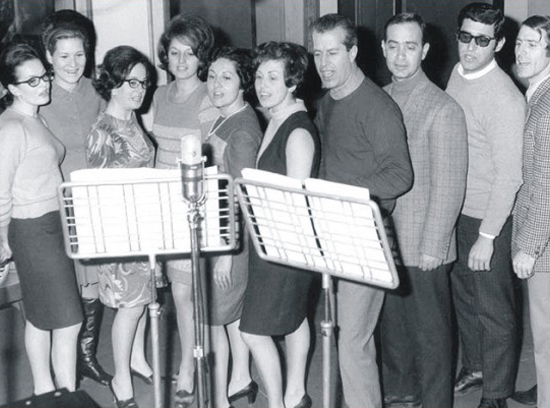
Many years later in 2011, Danger Mouse and Daniele Luppi released Rome, a soundtrack for a non-existent movie, that took five years to record. Obviously die hard fans of that era of Italian cinematic sound, the producers had their hearts set to develop the sound and process as authentic to that time as possible. The album was recorded using only vintage analogue recording equipment and musical instruments from the 1960s and 1970s. They also took the opportunity to reunite Alessandroni’s Cantori Moderni choir, who had not performed together since the early 1980s. Dell’Orso’s beautiful voice can be heard on the Theme of Rome track. The album also features vocals by Norah Jones and also Jack White who also provided the lyrics for his three songs. Even more recent, Dell’Orso was picked up by Alex Puddu, another true devotee of Italian vintage sound, to work on his 2013 album Registrazioni Al Buio, where she laid down 3 very smooth tracks (5*).
To try and cover all the composers, producers and productions Edda Dell’Orso worked with especially in the specific 60′ to 70’s period, would be a bit of a feat, and true fans will agree that I’m really only scratching the surface here. Her work is the epitome of intelligence and sophistication and she is the sound of Italian cinema, and remarkably she still continues to perform today with her strong distinctive voice. And obviously there’s a lot more we can talk about, regarding those great Italian composers that she worked with, that thankfully are now getting the praise they have always deserved. In time I’m hoping to cover a special selection of favourite cinematic Italian 7’S, but for now, stay tuned because there will be a follow up post tomorrow, celebrating another Italian female legend of the cinema soundtrack, Christy.
(1*) Edda Dell’Orso performing C’era una volta il West live in 1982.
(2*) Alessandroni was an accomplished whistler, and he can be heard quite famously on numerous Leone’s western soundtracks, and also was responsible for THAT twangy guitar riff that is central to the main theme for The Good, the Bad and the Ugly.
(3*) I Cantori Moderni, was an eight-to-sixteen person vocal group featuring Edda Dell’Orso, Giulia De Mutiis (Alessandroni’s first wife), Gianna Spagnuolo, Augusto Giardino, and Franco Cosacchi.
(4*) Mario Bava’s work from the “golden age” of Italian horror films is said to have kick-started the giallo film genre and the modern “slasher film”. He was also a special effects artist and had all director, screenwriter, and cinematographer credits for many movies including Danger: Diabolik, Planet of the Vampires, The Whip and the Body, Black Sabbath and Kill, Baby, Kill to name but a few.
(5*) Dell’Orso with Alex Puddu band captured live in Copenhaghen.
Research and referencing…
Albert Collins – Defrost – Thaw Out

 Hall Records 45-1925 US 1964, Hall-Way Records S-1795 US 1963
Track 1: Defrost 1963 Track 1: Thaw – Out 1964
Albert Collins was born on 1 October 1933, and was raised by two farming parents in Leona, Texas, approx. 100 miles north of Houston. He was introduced to the guitar at an early age through his cousin Lightnin’ Hopkins, also a Leona resident, who frequently played at family reunions. In 1938 his family relocated to the third ward district in Marquez, eventually settling in Houston in 1941, where he later attended Jack Yates High School. Collins initially took piano on lessons when he was young, but during periods when his piano tutor was unavailable, his cousin Willow Young would loan him his guitar and taught him the altered tuning (that he used throughout his career). His idol when he was a teen was Hammond B-3 organist Jimmy McGriff, but the growing teenager made the decision to concentrate on learning the guitar after hearing Boogie Chillen‘ by John Lee Hooker.
 Aged 18, Collins started his own group called the Rhythm Rockers (a seven-piece group consisting of alto, tenor, trumpet, keyboards, bass, and drums) in which he honed his craft. But Collins would still hold his jobs which around this time, included working on a ranch in Normangee, Texas for four years, followed by twelve years of driving a truck for various companies. In 1954 Collins, then aged 22 and still without a record release, was joined in by the 17-year-old Johnny Copeland who had just left the Dukes of Rhythm (a band he had started with Houston blues musician Joe “Guitar” Hughes). Collins started to play regularly in Houston, most notably at Shady’s Playhouse, where James “Widemouth” Brown (brother of Clarence “Gatemouth” Brown) and other well-known Houston blues musicians would meet for the Blue Monday jams.
By the mid 1950s he had established his reputation as a local guitarist of note and had started to appear regularly at a Fifth Ward club called Walter’s Lounge with the group Big Tiny and The Thunderbirds. The saxophonist and music teacher Henry Hayes had heard about Collins from Joe “Guitar” Hughes. After seeing him perform live, Hayes encouraged Collins to record a single for Kangaroo Records, a label he had started with his friend M. L. Young. Collins recorded his debut single The Freeze b/w Collins Shuffle, for Kangaroo Records at Gold Star Studios, Houston, in the spring of 1958, with Henry Hayes on saxophone. Shuffle is an upbeat rippin R & B groover while Freeze, in contrast, is a slow but deadly creeper with sharp plucking knife cries that Collins is so now renown for. What an incredible wax debut, and a sure definite sign of things to come from this master!
That debut 7″ really was just the begins of a long run of singles which Collins would release the next few years, for regional labels. Conflicting research is telling me that he’s big million seller Frosty (though it apparently never landed on any national chart, so it’s not easy to check that claim’s veracity), happened for him in ’62. However it looks like the release date for that one was in fact in ’64, after being recorded at Gulf Coast Recording Studio, Beaumont, Texas, for Hall Records. Owner Bill Hall, had signed Collins on the recommendation of Cowboy Jack Clement, a songwriter and producer who had engineered sessions for Jerry Lee Lewis and Johnny Cash at Sun Records. Possibly there’s an earlier pressing that I can’t find any info on?
In 1963 he recorded De-Frost, a low grinding icy cool instro that burns like cold fire. With driving percussion, keyboards and horns, it’s embodies and slowly devours the listener. From that very first guitar note, most blues lovers will pick that technique and sound, and call out “The Master of the Telecaster”. The following year in 1964 he recorded Thaw-Out, which is likely a reworking of De-frost, but this time the driving is now the ploughing! The shards are deadlier and sharper, and let me tell you that this is one for the early keen dance floor, who are eager to warm up the bones.
During this period, even more of Collins’ song titles were uniquely associated with freezing temperatures, like Tremble (1964), Sno-Cone and Dyin’ Flu (1965), Don’t Lose Your Cool and Frost Bite (1966). These singles, along with his cold, crisp guitar technique, earned Collins his nickname “The Iceman.”
 In ’65 Collins’ debut LP, The Cool Sound of Albert Collins (TCF-8002), was released by Hall. Mainly a collection of his singles with the exception of some label additions, Kool Aide (another De frost reworking?) Shiver N’ Shake the very sophisticated Icy Blue. In ’69 the Blue Thumb imprint repressed it with a new title and cover upgrade as Truckin’ with Albert Collins. Through the rest of the 1960s, Collins pursued his music with short regional tours and recordings for other small Texas labels while continuing with his work day jobs. In 1968, Canned Heat’s Bob “The Bear” Hite, had a very strong interest in the guitarist’s music, and took Collins to California, where he was immediately signed to Imperial Records. By later 1968 and 1969, the ’60s blues revival was still going on, and Collins got wider exposure opening for groups like The Allman Brothers at the Fillmore West in San Francisco, and playing the San Francisco psychedelic circuit.
Collins didn’t have a lot of success in the most part of the seventies and actually hid into retirement as a result. It was his wife that pushed him back up on his feet and just as well! In 1977 he was offered a record deal by Bruce Iglauer of Alligator records in Chicago, which led to his most successful release Ice Pickin’. It won the Best Blues Album of the Year Award from the Montreux Jazz Festival, and was nominated for a Grammy. Finally it was time for Collins to receive some of that overdue and so well deserved success. With his new signature backing band the Ice Breakers, he would release successful “cool” themed LP’s, and take home a bunch of awards. In 1987 he won his first Grammy Award for Showdown, an impressive three-way guitar duel with Johnny Copeland and the newcomer Robert Cray.
Collins’ technique, his “attack” guitar style, and his minor tunings, were incredibly influential. In the live setting he was known for his showmanship, and his stage presence was legendary, with his famous “guitar walks” into the crowd. It was not unusual for Collins to conclude his concerts with a grandiose exit from the stage by walking straight through the crowd (with the use of his legendary 150 foot guitar cord) and out the front door of the venue, to stand in the middle of the street wailing on his guitar while bringing the city traffic to a halt.
The Iceman was robbed of his best years as a blues performer, after a three-month battle with liver cancer that ended with his premature death on November 24, 1993. He was just 61 years old.
References and recommendations…
Encyclopedia of the Blues By Edward Komara
Graded on a Curve By Joseph Neff
AllMusic biography by Richard Skelly
Charlie Feathers – Can’t Hardly Stand It.

 King 4971 US Year 1956
Track 1 – Can’t Hardly Stand It Track 2 – Everybody’s Lovin’ My Baby
In the music world, earning a legendary status doesn’t necessarily stem from hits, success and riches. Such is the case with the highly influential and respected rockabilly wonder, Charles Feathers. Yet this unique talent who was there in the Sun sound booth spurring on a young Elvis, never even saw a billboard credit.
Charles Arthur Feathers was born in Slayden, Mississippi, just outside of Holly Springs, on June 12, 1932. Growing up on his parents farm, he became interested in music at a young age, singing in church and regularly tuning in to WSM’s ‘Grand Ole Opry’. The Opry was where young Charlie would find his earlier influences like Bill Monroe, but he’d was also picking up on the sounds of the Negro sharecropper’s who worked the fields in the Mississippi backwoods. One field hand in particular, Junior Kimbrough, introduced him to the acoustic guitar, providing him with valuable lessons which he eagerly absorbed.
By the age of nine, Feathers had become an adept guitarist and was beginning to develop his unique vocal style, which likely was patterned after that of his hero Bill Monroe. Honky tonk great Hank Williams’ MGM recordings of the period also impressed Charlie greatly. He could understand and appreciate the feeling in Hank’s lonesome hillbilly whine, and it soon rubbed off on him.
Charlie  left school at a very early age, after the second or third grade, likely around 1948. He struggled finding any employment, so he traveled to Cairo, Illinois to work the oil pipeline’s with his father. This work later took him to Texas where Charlie, guitar in hand, hit the honky-tonks and juke joints in his spare time, providing him with valuable experience in playing the live circuit. In 1950, 18 year old Feathers moved back to Memphis where he got hitched. He also started working for a box manufacturer until a bout with spinal meningitis left him hospitalized. While bed ridden, he listened to the radio incessantly, and would emerged from his stay with drive and determination to become a professional singer.
By 1954, Feathers was working his way into the confines of Sam Phillips’ Memphis Recording Service, with an eye toward getting something released on Sun Records. He filled in whenever and wherever he could, helping with arrangement ideas, even playing spoons on a Miller Sisters recording, Someday You Will Pay. He soon scored a very important writing credit along with engineer-steel guitarist Stan Kesler on the Elvis 7″, I Forgot to Remember to Forget. Released on August 20, 1955, this Sun 7″ is flipped with the gorgeous Junior Parker song (billed as “Little Junior’s Blue Flames” on the Nov. 1953 Sun release) Mystery Train!
 Phillips decided to start up a non-union label called Flip to test out new local artists. He paired up Feathers with country session songwriter-musicians Bill Cantrell and Quinton Claunch, and released Charlie’s first single on that label, Peepin’ Eyes, flipped with I’ve Been Deceived. Released in April 1955, the record did reasonably well on regional charts, selling approximately 2585 copies in that first month (1). An eager Phillips brought Feathers back into the studio on November 1, 1955 for a second session.
January ’56 saw the release of titles from that session, Defrost Your Heart and Wedding Gown Of White (Sun 231). Phillips had complete faith with Feather’s latest release, but obviously disappointingly surprised with the unexpected low amount of units sold (approx. 919) this time around. The lack of success was certainly a unjust mystery, as some would say the two tracks were just as strong as Charlie’s Sun predecessor. As Feather’s contract was due to expire soon, Phillips was unwilling to renew his commitment to him for a second term, as he was now devoting much of his time to Sun’s latest stars, Carl Perkins and Johnny Cash, whose flames were shining far more brightly than Feathers’.
But the artist had bigger visions. Now tired of being cast in the hillbilly mould, and eager to record rockabilly, Charlie set about reforming his band in order to cut this new sound (2). Booking studio time for January 31st, the band headed to 706 Union where they cut four proto-rockabilly styled numbers, Honky Tonk Mind, So Ashamed, Frankie And Johnny and Charlie’s own Bottle To The Baby. But the shackles tying Feathers to a hillbilly stereotype proved difficult to break and the hope to convince Phillips to extend his contract with Sun for another term, seemed hopeless. But luckily for Feathers, his talent had not passed completely unnoticed.
Les Bihari, head  of Sun’s cross-town rival Meteor Records, who had become aware of Charlie’s rockabilly intentions and unique talent, invited him to visit his studio on Chelsea Avenue to cut a demo session. Along with lead guitar player Jerry Huffman and Jody Chastain, who had switched from steel guitar to string bass, they laid down the two-sided rockers Tongue-Tied Jill and Get With It. Acetates of the two songs were sent back to Phillips who was, by all accounts, uninterested in either song but, particularly Tongue-Tied Jill, which he considered degrading to the vocally impaired. But Bihari on the other hand, showed a keen interest, and coupled both songs for release in June (Meteor 5032), both on a 10″ and a 7″ in 1956. Despite the quality of the record and the surprisingly good sales, royalty statements were poor, prompting Huffman to state “The first check was such a pittance. We told him (Bihari) what he could do with it”. Now, with no contract, the trio began to flounder. That is, until they were approached by Syd Nathan’s strong Ohio based independent label, King Records. Alerted by a Memphis based distributor for King who had heard the Meteor disc, Nathan dispatched King’s country division A&R head, Louis Innis, to the southern locale to audition Charlie and his band. An immediate contract was organised, and with the ink barely dry, a refreshed group were in King’s Cincinnati studio to cut their first session for the label on August 18. Four tracks were laid down with dirt and authority, and it is here that Charlie Feathers’ rockabilly flame burns best.
His gift was apparent from the beginnings, and his 1956 King releases were all shine from the get go! The first King release for Charlie is my standout Feather’s 45, with the flaming echo laden Everybody’s Lovin’ My Baby on the A side, and the infamous flipped out flip, Can’t Hardly Stand It (King 4971 October 1956).
Well, the sun’s gone down
And you’re uptown
And you’re just out runnin’ around
I can’t hardly stand it
You’re troublin’ me
I can’t hardly stand
It just can’t be
Well, you don’t know, a-babe I love you so
You got me all tore up, all tore up…
The lines are simple, but the infatuation is deep. Feathers sings this broken ballad while drunk on love, and I can’t help but feel, that if that little lady could only hear this howling call out on his six string, she would have him back in a smack! God I love this! Even his guitar feels sadness, like that of a loyal dog when he knows his master is feeling lost. One bass, one guitar and one bruised man, and you have an iconic Feathers classic. Again, many years later covered by The Cramps, and with that great electrifying shock wave manner that The Cramps do so well, but this song belongs to Feathers, and it’s him inside and out! From that same one day session, One Hand Loose and a reworked Bottle To The Baby (King 4997 December 1956) was released and is another two sider, filled with hot twangy stuttering goodness!
Very soon after, another four titles (3*) were cut in the studios on January 6th, 1957. Louis Innis oversaw the session and attempted to polish Charlie’s sound, by adding a vocal group fronted by Johnny Bragg. This cleaner “country pop” result I think it’s fair to say, didn’t really complement Feather’s style nor did it improve Charlie’s rockabilly reputation. In an attempt to expose Charlie to a wider audience and possibly sell more records, he was booked to play gigs with Sun label luminaries such as Warren Smith, Jerry Lee Lewis, Johnny Cash and Roy Orbison. Record sales were a defining factor to a performers success, so when Feather’s King records were still selling poorly, he was dropped from the company’s roster later that year.
 Feathers had signed a one-off deal with Charlie Kahn’s Kay label in Memphis late in ’58, and traveled to the WHBQ radio studio in Memphis to lay down four sides in December. After eighteen months away from a recording studio, Charlie’s originality had not worn away, and his fire was still well and alive, as the wild and glorious Jungle Fever proves (Kay 1001). But this searing rocker, along with the other 3 tracks recorded (4*) would not see the light the of day until June 1960. Kahn did not seem to appreciate the originality of the recordings, deciding to leave them in the can for almost two years.
Maybe it was an itch, or maybe built from frustration, but Feathers took a sharp turn off the rockabilly highway in ’59, when he teamed up with former Sun session men Bill Cantrell and Quinton Claunch, to record two folk inspired numbers Dinky John and South Of Chicago. These refreshing songs harked back to Feathers’ Bill Monroe influence and out shone the bland, typecast folk material of the day, yet Hi label boss Joe Cuoghi declined to push the recordings. Not to be easily thwarted, Charlie hawked the songs to Walter Maynard, who eventually put the record out in July 1960 on his Wal-May label under the pseudonym of Charlie Morgan.
 Feather’s would continue to release a handful more 7’s, with various willing labels. Some notables are Wild Wild Party, released in December 1961, Johnny Burnette’s Tear It Up flipped with the fab Stutterin’ Cindy, was released in ’71, and Uh Huh Honey in 1973. But by this stage of his career he was performing to ever dwindling crowds, and his priorities shifted elsewhere, like car racing and softball. As Billy Millar illustrated, “…Charlie gained such a rep around town as a top fast pitch hurler that many of his teammates were unaware of his musical exploits”. But Charlie was never far from his guitar and tape recorder. He would continue to record and perform throughout the 70’s and 80’s and even release a bunch of 7’s on his own private Feathers label, which were sold at his concerts. And in ’91 he released a self titled album, his final recording.
On August 25, 1998 Feathers suffered a stroke and was admitted to the St. Francis I.C.U in Memphis. Falling into a coma a day later, his condition deteriorated and he passed away on August 29. His passing was of course a sad loss to his family and friends, but also to his many admirers worldwide.While he may never have achieved the chart success that he well deserved, his legacy is concrete and will continue to spread tomorrow and the days after.
“Rockabilly is different. Nothin’ can touch it, man; and it don’t take a big band to do it…a lead man and a good acoustic rhythm and a big slap bass. Can’t beat it, man!” Feathers was a true die hard believer of the “religion” til the last day.
1* Shortly after the Flip disc was launched onto the market, Phillips was forced to re-release the record on Sun proper (Sun 503), as he was threatened with legal action from one Ed Wells (owner of the Flip label) over improper use of label name.
2* With steel guitarist Jody Chastain brought into the fold, and very likely Jerry Huffman as the guitarist and one Shorty Torrance as string bassist.
3* Too Much Alike, When You Come Around, When You Decide and Nobody’s Woman.
4* Why Don’t You, and Jody Chastain’s release My My with instrumental flip Jody’s Beat (Kay 1001).
Referencing…
Rockabilly The Twang Heard ‘Round the World – Robert Gordon
Tip Top Daddy – Charlie Feathers, His Life and his Music by Shane Hughes
Jerry Lott “The Phantom” – Love Me

 Dot Cat# 16026 USA Year 1960
Jerry Lott a.k.a. Marty Lott, was born 30 January 1938, near Mobile, Alabama, and grew up in rural Leaksville, Mississippi near the Alabama border. As a kid he played country music on the school stage, which progressed to playing at Paynas Furniture Store in Lucedale, Mississippi. Jerry started entering and winning local performing contests, which led to touring, a familiar pattern to so many other artists on this blog.
But in 1956 when Elvis Presley came along, Lott’s eyes were pried opened, and his soul was charged with rock and roll. Country music was now the yesterday sound.
 But Lott had written a simple yet sweet country love song, Whisper Your Love, which he says he spent a good 3 months putting it together. In the summer of ’58, Lott’s manager Johnny Blackburn, rented some studio time over at Gulf Coast Studios in Mobile, Alabama. Lott told Derek Glenister of New Commotion magazine in 1980, that someone had asked “What you gonna put on the flipside?”. Such was the naivete and innocence of the times, Lott had honestly never even thought about it. So he and the band shot form the hip on the B side! “Someone suggested I wrote something like Elvis ’cause he was just a little on the wane and everybody was beginning to turn against rock ‘n’ roll. They said, ‘See if you spark rock ‘n’ roll a little bit.’ It wasn’t any problem at all, and I wrote Love Me in about ten minutes”.
Lott continues with his story…”Me and Johnny Blackburn worked the controls in the studio, as we didn’t want it to sound like a commercial record, that was for sure. I put all the fire and fury I could utter into. I was satisfied with the first take, but everybody said, ‘let’s try it one more time’. I didn’t yell on the first take, but I yelled on the second, and blew one of the controls off the wall. I’m telling ya, it was wild. The drummer lost one of his sticks, the piano player screamed and knocked his stool over, the guitar player’s glasses were hanging sideways over his eyes, he looked like he was hypnotized”.
The result is a lusty explosion of animalistic energy, and if it had been 20 years later, you’d call hard punk! A monster was born on that day in ’58, and to this day, it still hasn’t lost any of that almighty fury! Clocking in at around 1.30 min., it’s a fast roller coaster ride through to the depths of rock ‘n roll hell, and it feels even with the frantic energy that Lott releases here, he is struggling to keep up with the manic “full steam ahead” drive the rest of the band are pushing out. But back then, wild got you nowhere without a record deal in your hands. Manager Blackburn sat on the tapes for more than a year, unable to clench any label interest.
 Lott, known at this time as The Gulf Coast Fireball, left Mobile for Los Angeles to shop his master tape around. Then one day, on a truly bizarre impulse, he trailed pop crooner Pat Boone to church one Sunday morning and convinced him to give the tape a listen. It sounds like Boone had now been converted or had some kind of other spiritual awakening soon after. It was Boone’s idea to rename Lott The Phantom, and even agreeing to issue the record on his own Cooga Mooga label (an euphemism for God, as in Great Cooga Mooga). Eventually Lott signed a contract with Boone’s management but the single Love Me b/w Whisper Your Love was released on the label Boone recorded for, Dot Records in 1960 (apparently Lott never even met anyone at Dot). It was also released with a nifty picture sleeve, which normally was reserved only for the really big stars, and which I still have to get my hands by the way.
The song Love Me was appropriately covered by The Cramps in the late 70’s and released on both the Drug Train 7″ in ’80, and on the Bad Music For Bad People Lp in 84. The raucous romp is so very suited for Lux and Co., as can be seen in early footage from June of 1978, when they played at the California State Mental Hospital in Napa, CA.
But the deserved success story never really amounted for Lott, and in fact life instead, would soon drag him down into a darker chapter. Sadly in 1965, Jerry’s wife took her own life, and shortly thereafter, in 1966, while still attempting to tour, The Phantom was involved in a near fatal auto accident in York, South Carolina. After his car tumbled 600 feet down a mountainside he was left paralyzed below the neck. Lott continued to write songs, but he never recorded again.
But you know what…plenty of “rockers” since, have been signed and have had deals, have hit the big stages and have recorded hundreds of hours of material, yet the majority, if not all of those songs, would crumble in fear if they came up against the wild young reckless animal that is Love Me! Jerry Lott passed away on September 4th, 1983 at the age of 45.
Jerry Lott (The Phantom) – Vocals
Frank Holmes – Electric Guitar
Pete McCord – Bass Guitar
H.H. Brooks – Drums
Bill Yates – Piano
Referencing and interests…
Rockabilly – The Twang Heard ‘Round The World – published 2011, Voyageur Press.
Wanda Jackson – Fujiyama Mama

 Capitol 7P -73 JAPAN – Year 1958
Well for this post it was actually not too difficult to find some strong reference and facts (which is a nice change), for this featured artist who is the dazzling Wanda Jackson. The difficulty this time was instead, trying to chose which 7″ to feature, as she has just so many that thrill me! I’ve decided to go with the glorious Japanese picture covered dancer Fujiyama Mama.
 Wanda Lavonne Jackson was born on October 20, 1937, to Tom Robert Jackson and Nellie Vera Jackson, in Maud, a small town on the outskirts of Oklahoma City. Her father, who himself was a country singer, moved the family to Bakersfield, California in 1941, in hopes of a better life, by escaping the poverty created by the Dust Bowl during the Great Depression. He was also a guitar player and a fiddle player, but in a time of deep and sad depressing surrounds, once little baby Wanda came along, he couldn’t continue with his music.
Wanda’s father noticed that his little young Wanda showed an interest in music, so he bought his only child that first musical instrument. Wanda recalls to Craig Morrison in the book Rockabilly The Twang Heard ‘Round The World, “When I was about six, he bought me a little guitar – it had the Uncle Sam hat on it because it was wartime. He put it in my hands and eventually I could reach around and he started teaching me chords”. He gave her lessons, taught her plenty of Jimmie Rodgers songs, and encouraged her to play piano, and in addition, he took her to see such acts as Tex Williams, Spade Cooley, and Bob Wills, which left a lasting impression on her impressionable young mind.
Tom moved the family back to Oklahoma City when his daughter was 12 years old. In 1952, she won a local talent contest and was given the prize of her very own 15 minute daily show on KLPR. The program soon after extended her spot to 30 minutes, which lasted throughout Jackson’s high school years. It was through this radio exposure that Jackson was discovered by country star Hank Thompson, who invited her to sing with his band, the Brazos Valley Boys. She began performing with them on weekends.
In 1954, she recorde d the single You Can’t Have My Love, a duet with bandleader Billy Gray, which hit No. 8 on the country charts. Thompson tried to get her signed with Capitol Records, but Ken Nelson, a company producer, said “Girls don’t sell records,” so Jackson signed with Decca instead, recording a good batch of singles for the label between 1954 to 1956.
Jackson insisted on finishing high school before hitting the road, and when she did, her father became her road manager and traveled by her side. While her mother stayed back and continued to work, somehow on top of that, she found time to make and help design Wanda’s stage outfits. “I was the first one to put some glamour in the country music…fringe dresses, high heels, long earrings,” Jackson said of these outfits. When she first toured in 1955 and 1956, she was placed on the Ozark Jubilee tour that featured many up and coming acts including Elvis Presley. The two hit it off almost immediately and actually dated for a brief time. Jackson said it was Presley, along with her father, who influenced and encouraged her to sing rockabilly.
In 1956, Jackson finally signed with Capitol, and one of her first 45’s has one of my favourite rockabilly B-sides Hot Dog! That Made Him Mad. It’s a cracker! The next year Jackson cut the rockabilly hit Fujiyama Mama, penned by Earl Burrows. Jackson told country music expert Rich Kienzle that she first became aware of the inflammatory tune when she heard R&B artist Annisteen Allen‘s 1954 version playing on a juke box when she was still in school in 1955. Jackson recalls that she “just flipped over it.” Burrows’ lyrics demonstrate that the bombings in Japan a decade earlier, were still viewed as being an impressive display of American might, without any consideration given to the moral implications of the devastating destruction which was unleashed onto the enemy. It is only now that I’m featuring this song (this Japan pressing comes with the lyrics…if you’re lucky) and as I read the lines, do I wonder how this song could have been taken so lightly, and how would it go down today. Sensitivity versus tongue in cheek. In the end, it’s really just a damn good dance floor country stomper, with some very fiery vocals, sexy attitude and flammable one liners.
 I’ve been to Nagasaki, Hiroshima too!
The things I did to them baby, I can do to you!
I drink a quart of sake, smoke dynamite!
I chase it with tobbacy and then shoot out the lights!
Well you can talk about me, say that I’m mean!
I’ll blow your head off baby with nitroglycerine!
Well you can say I’m crazy, so deaf and dumb!
But I can cause destruction just like the atom bomb!
‘Cause I’m a Fujiyama Mama
And I’m just about to blow my top!
Fujiyama-yama, Fujiyama!
And when I start erupting,
Ain’t nobody gonna make me stop!
Ironically, the song was a major hit in Japan and Jackson was treated like a dignitary when she toured there briefly in 1959. There are a few other versions of Fujiyama Mama that are totally enjoyable, one in particular released just after Allen’s version in 1955, by the very cutesy Eileen Barton, that has absolutely nothing wrong with it at all! For a punkish version, check Pearl Harbour‘s spin from 1981, and for something quite cheeky and off beat, go to Petty Booka‘s take, released in 1996, which sadly isn’t available on a 7″.
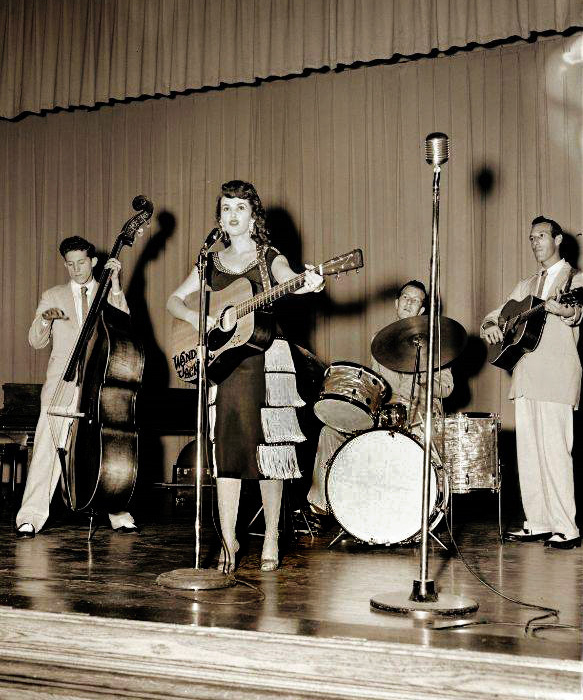 Jackson’s relationship with Capitol lasted until the early ’70s and in that time she released some “must have” 7 inches. Hot ones that I would suggest you add to your collection (as if you don’t already have them) are… the 1961 release Funnel of Love, B side to Jackson’s major country-pop single Right Or Wrong, the remarkable and favourite popcorn number Whirlpool from 1962, and the Elvis cover Hard Headed Woman which you can find on a french and Aussie 45 if you dig deep enough (likely pressed 1961). Another popular cut would be Let’s Have a Party, yet another Elvis cut, which was a U.S. Top 40 pop hit for her in 1960, after which she began calling her band the Party Timers. There’s also the fiery, violent My Big Iron Skillet from ’69, which humorously (perhaps) threatened death or assault for cheating on a spouse, made her a top 20 hit!
Jackson’s popularity bounced back and forth between country and rockabilly; she did this by often putting one song in each style on either side of a single. This is certainly the case with the flip of Fujiyama, which has the slow country ditty No Wedding Bells For Joe. As rockabilly declined in popularity in the mid-1960s, she moved to a successful career in mainstream country music with a string of hits between 1966 and 1973, including Tears Will Be the Chaser for Your Wine, A Woman Lives for Love and Fancy Satin Pillows.
 Wanda was a big attraction in Las Vegas from the mid ’50’s into the ’70s, and toured regularly, and in fact still does. She married IBM supervisor Wendell Goodman in 1961, and instead of quitting the business, as many women singers had done at the time, Goodman, like a good man, instead gave up his job in order to manage his wife’s career. Jackson followed Kitty Wells‘ lead as only the second country female vocalist to have her own syndicated television show, Music Village, from 1967 to ’68.
Obviously I’ve only touched here, on the talent and the star quality that is Wanda Jackson. Don’t be surprised if she turns up here again with another smokin’ 7″, cause as I said, she was packin’ them!
In 2009, Wanda Lavonne Jackson was inducted into the Rock and Roll Hall of Fame.
References and interests…
Rockabilly – The Twang Heard ‘Round The World – published 2011, Voyageur Press.
Maki Asakawa – Chicchana Toki Kara
Express Compact ETP-4277 Japan 1970

 Track 1 – B2 Chiccana Toki Kara
Track 2 – A1 Yoru Ga Aketara
Maki Asakawa was a born in Ishikawa Prefecture, January 27, 1942. After graduating high school she worked as a civil servant for a short time before moving to Tokyo to pursue a far more inspirational career in music. She started by playing at United States military bases and cabarets, where she refined her style, which she says was largely influenced by Blues queens such as Billie Holiday and Mahalia Jackson.
 In 1967 Asakawa made her debut recording, releasing Tokyo Banka with B side Amen Jiro on Victor. In 1968, Asakawa got her big break when she appeared for three days running at the Shinjuku underground theater known as Sasoriza, a project of underground playwright Shuji Terayama. She soon signed with Toshiba, and by the next year had released the very, VERY cool and slick Yo ga aketara (At the Break of Dawn) and Kamome (Gull) on Toshiba’s subsidiary Express label.
1970 saw this featured Asakawa release, which has as the B2 track, Chicchana Toki Kara. This wonderful, yet not easy to find EP, has to be my favourite from Maki, with it’s big beat drive, high energy horns and cinematic production. Every time I play this I get comments as to how hasn’t Tarantino used this track for one of his movies. It’s 70’s sex, has a good amount of sting, and would be the ideal punch for a strong femme fatale introduction. And having the slow swinging Yo Ga Aketara as the opening track makes this 7″ a real delight (that distant train at the end…I mean really, what a way to see out such a cool track). Just the thought of seeing this performed in a dark underground club of Tokyo by Maki and that time just does my head in. The smoke, the black, the neons and the distant traffic outside…not too difficult to visualize. But this wasn’t just a time for Asakawa’s musical exploration.
In 1971, Asakawa made her big screen debut when she played the stairway prostitute in Shuji Terayama’s experimental Throw Away Your Books, Rally in the Streets. It was the first film for poet-playwright Terayama, and it was about an angst-ridden teen who hits the streets after dealing with his dysfunctional family. This hard to find movie has a strong underground following due to it’s non-linear Avant-Garde vision and amazing pre-punk psychedelic soundtrack. Asakawa’s recording of Nemuru No ga kowai is included amongst the tracks, and can also be found on her 1971 Maki II album, which by the way also include covers of Gin House Blues and The House Of The Rising Sun. That great LP also happens to include the incredible psychedelic Govinda (there should be a link below)…such a stand out Asakawa composition! The next year in ’72, Asakawa would release Blue Spirit Blues, and again here her voice somehow feels so right within the warm minor chords.
 In 1973 Asakawa would this time hit the small screen on the dark Japanese TV Series Kyôfu Gekijô Umbalance. From what I can put together, she appeared in season 1 episode 7, and I’m almost certain the link below is the clip from that episode, where she plays herself singing Yo Ga Aketara, on a cinema screen in a dark seedy theater, and with the dark seedy characters to match.
 Over the next 30 or so years, Asakawa recorded quite a lot of records, but it wasn’t all dark moody blues and folk jazz. I discovered the Catnap album through a favourite blog, Interstellar Medium – Foriegn Lavish Sounds, which you should hit up, for a far more detailed look into the great album. Released in 1982, it’s a colourful, bold yet smooth collision of electronic jazz funk post punk plus, and for myself, it was so exciting to discover this side of Asakawa. The opening track Kurai Me Wo Shita Joyuu and also Shinkyoku B are real high lights, if I was forced to choose. This album holds up to quite high to today’s very standard standards in my opinion.
As Maki Asakwa grew older, she never stopped performing live. Just before an appearance on January 15-17, 2010 where she had a concert in Nagoya, she died of heart failure before the show could go on. She was 67.
References and inspirations…
eden ahbez – Tobago / The Old Boat
 Del-Fi Records 4131 US Year 1960
Track 1 – Tobago
Track 2 – The Old Boat
Ever feeling like going away…far, far away? Sometimes the best trips are only as far as your record player. I have wanted share eden ahbez for some time on this blog, but the man was mysterious, you could even say mythical. Meaning there’s just not a lot out there to be found on this ahbez’s life.
Thankfully Brian Chidester’s elaborate Eden’s Island blog unveils a bit about the man, although after going through it all, you still want to know more. I’m so thankful that there are people out there spending the time documenting their knowledge and experiences with these disappearing artists. With some other news articles and such, here’s a brief summary of what I could put together, on eden ahbez and in particular, the story that leads to this 7″.
George Alexander Aberle was born, along with his twin sister Editha, on 15 April 1908, in Brooklyn, New York, to a Jewish father and a Scottish-English mother. Born in the depression, orphaned along with 12 other siblings, he spent his early years in the Brooklyn Hebrew Orphan Asylum of New York. He was then adopted, in 1917, by a family in Chanute, Kansas, and raised under the name George Mc Grew. During the 1930s, he lived in Kansas, where he performed as a pianist and dance band leader. But he didn’t stay long. He never stayed at any place for very long. He figured he didn’t fit into any prefabricated niches of society. He read books on Far Eastern cultures and philosophies and adopted the concept of a universal God. Then he was at home in the world. He hopped freight trains and waked across the country many times, and absorbed the echos of life around him. It’s probable he lived in New York City for some time, although little is known of that period of his life.
ahbez ventured to Hollywood, because he heard that’s where you go if you have a song…
Around 1940, Aberle arrived in Los Angeles and began washing dishes and playing live piano at the Eutropheon, a small health food store and raw food restaurant on Laurel Canyon Boulevard. The cafe was owned by John and Vera Richter, German immigrants who followed a Naturmensch and Lebensreform (1.) philosophy influenced by the Wandervogel (2.) movement in Germany. John Richter gave lectures throughout the Greater Los Angeles area during the 1940s, and some of the employees at the Eutropheon were young Americans who’d adopted his transcendentalist philosophy.
 These followers, known as “Nature Boys” and who included Robert “Gypsy Boots” Bootzin, wore long hair and beards and ate only raw fruits and vegetables, a lifestyle that would be influential on the hippie movement that was to come, in California. During this period, Aberle adopted the name eden ahbez, choosing to spell his name with lower-case letters, claiming that only the words God and Infinity were worthy of capitalization. He is also said to have desired the A and Z (alpha and omega), the beginning and the end, in his surname, but he was known to friends simply as ahbe. During this period, he wore long unkempt hair, a bronze beard and a flowing white toga with leather sandals. ahbez would soon met Anna Jacobson, who became his wife and the mother of his only child, Zoma.
Nature Boy – In 1947, ahbez approached Nat King Cole’s manager backstage at the Lincoln Theater in Los Angeles and handed him the music for a song he wrote (some say it was he’s valet that passed on the piece of sheet music to Nat). That song was Nature Boy, and Cole began playing the song for live audiences to much acclaim, but he needed to track down its author before releasing his recording of it. Legend has it, that he, along with his wife, were discovered living under the first L of the famous Hollywood sign. He would became the focus of a media frenzy when Cole’s version of ahbez’s composition shot to No. 1 on the Billboard charts and remained there for eight consecutive weeks during the summer of 1948. Just for the record, Capitol Records sat on the recording for about a year, then finally put out the track as a B-side to Lost April.
 ahbez was covered simultaneously in Life, Time, and Newsweek magazines. Frank Sinatra and Sarah Vaughan later released versions of the song. ahbez also faced legal action from Yiddish musical composer, Herman Yablokoff, who claimed that the melody to Nature Boy came from one of his songs, Shvayg mayn harts (Be Still My Heart). ahbez claimed to have “heard the tune in the mist of the California mountains.” There’s also reports that ahbez told the press that he’d heard the melody in the solitude of a cave, a notion he reiterated throughout his life. However, legal proceedings resulted in a payment to Yablokoff of $25,000 in an out-of-court settlement. (3.)
Soon after Nature Boy hit the top of the charts, R.K.O. Pictures optioned the rights to turn the song into a feature-length movie script, which likely melded into the late 1948 film, Boy with the Green Hair, a bizarre war time tale directed by Joseph Losey, starring Dean Stockwell. The picture featured Nature Boy throughout, and ahbez’s name was amongst the first in the opening credit roll.
 ahbez continued to supply Cole with songs, including Land of Love (Come My Love and Live with Me), which was also covered by Doris Day and The Ink Spots, but unfortunately, none of these versions brought in any real success. For a brief period, some of the biggest jazz and pop artists of the day took an interest in working with ahbez, and recorded his songs for major American record labels. In 1950, ahbez’s own Nature Boy Orchestra released End of Desire b/w California, the latter was also recorded by Hoagy Carmichael, re-titled Sacramento, about a vagabond traveling the California coast by freight train. End of Desire was recorded by April Stevens & also Jack Powers, backed by another ahbez original, Guitar Totin’ Cowboy. ahbez would also collaborate with Wayne Shanklin during the 1950s, and together they came up with Hey Jacque, released in 1954 by Eartha Kitt. B-side to Kitt’s holiday hit, This Year’s Santa Baby, thousands of homes unknowingly had another ahbez ballad on their hands if they’d only turned the record over. ahbez also worked closely with jazz musician Herb Jeffries, and in ’54, the pair collaborated on an album, The Singing Prophet, which included the only recording of ahbez’s four-part Nature Boy Suite.
Throughout the ’50s ahbez continued recording with prominent black artists, including Sam Cooke, whose 1958 Lonely Island would be the second and final ahbez composition to hit the Top 40. Gene Chandler also recorded an almost identical version of that very song, that same year. In 1958 ahbez produced a doo-wop version of Nature Boy by R&B vocal group the Shields, featuring Jesse Belvin. R&B singer George “Biggie” McFadden recorded ahbez’s The Lesson of Love for Jackpot Records in 1958 too. In an interview with the Associated Press from June ’58, ahbez called Lesson his true follow-up to Nature Boy, insisting that he was also writing a “rock ‘n’ roll spiritual.”
 In US mainstream, the strong tiki culture had introduced “exotica” music, a crossover between smooth jazz and Latin swing, with haunting melodies rooted in folklore sounds from different parts of the world. Often there were sound effects that would create an almost spooky jungle or dreamy island beach atmosphere, and even today it’s so easy to be completely taken away while listening to some of the Martin Denny and Arthur Lyman masterpieces of that time. ahbez’s first foray into the instrumental genre came in 1956, with three compositions he wrote for Bob Romeo & his Jungle Sextet’s Aphro-Desia LP. The tracks were Lisbon Street Dance, Zen and Sahara. The album jacket was graced by Anita Ekberg wearing a gypsy costume, and the cover also warned that the primitive rhythms therein could arouse uncommon emotions for the unaccustomed listener. Bob Romeo met ahbez’s Middle Eastern chord structures with proto-exotica percussion and abstract flute tones, with guidance from West Coast cool jazz giant Laurindo Almeida on guitar.
Eden’s Island – It was in 1960 when ahbez finally took an opportunity to record his full length solo album, Eden’s Island (Del-Fi Records). He had spoken of a “spiritual song cycle” as far back as 1958 in an interview with the Associated Press, and often performed bongo, flute and poetry gigs at L.A. beatnik coffee-houses such as the Insomniac Café (Hermosa Beach) and the Gas House (Venice Beach). ahbez approaches the field of exotica music from a different point of view, creating an epic concept album about an utopian society living in peace and harmony on an island far away from the modern western world as we know it. He would also utilize unusual combinations of instruments (flutes, bongos, vibes) and sound effects like creaking boats to conjure up the aural equivalent of a tropical breeze, but unlike Denny or Lyman, ahbez often added his own spoken poetry, speaking of coves, paradise, and other idyllic subjects. Eden’s Island seemed to be the grandiose summation of ahbez’s philosophic idealism.
 The 7″ released from this album actually has a twist with the A side, in that it is an instrumental version of the opening and title track of the LP. I personally find this version, title Tobago on the 45, more pleasing. It’s pure escapism with it’s wind through the trees and the faraway birds. It’s not too difficult to picture ahbez’s figure standing distant on an far island hill, but close enough to make out his robe and hair slowly blowing through the salty wind, as he plays his wooden flute…and this weaving and undulating melody. On the B side is The Boat Song, as it is laid down on the LP. Again here, the listener is transported, however this time, the journey is further away, deep into the far ocean, but it still carries with a lovely rhythmic sway. Perfect track to listen to after a long night out DJ’ing or dancing, when you’ve just come home and you’re feeling completely wrecked! Chances are you’ll be completely lost into a peaceful state of sleepful bliss by the time the track is done…and it’s likely 8 hours later you’ll wake up to the crackling needle wearing down on the turntable.
Very grateful to have a 7″ release from the unique Eden’s Island album, especially with these two tracks. And while the whole LP is a journey that probably should be taken continuously from beginning to end, Full Moon, Banana Boy, and the prophetic La Mar all a big thumbs up from me. But was the world ready to take a trip out to Eden’s Island in 1960? Well, according the record’s producer Bob Keane, the album sold less than 500 copies. Adding another reason why it’s now a quite sort after record for a lot of exotica collectors. After this album, ahbez’s appearance on vinyl became thin.
During the ’60s, he did release a handful of singles on various labels. Surfer John (flipped with John John), is an amusing and snappy shot of surf-exotica by Nature Boy & Friends (Bertram International Records) that tells a brief tale of a surfer who wasn’t afraid of taking on the largest of waves, well until until one fatal day that is. The kooky Yes, Master (b/w Jungle Bungalow), by Don Carson & the Casuals (Bertram International Records) is also witty and includes sound disciplinary clapping that sounds more like spanking to me. In 1960, there was also quite an illustrious operatic version of Nature Boy (b/w Lonely King of Rock and Roll) by Don Reed & “The Voice Of Love” Lorelei, that is truly wondrous (A&R Records). The novelty tune titled Mr. K by John Bean (Reprise Records) from 1963, with burps and all, makes you wonder can it get any more bizarre?
Anna Ahbez died in 1964, at the young age of 35, from cancer. Footage of her funeral shows family members and friends looking on as ahbez sits crossed-legged by Anna’s gravestone, playing a gong, and reciting some unknown words (the footage being silent). Zoma Ahbez died of a drug overdose in 1969, having been found seated in a lotus position. Some have claimed foul play was involved.
From 1970 onward, ahbez himself released very little. After Elvis Presley’s death in August 1977, ahbez’s old songwriting partner, P. Sterling Radcliffe (aka Don Sterling, aka Don Reed), re-recorded The Lonely King of Rock ‘n’ Roll, a tune the pair had written and released in 1960, as a new single on Via Records; Radcliffe left ahbez off the credits.
Anbez passed away on March 4, 1995 due to injuries incurred from an auto accident. At the time of his death, ahbez had been working on a book and album titled The Scriptures of the Golden Age. The overnight smash, Nature Boy, is best remembered for its universal benediction, “The greatest thing you’ll ever learn is just to love and be loved in return.” It has since been covered by literally thousands of artists, including Miles Davis, Grace Slick, and David Bowie. Congressman Bill Aswad recited the lyrics before the Vermont House of Representatives at the passing of his state’s same-sex marriage bill in ’09.
1. Lebensreform (“life reform”) was a social movement in late 19th-century and early 20th-century Germany and Switzerland that propagated a back-to-nature lifestyle, emphasizing among others healthy raw organic foods, nudism, sexual liberation, alternative medicine, and religious reform and at the same time abstention from alcohol, tobacco, drugs, and vaccines
2. Wandervogel is the name adopted by a popular movement of German youth groups from 1896 onward. The name can be translated as rambling, hiking, or wandering bird, and the ethos is to shake off the restrictions of society and get back to nature and freedom. Soon the groups split and there originated ever more organisations, which still all called themselves Wandervogel, but were organisationally independent.
3. To that end it is worth noting that the first two measures of the song’s melody also parallel the melody of the second movement in Antonín Dvořák’s Piano Quintet No. 2 in A, Op. 81 (1887). It is unknown if ahbez and/or Yablokoff were familiar with Dvořák’s piece, or if they arrived at the same melodic idea independently.
Again I have to mention how useful Brian Chidester’s elaborate Eden’s Island website was for this post. Please do visit it for a far more in-depth reading on abhez and the life around him. Also referencing…
Tarheel Slim – Number 9 Train / Wildcat Tamer

 Fury Records Cat# 1016 US Year 1959
Track 1 – Number 9 Train
Track 2 – Wildcat Tamer
Alden Bunn, aka Allen Bunn, Tarheel Slim, was born in the country side outside of Rocky Mount, North Carolina in 1924, and grew up working in the tobacco fields and listening to his mom’s Blind Boy Fuller 78’s. Eventually he learned to play guitar, and by around 20, was singing and playing in church right by Thurman Ruth, the leader of a local gospel quartet called the Selah Jubilee Singers. But before we ride on the Number 9 Train, there was quite a journey that “Slim” lead, with other groups and ventures, that we should know about.
THE JUBILATORS – THE LARKS
The story of The Larks begins sometime around 1927, when singer Thermon Ruth founded the Selah Jubilee Singers in Brooklyn, New York. Later in the 40’s, The Selah’s based themselves in North Carolina where they had a radio show…a daily program of jubilee music that aired over WPTF in Raleigh. In 1945, Ruth tried to persuade Eugene Mumford (from The Four Interns) to join the Selah Jubilee Singers, but before he could do so, Mumford was falsely charged and convicted with quite an ugly crime (1*). His incarceration would put his life on an unpleasant hold.
Allen Bunn who had joined The Southern Harmonaires in 1945, soon joined Thermon Ruth in the Selah Jubilee Singers as the group’s guitarist and second lead singer. The group recorded for Decca from 1939 to ’44, with their most well remembered recording I Want Jesus To Walk Around. Three years later, Ruth and Bunn decided to break away to form a new group, The Jubilators. They linked up with Mumford, now released from prison, and with three members of The Southern Harmonaires, David McNeil, Hadie Rowe Jr., and Raymond “Pee Wee” Barnes.
Thermon hired two teachers to get them into shape according to his standards, and for a few months they were taught how to sing together and also got a few lessons on stage presence. The Jubilators then competed against other gospel and jubilee groups in the state, even winning a 50 pound cake in a contest with the Selah Jubilee Singers!
Finally, the Jubilators decided it was time to get on record. So all six of them piled into Bunn’s car and drove up to New York. They stayed with some of Ruth’s relatives on 143rd Street in Harlem and for about a week they rehearsed constantly. Then, on October 5, 1950, they were ready, and they set out for what was possibly the most amazing day of recording in history. In one single day, they recorded 17 songs for four different labels, under four different names (2*). Apollo owner Bess Berman recognised the realm of possibilities, and signed them to a contract which allowed the other companies to release the other recordings, but wanted to promote them as an expansive R&B group rather than a gospel group. So the Jubilators faded into history (at least for several years), and “The Five Larks” emerged (even though there were still six of them). Thermon Ruth deliberately selected the name to fit in with the Ravens and Orioles, as a “bird group.”
 The Larks were then booked on their first tour, and drove down to Washington, D.C., when they lost Hadie Rowe to the army (after receiving his draft notice, he was no longer able to continue on with the group…this probably is the reason why the “5” was dropped from the group’s name). In December 1950, they had their first session for Apollo, featuring Mumford on lead vocals. The session produced two masters, Coffee, Cigarettes And Tears and a cover of My Heart Cries For You (3*), but in the end, the recording didn’t even hint at the greatness inherent in the group. But on January 18, 1951, they returned to the studios to cut a couple of new tracks, which would prove far more successful and are really now Larks “classics”. With Gene on the lead once again, they laid down It’s Breaking My Heart (a pretty ballad that Apollo chose never to issue), When I Leave These Prison Walls, and Hopefully Yours. The latter two songs had been written by Gene when he was in jail and show a certain hope for the future.
On February 14, 1951, they got national exposure by singing Lucy Brown on the Perry Como TV show, a Norfolk Jazz Quartet original, which was recorded in 1938 and known as Suntan Baby Brown. Their take is a much more upbeat snappier version, and it’s dynamite! While Thermon would sing lead on the recorded version, it’s Gene out in front on the Como show. Please I beg you, look it up on you tube…Allen Bunn plays the guitar, but rarely opens his mouth to sing. If you’re into 78’s, try and get Lucy Brown as it has the great I Ain’t Fattening Frogs For Snakes on the flip.
Finally chart success would come later in 1951, with the bluesy Eyesight To The Blind, with Bunn on lead vocals and guitar… it made # 5 on the R&B charts. This was followed up by another R&B top ten hit Little Side Car, a reworking of Smokey Hogg’s Too Many Drivers, and again with Bunn on lead vocals. This is one sweet 45 and has the drifting Hey, Little Girl on the flip.
Another standout track that has to be mentioned is Shadrack written by Robert MacGimsey in 1938. While Louis Prima, Louis Armstrong and even The Wanderers all do amazing versions of this biblical classic, The Lark’s jiving version is so super! Again live footage out there with Allen Bunn singing lead! This period was the height of The Larks’ popularity, however, Bunn decided this was also the right time to go out own his own.
Going Solo – His first solo sessions were for Apollo in ’51 where he recorded two sessions that produced four singles, and were issued under the name Allen Bunn (accompanied by Sonny Terry and Brownie McGhee). Amongst the recordings were The Guy With The .45, Wine, Discouraged, Baby I´m Going to Throw You Out and the very down and dirty Two Time Loser. He was still touring with The Larks when he cut his first session for Bobby Robinson Red Robin label. One of these tracks is the amazing Too Much Competition (reissued in ’73), which stands mighty and tall, and you could call it the big brother to Betty James’ I’m a Little Mixed Up (it really makes me wonder sometimes, if that is in fact Bunn on that killer Betty James track).
 The Lovers – Around 1955, Bunn married his sweetheart Lee Sanford, who were intertwined with deep love and affection for one another, but they also shared a strong musical chemistry. “Little Ann” and Bunn sang and recorded together, first as The Lovers, for Lamp, Aladdin’s subsidiary in 1957. Together the tight partnership would go on to release a string of 45’s for other labels including Fire, Fury and Port. They’d also have name variations on some releases, and while Bunn was now pretty much going by the name “Tarheel Slim”, his writing credits were mainly represented as Bunn. The earlier Lovers tracks were slow dancers and appropriately very cutesy love songs. Once they ditched the “Lovers” tag, I feel it was then, that they got a bit more “down with it” so to speak. Can’t Stay Away and the charming dancer Security, proved they both could let their hair down some and get a bit shakey. The heart wrenching 1959 It’s Too Late, is a stunning blues ballad with a broken hearted poor little Ann weeping hysterically… literally (this song would get a reworking as Two Time Loser a few years later, only this time it’s Slim who breaks down). I Submit To You is also high on recommendation.
Bunn also released a couple of 45’s with a group called The Wheels whom he evidently managed. Let’s Have A Ball was on Premium in 1956 and the upbeat Clap Your Hands was released on Folly in 1959.
Tarheel Slim – So now to the real reason why we’re here reading all this. While “Slim” made his official entrance in 1958 with his wife Little Ann, it was the next year when he would release his solo and most desired red hot screamin’ 45 on Fury. The A side Wildcat Tamer is a perfect rhythm and blues dancer. Nice and raw and perfectly tempo-ed. But despite the track name, it’s more of a tempting entree of what’s to come steaming your way when you journey to the flipside. And the monster that awaits is named Number 9 Train. Tarheel’s vocals and rhythm here is sharp and classic blues rocker material. But there’s another element going on here underneath, that’s adding even more to the fire, and the name of that wild spark is Wild Jimmy Spruill. Although session guitarist Spruill is best known as a sideman (4*), he was a wild and sought after guitar player. His sound was unconventional, notable for its hard attack and sense of freedom, unexpectedly going from assertive lead parts to rhythmically dynamic, scratching rhythms. At no time did Spruill use picks or any effects on his guitar – his sound was solely the result of his fingers. You can hear more of his impeccable finger work on his solo recordings, notably Hard Grind from ’59, The Rooster and Cut and Dried from ’64 and I believe he also played on Tarheel Slim’s Security. Together these two cats mix up a storm, and make both sides of this 45 hard to pass. Train really does come to life when it’s up loud on a worthy amplifier…and preferably with a dance floor close by!
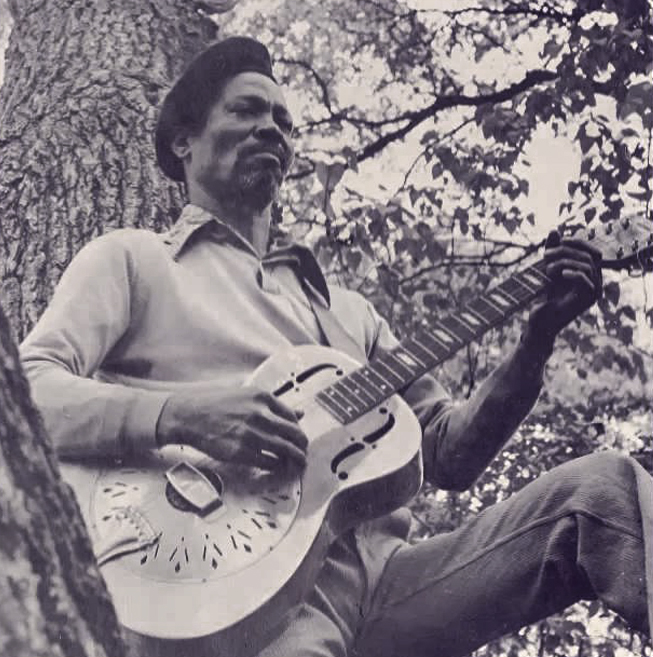 Unfortunately Taheel Slim and Little Ann’s career seemed to fade away around the early 60’s and nothing was heard from them until the early 70’s when blues researcher Peter Lowery dug up Tarheel Slim to play a few gigs where he performed with an acoustic guitar in the style of “folk blues”. Slim played a few festivals in 1974 and was well received, and even got back into the studio and would release a couple albums for Pete Lowry’s Trix label, which harked back to Bunn’s Carolina blues heritage. The 1972 single release No Time At All is a beautiful melon collie finger picking instrumental which I believe was his last 45. These later sessions would prove his last. In 1977 he was diagnosed with throat cancer and died from pneumonia brought on by the chemotherapy.
Side Notes…
(1*) On July 1945, Mumford had been arrested and jailed by the army Military Police who were rousting people looking for marijuana. They turned him over to civilian authorities, whom he satisfied of his innocence. But just as he was leaving police headquarters, a white woman pointed him out as a recogniseable criminal. Subsequently re-arrested, he was charged with attempted rape, housebreaking, and assault. The case took a year to come to trial and, in spite of an alibi, he was found guilty, a conviction that was upheld in the subsequent appeal. Sent to prison, Mumford spent two and a half years on a prison work gang. Finally, enough evidence came to light that he was granted a full pardon from the governor of North Carolina. (This was treated as a miracle; a black man in the 1940s South being pardoned after having been accused by a white woman.) On June 1949, after having served 29 months in jail, Gene Mumford was a free man. For a more detailed account of his sentence, click onto Marv Goldberg’s in-depth Larks entry below.
(2*) Initially, billing themselves as the Selah Jubilee Singers, they recorded four gospel songs for Jubilee Records, before moving on to record as The Jubilators for Regal Records in New Jersey. Then they drove to Newark, recording four secular blues songs, including Lemon Squeezer, as The 4 Barons for Savoy Records. Finally, they drove back to Apollo Records in Manhattan, where, as The Southern Harmonaires, they recorded four more gospel tracks. For a more detailed account of this day, click onto Marv Goldberg’s in-depth Larks entry below.
(3*) My Heart Cries For You was a hit for Guy Mitchell, Dinah Shore and Vic Damone.
(4*) Other notable Wild Jimmy Spruill moments are The Happy Organ by Dave “Baby” Cortez, Wilbert Harrison’s Kansas City, and Bobby Lewis’s no.1 hit Tossin’ and Turnin, which by the way, Peter Criss from KISS covered on his solo album! Also check out Dale Hawkins version of Number 9 Train!
Referencing and recommendations…
The Larks photo from top left clockwise…Allen Bunn, Gene Mumford, Raymond Barnes, Thermon Ruth and David McNeil
Santo & Johnny – Slave Girl (EP)

 PARLOPHONE GEP 8806 UK – Year 1960 PARLOPHONE GEPO 70009 AUS – Year 1960
Slave Girl (Side 2 Track 2)
While this is a far lesser known track from the Farina brothers, this exotic sultry instro has to be my fav from this talented duo! And to find it on a 45, means I can now take it with me everywhere I go.
Farina brothers, Santo Anthony & John Steven, were born in Brooklyn, New York, just 4 years apart. Santo, the elder, was born October 24, 1937 and then Johnny followed, April 30, 1941. The boys were young when their Dad was drafted into the army and stationed in Oklahoma. One evening on the radio, he heard this beautiful accent while listening to country and western…it was the sound of the steel guitar. He wrote home to his wife and said “I’d like the boys to learn to play this instrument”. When he returned from the war they searched out for a man who could get them started with the steel. The boys, I imagine, probably jumped for the opportunity. What kid doesn’t want to play a guitar of sorts?
But althou gh their dad was super keen to have the boys learn that very particular style that carried those unyielding memories, and although he was successful in finding a lap steel guitar somewhere in a music store in Brooklyn, there was no certainty that the right teacher who had the specific skills would materialize. After a few failed attempts from baffled music school tutors, who just lacked the know-how to master the “sound”, their frustrated dad searched himself and eventually found an authentic Hawaiian musician with the skills. The brothers finally had a teacher with the expertise, and thanks to some Italian food coaxing, he would tutor the boys at their own home. After about 5 months, the teacher headed back to Hawaii, and the brothers never saw him again, but he had left behind enough of his teachings for Santo and Johnny to now take flight…and spread their wings they did.
When Johnny reached the age of twelve, he began to play accompaniment to Santo on a standard electric guitar (his big brother helped him learn to play). Their supportive father had bought them a Webcor tape recorder, and encourage them to write their own material and record everything. The brothers eventually formed a duo and became rather popular in school, soon started performing at church dances, weddings, clubs and other events in the New York boroughs. The Farina brothers began to gather fans from Brooklyn to Long Island.
In 1958, Mike Dee & The Mello Tones (Santo Farina on steel guitar; Johnny Farina on electric guitar and with their uncle Mike Dee on drums) recorded a self-penned instrumental which they called Deep Sleep. Loosely inspired by the song Softly, As In The Morning Sunrise (Sigmund Romberg, 1929), it had the same chord progression but a simpler melody line. Deep Sleep would in time become Sleep Walk.
 The determined younger brother, Johnny, made the rounds of the New York record companies searching for a publishing deal, with a couple of their recorded demos in hand. His persistence and determination paid off and they got lucky with Canadian American Records, who signed them to a song writer’s contract. Although grateful I’m sure, it was a recording deal which is what they were really chasing, and soon enough the opportunity was granted to them. Their first release in 1959 was consummated, and it was called Sleep Walk. And did it do well? Umm…yes it did! It was recorded at Trinity Records in Manhattan and entered Billboard’s ‘Top 40’ on August 17, 1959. The moody eerie composition rose to the No.1 position on the American charts, for two weeks in September, and remained in the ‘Top 40’ list until November 9. There’s a great live version from ’59 on the Saturday Night Beech-Nut Show, on youtube I recommend you looking for.
Santo and Johnny actually wrote lyrics to Sleepwalk, and after the instrumental was a hit song, Betsy Brye (real name is Bette Anne Steele) released a beautiful “lynchesque” vocal version as a single in 1959 (Canadian American Records 106), which did not chart on the Hot 100, but damn I like it! At first it was believed that the composition was written at 2.am early one morning, when one brother woke the other with an idea. But a recent interview with Johnny reveals that it was a long and constant progression of revisited ideas that finally got them the hit.
 The follow-up song “Tear Drop” was also a hit, though their self titled LP released that same year, was less successful in the United States. But that takes nothing away from the lp, which was arranged and conducted by Bob Davie, who had been the guiding hand to all of Santo and Johnny’s musical activities. It included some fabulous interpretations of well known ditties such as Caravan, Raunchy, Dream, and there’s even a take on Chuck Berry’s School Days. And you have to hear the wildly hypnotic version of Summertime. But the standout for me at least, has to be the self penned Slave Girl, and it wasn’t that long ago that I made the discovery of it in the form of a mono UK 7″ EP. There’s just something so exciting about this wonderful piece of exotica. It’s slinky (yeah I know I like using that term), sensual, so rhythmic, and it’s quite transporting, but unfortunately it’s also just too short! It’s a fine early night spinner, to get the right kinda’ cool in the air. This ep also includes a gorgeous version of Blue Moon which makes it even more desirable. Also funnily enough, I recently found an Aussie copy with an alternate picture sleeve, in a local record shop bargain bin.
With their unmistakable sound, they appeared on all the top music shows, “The Alan Freed Show”, “Dick Clarks’ American Bandstand”, “The Perry Como Show” etc. etc. Their fame spread to other countries and they got booked on tours in Australia, Mexico and Europe. After the less successful debut album, they issued five more albums for Canadian-American, before the company dissolved in 1965. But Santo & Johnny continued to record and release a great amount of Lp’s and 45’s with other various labels including Imperial, Ricordi and Produttori Associati, the Italian label founded in 1969 by Antonio Casetta. The albums were ethereal, relaxed, sometimes swinging, and variously themed (James Bond, Hawaiian songs, country music, rock and roll hits, etc.), but were more popular internationally than at home.
In 1964, they released an album of Beatles covers including And I Love Her, which hit #1 in Mexico and held the spot for 21 weeks (they received The Golden Kangaroo Award for it). In 1973, Santo & Johnny recorded Nino Rota’s The Godfather theme which went to #1 in Italy and stayed at that spot for 26 weeks which broke all records in Italy (there certainly feels like some Jean-Jacques Perrey channeling going on in that one). They received a “Gold Record” in Italy and were inducted into the Italian Music Hall of Fame.
 Santo and Johnny’s distinctive sound influenced a generation of not just guitarists, but all kinds of musicians. “Sleep Walk’s in everybody’s DNA,” says Farina. “John Lennon said he was inspired by Sleep Walk, and that’s why he wrote Free As A Bird. George Harrison released a song called Marwa Blues inspired by Santo and Johnny”.
1999 was a great year for Sleep Walk, it earned BMI’s Millionaires Award symbolizing 2 million airplays on the radio. Also that year, Brian Setzer’s version earned him a Grammy Award for best instrumental of 1999. Because of constant radio airplay and numerous TV show and commercial plays, Sleep Walk continues to be one of the most popular and quickly recognized instrumentals of the 20th century. It was also used throughout the 1992 Stephen King movie, Sleepwalkers.
In 2002 Santo & Johnny were inducted into the International Steel Guitar Hall of Fame. Hanging proudly on his wall, Johnny has 2 Gold Records, one for Sleep Walk and on for The Godfather.
Santo retired from music in the early 70s, but Johnny continues to perform, now taking on the lap-steel role, and still finds time to record new material with his own band. He is also the president of Aniraf, Inc., an international record company based in New York, and currently operates the official Santo And Johnny website.
Sylvia Mayer En The Southsea Hawaiians – Ulili-e-hula

Carinia Company 45-EPR-3038 Sydney Australia 1956
With a special Hawaiian theme coming up at Night Train this week, I thought what a great opportunity to post this wonderful exotic, twangy delight, that really, I know not that much about. And to tell you the truth, I don’t even own this! This copy belongs to a good friend of mine (hey Bibs!), who has let me look after it for some time…bless his soul. I remember that first night he played it in the background to a lovely summer night with great friends in the mountains. No one seemed to take much notice, however I turned around and looked at him with big (probably drunken) eyes of wonderment.
I had to find out more about this dreamy wave that was drifting me away.
There’s a few, I guess, odd things about this release. Firstly it’s an Aussie pressing, on an obscure local Sydney label called Carina Company. Can’t find a release date *, and when I looked through what I could find of the label’s back catalogue, I found a confusing collusion of ethnic all sorts. There’s cha chas and rumbas, national choirs and German hit parades, but also, what I found very strange amongst it all, is one Hendrix release (No Such Animal-1971). Looks like the label was on the circuit from 1957 to 1975, so not too sure why I can’t seem to source more info on it. The back cover tells me the manufacturer was set up in the Daking House, Rawson Place, Sydney.
The second odd thing about this release is the artist Sylvia Mayer, turns out to be Dutch. My researching (goggling) has lead me to Steel Guitarist extraordinaire, Edward (Ekualo) Mayer, who it seems Sylvia was married to. Currently he is established in South Florida and has a group named KAHANU ALA, and is apparently responsible for a majority of the background Steel-Sounds of Sponge Bob…although uncredited. Would love to confirm if it is he who is playing on these tracks, and who are these other “South Sea Hawaiians”? And did Sylvia record anything else other than these 4 tracks that appear here on this ep entitled Zuidzee-Dromen (meaning South Sea Dreams)?
Whether these musicians are authentic Hawaiians means little to me, as I love the sound that have here (I’m certain Edward was originally from the South Pacific). Ulili-e-hula I’m guessing (which I’m doing a lot of on his post) is a traditional song, as I’m finding a few lovely versions out there. I discovered two beautiful versions by Israe Kamakawiwo’ole, where I also was able to find English translation to at least his version.
The voice of the sandpiper is soft and sweet
Little bird who lives by the sea
Ever watchful on the beaches
Where the sea is calm
The sandpiper
The sandpiper returns
Sandpiper runs along the beach
Where the sea is peaceful and calm
The voice of the ‘ulili is soft and sweet
How are you, stranger? Very well
You grace our land
Where the sea is always calm
The sandpiper
The sandpiper returns
Sandpiper runs along the beach
Where the sea is peaceful and calm
I hope you also can feel the glow of this track. A lovely tune to play early in the set, while the cocktails are slowly getting stirred, and as the breeze is cooling.
*UPDATE! Looks like a release date from 1956 according to rateyourmusic.com/artist/sylvia_mayer
Thanks ianhartnett for this info!

Joe Meek / Tom Jones – Chills & Fever

Tower Cat# 190 US – Year 1966
Joe (Meek) Versus The Volcano!
I have to say, Chills And Fever is one of my favourite R&B songs of all time. It’s had a handful of great and worthy interpretations, from reputable artists including Jet Harris, Allen Wayne and of course the unsurpassed Ron Dunbar. But being the Meek Geek that I am, it’s this delectable elusive cut that intrigues me the most, and in which I chosen to share.
But first…a bit about this Mr. Jones.
Thomas J ohn Woodward was born in Pontypridd in Glamorgan, South Wales, on 7 June 1940. His parents were Thomas Woodward, a coal miner, & Freda Jones.
Tom began singing at a very early age, and wasn’t really into sports or even school. But he was a kid who would receive far more fulfillment when singing at family gatherings, weddings and in his school choir. At 12 he was diagnosed with tuberculosis, causing him to spend 2 years in bed recovering. While he does describe it as the worst time of his life, it did give him the opportunity to do nothing other than sing and draw. In his teens he was becoming something of a tearaway, missing school, drinking and chasing girls.
By the late 1950s Tom had become entranced by the new rock ‘n’ roll sounds coming from the radio, and was big on the sound of American soul music, with early influences including blues and R&B singers Little Richard, Solomon Burke, Jackie Wilson and Brook Benton, as well as Elvis Presley, whom Jones idolised and would later become good friends with.
 Tommy Scott and the Senators – In March 1957, Tom married his high school catholic girlfriend, Melinda Trenchard, when they were expecting a child together, both aged 16. The couple’s son, Mark, was born in the month following their wedding. To support his young family, Tom took a job working in a glove factory and was later employed in construction. His big full-throated, robust baritone voice first became apparent when he became the frontman for Tommy Scott and the Senators, a Welsh beat group, in 1963. The band’s leader Vernon Hopkins, lured Tom away from his usual drinking spot after Tommy Redman (their current singer) failed to show up one night. Hopkins persuaded him to perform with the Senators at the local YMCA (with the help of a crate of beer). It was only meant to be a one-off, but Tom was bitten by the bug.
 They soon gained a local following and reputation in South Wales. In 1964 the group recorded several solo tracks with producer Joe Meek, who took them to various labels, but they had little success. Later that year Decca producer Peter Sullivan saw The Senators performing in a club and directed them to manager Phil Solomon, but the partnership was short-lived.
The group continued to play gigs at dance halls and working men’s clubs in South Wales, and one night, at the Top Hat in Cwmtillery (which only just burnt down a couple of years ago), Tom was spotted by London-based manager, Gordon Mills. He became Tom’s manager and took the young singer to London, and renamed him Tom Jones, to exploit the popularity of the Academy Award winning 1963 film.
Joe Meek
Now I’m only going to touch on the genius that is Joe Meek here. This complicated yet marvelous man definitely deserves a much more in depth write up, and I can assure you that this will not be the only Meek production I will cover here on Seven45. This pioneering record producer and songwriter, is most likely known for the that Tornados instrumental Telstar, (which became the first record by a British group to reach No.1 in the “Billboard Hot 100” in 1962), but his life story is truly fascinating, be it too short. A wiz kid with electronics, Meek had a unique sense of adventure when it came to music production.
 Meek was born on April 5, 1929, at 1 Market Square, Newent, Gloucestershire. His early upbringing was rather bizarre, as apparently, the first four years of his life, he was raised as a girl thanks to his mother’s intense desire to have a daughter. As a child, Meek had performed theater plays of his own making with the neighbour’s children, and whenever possible, he himself would play the princess. Of course his classmates bantered him about that, as well as his brothers did. More than likely, this is perhaps why Meek more and more, backed out into his own isolated fantasy world.
He acquired an adventurous passion for performance art and sound experimentation, from a very early age, filling his parents garden shed with begged and borrowed electronic components, building circuits and what is believed to be the region’s first working television. By the age of ten he had built a crystal radio set, a microphone, and a tube amplifier.
At age 14, he expanded his rig, working dance parties as a mobile DJ. And at 16 he acted as a musical supervisor, providing sound effects for local theater groups, that he had recorded on a homemade tape machine. (He built a disc cutter when he was 24 and used it to cut his first record – a sound-effects library).
When he grew up, he did a stint doing his National service in the Royal Air Force as a technician, which only escalated his lifelong interest in electronics and outer space. From 1953 he worked for the Midlands Electricity Board. He used the resources of the company to develop his interest in electronic music production, including acquiring a disc cutter and producing his first record.
Meek In London…
Meek first arrived in London in 1954 after landing a job as a sound engineer for Stones; a popular radio and record shop on Edgware Road. After spending time working at Stones, Meek progressed to a new job, becoming a producer at Lansdowne Recording Studios, moments away from his home on Arundel Gardens in Notting Hill.
 At Lansdowne, Meek proved to be quite the maverick, frequently ignoring his superiors in order to pursue his quest to develop new sound techniques. He maintained a strictly guarded “secret box of sounds”…a container kept under lock and key which held all manner of unusual objects for creating unorthodox audio effects. Confident in his new role, he wrote a letter home to his mother stating, “I’m sure your son is going to be famous one day, Mum.”
But before long, Meek became tired of working within a large organisation and decided to go it alone as an independent record producer and established his own label, RGM Records (Joe’s full birth name actually being Robert George Meek).
 Between 1961 and 1967, the accommodation above 304 Holloway Road was rented out by Meek, where he set about creating a makeshift but innovative studio. Back then, such a move was revolutionary, as it was a time when pop records were the domain of big corporations, tightly controlled by cigar-puffing businessmen. The sound engineers who worked for these companies did so in strict, clinical environments, armed with clipboards and donned in white lab coats.
Joe Meek’s way of working was the complete opposite to the traditional methods. From the stairway to the bathroom, all rooms were made available for recording sessions. Joe would also use seemingly every day domestic items to create all manner of new sounds, the flat itself more or less becoming an instrument in its own right. He was particularly fond of stamping on the upper floors to enhance drumming effects.
As his experiments developed, Joe Meek’s work took on an eerie, futuristic sound; one which he hoped would define an era as the space-age began to grip the 1960s.
The first major hit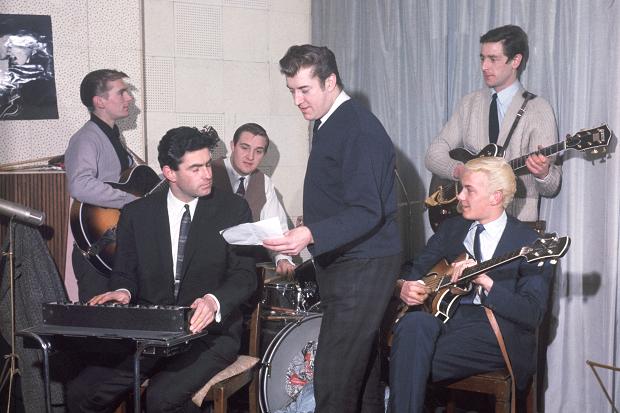 to be produced at Holloway Road was John Leyton’s Johnny Remember Me, a song about a young man haunted by his dead lover. The single reached UK number one in July 1961. But that success was followed by an even bigger hit in August 1962, with Telstar, an instrumental track created to celebrate the success of the radical new communications satellite which had been launched in July 1962. Played by Meek’s (other) backing group, The Tornados, the ode to space technology featured all manner of sci-fi sounds which had been concocted in the unlikely setting of the north London studio. The record was an instant success. It became the first record by a British group to reach No.1 in the Billboard Hot 100 in the United States, which was a massive achievement!
Telstar’s popularity should have set Meek up financially for life. However, a French composer by the name of Jean Ledrut claimed that the tune was pinched from a score he’d written for the Napoleonic film, Austerlitz. This led to a lengthy legal battle which prevented Joe Meek and the Tornados receiving any royalties from their hit.
In 1963, Meek had himself another band to record, a bunch of fairly unknowns who went by the name Tommy Scott & the Senators. They recorded seven tracks with Meek, who then used Ritchie Blackmore (and The Outlaws) to enhance some of those RGM recordings which were done in a single day session. Meek took them to various labels in an attempt to get a record deal, with no success.
 But soon Jones, who had had a name change and a fresh signing to Decca, would score that worldwide hit with It’s Not Unusual in 1965, and shot to mega stardom. With this sudden popularity, Meek, who had always refused to release his “Jones” recordings, now decided to cash in and sold the tapes to Tower (USA) and Columbia (UK)…releasing Little Lonely One – That’s What We’ll All Do. This was all done much to the singer’s annoyance. Jones -“We really pinned our hopes on that recording session. Meek said it was going to be released but we never heard anymore…I want to disassociate myself from it”. Meek released another single in October, Lonely Joe – I Was a Fool, then finally Chills And Fever – Baby I’m In Love.
Chills And Fever fever!
The first and original release of Chills and Fever was on the Detroit label Startime (Cat# 45-5001), who credited the track to Johnny Love and his Orchestra. But when it was picked up for national distribution by Dot Records (a label that licensed a huge array of records including some of my most treasured gems) Johnny was changed to Ronnie Love…and it signaled the beginning of one man’s incredible career in music.
Turns out the man behind the record was neither the earlier personas, but instead one Ron Dunbar. A man of talents who ended up becoming one of the most prolific writers in Detroit this side of Holland-Dozier-Holland, and his name appears on a mind-boggling assortment of writing credits, including Patches, Give Me Just a Little More Time and Band Of Gold. Ron also had a hand in A&R work, most notably with Holland-Dozier-Holland when they split from Motown in ’68 to form their Invictus/Hot Wax production company.
Love laid down Chills and Fever, which was penned by Bobby Rackep and Billy Ness, in 1960, and managed to make it to #15 in R&B and #72 in Pop.
Tom Jones & The Squires did finally make it into the Decca studios in the summer of ’64, to re-record Ronnie Love’s hit for a second time. While the band were comfortable with the “demoed” version, the label wasn’t happy with quality, and took the opportunity to augment the arrangements with experienced session musos. The result is a go-go stomping version with classy backing gals and sharp horns, but some would say, all too over produced. To me this version sounds more like a session studio band, and not so much a closely bonded band, but either way, a far turn from Meek’s production. It was Tom Jones’ official first single, and it failed to chart when it was released in late 1964 through Decca.
 I just adore Love’s version, and it’s the one that I like to play out the most…the kids love it! But when I first found out that Meek had a version with Jones, I just had to find it. I love the meek sound. It’s really grown on me over the years, and I love the man and his story. As I said, there’s just too much Meek to write about in one post, and I have to encourage you all to read up more on him (there’s some amazing posts mentioned below, and even a movie was made about him recently called Telstar: The Joe Meek Story). He had a tragic ending to his short life and obviously he had his issues and faults. But he left us some very cool and diverse yet Meek typical tunes. The Rondos, Little Baby is one of my favourites, driving and dreamy. The Honeycombs Can’t Get Through To You is fab raw pop punk garage and The Moontrekkers spooky Night Of The Vampire is a hoot! But when I listen to The Cryin Shames Please Stay…well…there’s proof that this “tone deaf” sensitive genius, had an incredible talent that should have made him far, far more recognised.
Side Notes…
The Outlaws, who’s name was originally conceived by Meek , were the house band that did all the session work for his productions. As such, they were used for recordings,”Demo (music)” and Audition. Many of the The Outlaws’ songs were written by Meek and credited to his pseudonym Robert Duke.
The Cryin Shames Please Stay is a cover version of The Drifters’ 1961 release, written by Burt Bacharach and Bob Hilliard.
Ron Dunbar’s Grammy for Patches was recently pawned on an episode of “Pawn Star”. Rick admits to not having a clue about the song or even Dundar. He ends up with it for $2350 (thinks he can get $5000 for it). News is from Dunbar’s facebook page, it is now back with it’s rightful owner.
Tower Records was a subsidiary of Capitol Records from 1964 to 1970. A label that often released music by artists who were relatively low profile in comparison to those released on the parent label, including a number of artists such as The Standells and The Chocolate Watch Band. For this reason Tower is often associated with the “garage” rock phenomenon of the 1960s. Freddie and the Dreamers‘ I’m Telling You Now, became Tower’s only #1 hit on Billboard. Tom Jones’ only 6 songs recorded in 1963 by Meek, were released by Tower two years later in 1965, while he was actually signed to London subsidiary, Parrot. Four of those singles were released in the U.K. (Columbia – Meeksville Sound) but Meek’s version of Chills wasn’t, making it very much “in demand”.
Reference and great reads…


Maria Dallas – Ambush
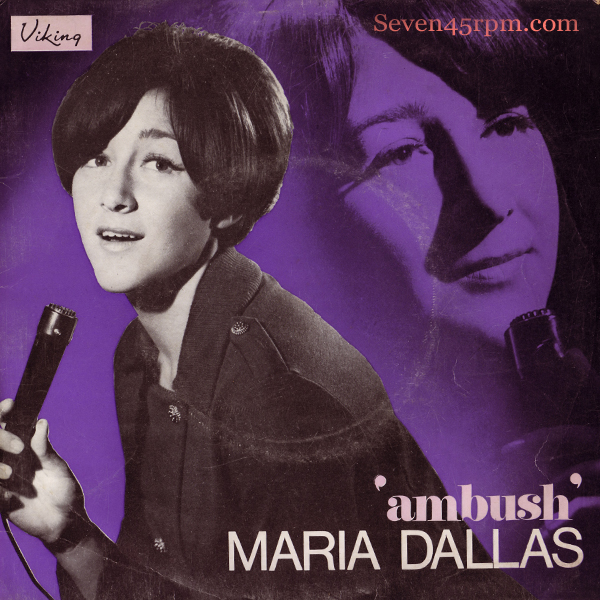
 Viking EP – Cat# VE-1001, (EMI) Australia Recorded 1967 Released 1968
Ambush (Side 2 Track 2)
I only just recently stumbled across this gem in a box of random rough 45’s in my favourite local record store, but somehow, I just knew there was going to be a little “something special” about it, so I grabbed it. When I got home, I polished it up, flicked the switch to 45 and placed the needle down. Yeah, it was alright, straight country beat…but as track 2 on 2 started up, a feeling inside told me to turn up the volume…and that something special was certainly affirmed! I had to find out more about Miss Dallas!
So I start to dig around for some history lessons on who I thought was certainly a Nashville singer, but to my surprise, I find out that she is in fact currently living here in the north of Australia, in Queensland. But that wasn’t the only surprise…she was actually born and breed in New Zealand!
And once again, I find that not a lot of information can be found on her, but I wil try and gather what I can, mash it all together, with hopefully some facts here and there.
Marina Devcich was born to a Croatian family, on April 14th 1946, in the provincial town of Morrinsville (in the Waikato region of New Zealand’s North Island) and was the second youngest of twelve children. She was gifted with a distinctive voice which you seriously could compare to say, Wanda Jackson, with a stir of Brenda Lee.
In 1964, Marina (wh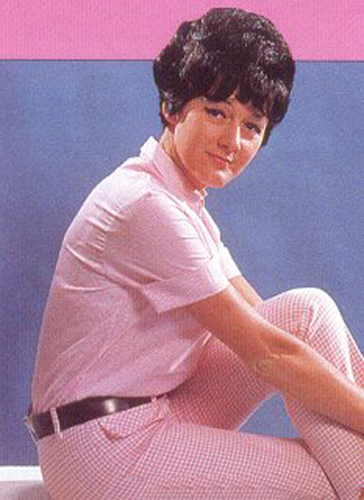 o was a hairdresser at that time) and Isabel Leigh won a Johnny Cooper talent quest in Morrinsville. Further solo performances with the Lew Manson Band around the Waikato area followed. One night in 1965, she was booked to appear in a Morrinsville hotel with Howard Morrison (who started up the very popular Howard Morrison Quartet with guitarist Gerry Merito) and Auckland bandleader Mike Perjanik (who formed The Mike Perjanik Band after departing The Embers, and would go on produce the “sound” for the NZ beat girls The Chicks, write hits for Dinah Lee and arrange for Ray Colombus).
Perjanik went straight back to Auckland to tell Viking Records’ chief Ron Dalton that he’d found his next star in the Waikato. Dalton decided to rename her Maria Dallas, and almost overnight the girl with the power packed voice found herself in an Auckland professional recording studio.
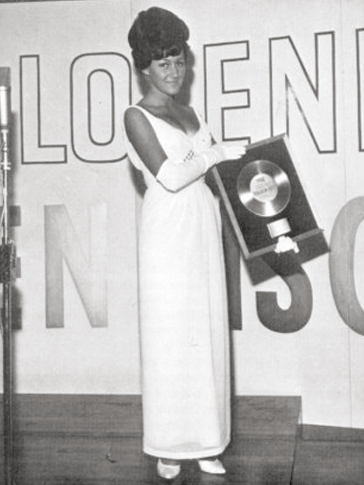 In ’66, Viking released a bunch of 7’s for Dallas including an EP titled Queen of the House (VE 224), which included a very oddly produced version of How Does That Grab You Darlin’, with very kooky keyboard backing. But it was her recording of Jay Epae’s Tumblin’ Down, that would bring her success! It in fact became a massive hit and it would be Maria’s signature tune. The song made it to number 11 on the national charts and was entered into the Loxene Golden Disc Awards, where it took first place!
Tumblin’ does have a catchy pop quality to it, and it has grown on me. It is also included on this EP, but it certainly isn’t the star on this spinner as far as I’m concerned. That title goes to…well…the infectious title track…Ambush! With it’s big kick start, instantly we have fuzz guitar, searing keyboards, and killer cool backing vocals. And who doesn’t love a song that starts straight into it’s punchy chorus?! This track has got a lot of sass to it…that kinda Ann Margaret sass (well I think it does), and it’s relentlessness makes it a good dance floor shaker! And it looks like it made it to number 12 in Oz, in October of 1967!
Viking churned out six albums during 1966 and 1967, and a similar number of singles. None of the singles fared as well as Tumblin’, and despite it’s success, Maria never felt at home as a pop singer, so she would return to her country music roots. She moved to Australia in late ’67, before venturing off to Nashville where she recorded in the famous RCA Victor Studios with producer Felton Jarvis (who was working with Elvis at this period and almost until his death) and also with Chet Atkins.
Although singles were still released during her absence, New Zealanders had almost forgotten about her until she returned in 1970 with a song called Pinocchio, which went all the way to number 1 on the national charts. Viking capitalised by releasing another album in 1971 and a follow up in 1972, but Maria wasn’t able to reproduce her success after that. She would also release a few more singles on the Kontact label, in ’73, ’75 and even up to ’81.
Maria married an Australian an has lived here for many years. I would love to hear from anyone who knows how she’s doing!
Referencing sites and related links…
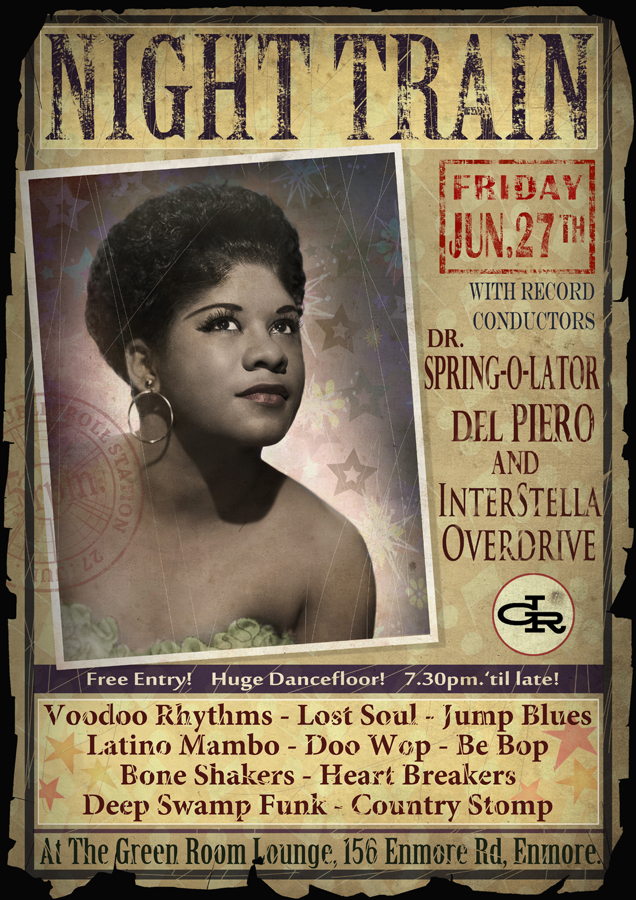

Little Walter And His Jukes – EP 1956

 Little Walter And His Jukes EP London REU 1061 Oct 1956
Track 1 – My Babe Written By – Willie Dixon
Track 2 – I Got To Go written by Marion Walter Jacobs
Track 3 – Roller Coaster Written By – E. McDaniels
Marion Walter Jacobs was born in Marksville, Louisiana, on May 1, 1930 and picked up the Harmonica at a very early age.
By the age of 12, the “unruly” but vastly talented youth decided to quit school and head for the Chicago, to become an itinerant street musician. On his travels, he would stop for the bright lights of New Orleans where he would pick up on odd jobs and busking. He would proceed to Memphis Tennessee, and then over to Helena Alabama, and also Arkansas and St. Louis Missouri, and then finally grounding down into the Windy City in around 1946. The thriving Maxwell Street strip clubs offered a spot for the still-teenaged phenom to hawk his wares, where he played with Tampa Red, Bill Broonzy, and Memphis Slim.
During this time, he also honed his musical skills on guitar performing with much older bluesmen such as Sonny Boy Williamson II, Sunnyland Slim, and Honeyboy Edwards, but garnered more attention for his already highly developed harmonica work.
Ora-Nelle. Little Walter would have been around 17 when made his first debut recording for Bernard Abr ams’ tiny Ora-Nelle label in 1947. The label was set up out of the back room of Abrams’ Maxwell Radio and Records store and only operated for a year or two. In that time the label only managed two releases, although 10 sides of alternate takes and unreleased material have since been discovered. Ora Nelle was named after a female relative, and the release series began at 711, not for numerological reasons, but on account of the winning combinations when shooting dice.
Ora Nelle w as the first label to record Little Walter, although according to fellow Chicago bluesman Floyd Jones, who suggests Walter’s first recording was an unreleased demo recorded soon after he arrived in Chicago on which Walter played guitar backing Jones. Ora Nelle was the only label to record guitarist Othum Brown, and the second to record guitarist Jimmy Rogers. On the debut 771A side we have the hard and heavy Ora-Nelle Blues, with Othum Brown accompanying Walter’s harp skills. Lovely stuff! And on the 711b flip, there’s the much faster foot stomping tune called I Just Keep Loving Her. Incredible! Still trying to confirm whether Othum or Walter sang on these tracks.
Note that the label never had distribution; Ora Nelles were sold out of the store, where copies were still in stock 20 years later, or resold by people who had bought them there. Good luck finding this original 78!
Little Walter joined Muddy Waters’ band in 1948, and by 1950, he was playing acoustic (unamplified) harmonica on Muddy’s recordings for Chess Records. In October of that year, they recorded the Waters classic Louisiana Blues. Nearly a year after Little Walter used an amplified harmonica for the first time on a groundbreaking July 1951 session that yielded She Moves Me.
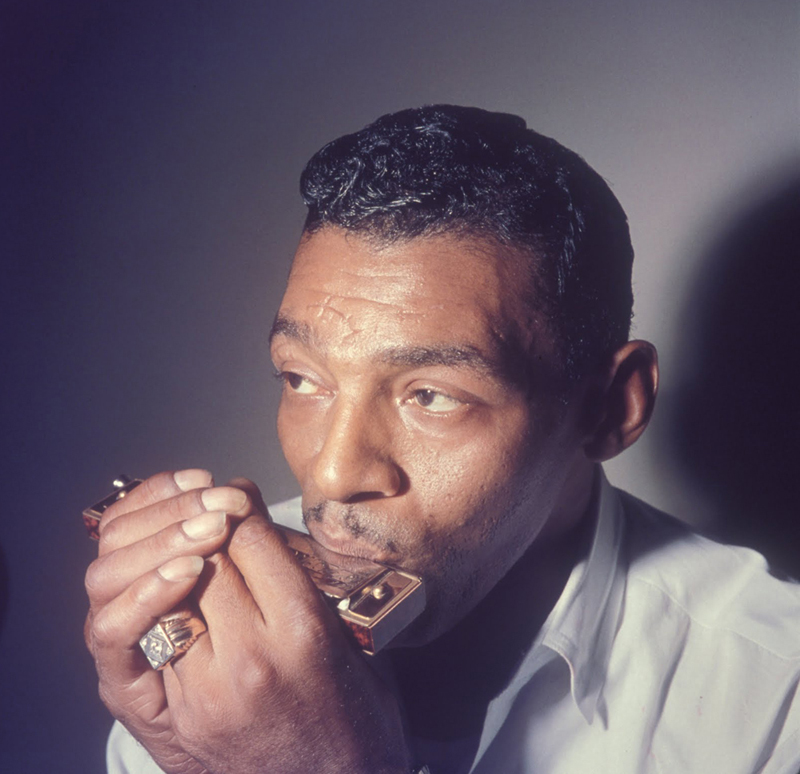 Little Walter reportedly grew frustrated with having his harmonica drowned out by the electric guitars, but would soon find a way to attack that problem. He adopted a simple yet effective method…he cupped a small microphone in his hands along with his harmonica, and plugged the microphone into a public address system or guitar amplifier. And now he could compete with any guitarist’s volume. There were other contemporary blues harp players such as Sonny Boy Williamson I and Snooky Pryor, who had also begun using the newly available amplifier technology for added volume, however Walter purposely pushed his amplifiers beyond their intended technical limitations, using the amplification to explore and develop radical new timbres and sonic effects previously unheard from a harmonica, or any other instrument. Madison Deniro wrote a small biographical piece on Little Walter stating that “He was the first musician of any kind to purposely use electronic distortion.”
Waters was among the earliest to recognize that blues possessed a formidable power when electrified, and along with Jimmy Rogers on electric guitar, Muddy had himself the hottest blues band in Chicago.
Little Walter And His Jukes – Walter had put his career as a bandleader on hold when he joined Muddy’s band, but stepped back out front once and for all when he recorded as a bandleader for Chess’s subsidiary label Checker Records on 12 May 1952. The first completed take of the first song attempted at his debut session became his first release. The cracking instrumental was called Juke (the retitled Your Cat Will Play), and it was the first real success for him. Deservedly, it topped the R&B charts for eight weeks, and is still the only harmonica instrumental ever to be a number-one hit on the charts, securing Walter’s position on the Chess artist roster for the next decade.
 Walter’s now had a pretty impressive band to himself, recruiting a young backing band that was already working steadily in Chicago backing Junior Wells, The Aces. They consisted of brothers David Myers and Louis Myers on guitars, and drummer Fred Below, and were re-christened “The Jukes” on most of the Little Walter records on which they appeared. Their first recordings were for the Checker subsidiary of Chess in 1952.
Some great stomping 45’s were to follow in the next couple of years including Crazy Legs which was released in ’53, Rocker from ’54, and Hate To See You Go, released in ’55. But for this post I’ve decided to showcase this fab Little Walter And His Jukes EP for a couple reasons! Firstly, that packaging! The art is eye popping and graphic, and the label itself with the gold text on the deep red, is just class in it’s purist form. Secondly, here’s a few of what I think are Little Walters’ best tracks, all one the one 7″!
My Babe, which was written by Willie Dixon, who also wrote (Little Red Rooster and I Just Want to Make Love to You), was originally released in 1955 on Checker Records. This composition was based on the traditional gospel song This Train (Is Bound For Glory), a hit when recorded by recorded by Sister Rosetta Tharpe in 1939. Dixon reworked the arrangement and lyrics from the sacred (the procession of saints into Heaven) into the secular (a story about a woman that won’t stand for her cheating man). The song was the only Dixon composition ever to become a #1 R&B single. (Note that Ray Charles had famously, and controversially, pioneered the gospel-song-to-secular-song approach also, and just prior to Walter’s release, with his reworking of the gospel hymn It Must Be Jesus into I Got A Woman,which hit #1 on the Billboard R&B).
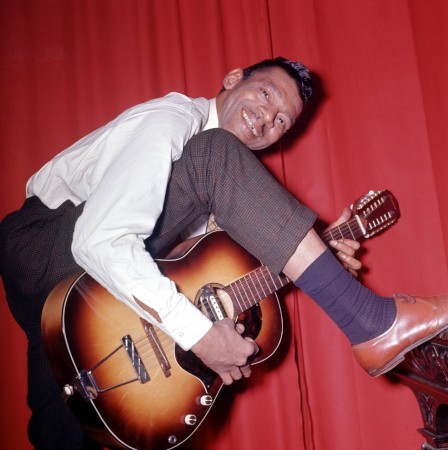 Backing Little Walter’s vocals and harmonica were Robert Lockwood and Leon Caston on guitars, Willie Dixon on double bass and Fred Below on drums. Guitarist Luther Tucker, then a member of Walter’s band, was absent from the recording session that day. My Babe was re-issued in 1961 with an overdubbed female vocal backing chorus and briefly crossed over to the pop charts. Ricky Nelson would release a far more pop version in 1958, while Dale Hawkins released a pretty fiery rockabilly version that same year.
I Got To Go is an up-tempo rocker reminiscent of his earlier 1953 Tell Me Mama…and this really is a rocker in it’s full glory. His playing of minor key scales over the major chord guitar backing adds, to a tension and energy to the piece as does his slightly fuzzed out vocal! Wild blues!
Roller Coaster, I have to say, is one of my favourite Walter tracks, and it’s the tasty icing on this sort after EP! His take on Diddley’s groover is quite sneaky, before it takes off with electrifying force. One glorious minor chord arpeggio throughout, nice and low and slithering, and it’s not long before Walter’s expressive tones really start to howl up a nice, maybe even gentle storm. With Diddley himself providing some rattling fretwork alongside the snappy kick and snare, it is just nothing but a blues dance floor masterpiece!
Thunderbird, the fourth track on this Ep, shouldn’t be ignored either, with it’s strong hustling locomotive rhythm. A more mild tempo possibly, but that does not deter Little Walter for a moment, as he burns up his harmonica skills quite feverishly and cleverly. Originally flipped to the 10″ My Babe, I’m almost certain this is the only 45 it was released on. Even another reason why you must seek this 7″ down!
Between 1952 and 1958, Little Walter on his own, charted 14 Top Ten R&B hits for the Chess label’s Checker subsidiary, including two number one hits, a level of commercial success never achieved by his former boss Waters, nor by his fellow Chess blues artists Howlin’ Wolf & Sonny Boy Williamson II. In the first part of the sixties he traveled to England winning over a new audience of white blues fans, and in 1964 he toured with the Rolling Stones (although this seems to have recently been refuted by Keith Richards). But Walter’s once phenomenal instrumental skills also diminished during the 1960s, plagued by alcohol abuse, a quick temper, and the bluesman’s penchant for barroom brawls. He did have a mean streak, and would never back down from a fight…and it was this belligerent attitude which lead to his death, after suffering head injuries from a street brawl. On Feb 1968, in Chicago, he sadly passed away at only 38 years old, a victim of his own indulgence.
 Of all the great bluesmans who were part of Chicago blues school, he is the only one that has never been imitated. He’s solos were carefully constructed masterpieces of energy that were never self indulgent. With his precision and control he was able to regulate the length power and sharpness of every note he played with furious yet calculated speed. His influence remains inescapable to this day, and it’s unlikely that a blues harpist exists on the face of this earth who doesn’t worship Marion “Little Walter” Jacobs. He was a skilled guitarist, and hell of a singer and songwriter, and is widely considered the greatest blues harmonica player ever. From the outset, he was a true original, a visionary musician and his influence goes beyond harmonica players.
Little Walter was inducted to the The Rock and Roll Hall of Fame in 2008 in the “sideman” category, making him the first and only artist ever inducted specifically as a harmonica player. His grave remained unmarked until 1991, when fans Scott Dirks and Eomot Rasun respectfully had a marker designed and installed.
photo credits: Don Bronstein, Jim O’Neal
Ora Nelle reord is from the collection of George Paulus
Essential reading by George Paulus & Robert L. Campbell
Referencing…
Blues Singers: Biographies of 50 Legendary Artists of the Early 20th Century By David Dicaire
Rockhall All Music Bill Dahl Masters Of The Blues Harp BluesWeb
Footage of Little Walter backing the great Hound Dog Taylor and Koko Taylor on a television program in Copenhagen, Denmark on 11 October 1967 was released on DVD in 2004 (performing Wang Dang Doodle). Further video of another recently discovered TV appearance in Germany during this same tour, showing Little Walter performing his songs My Babe, Mean Old World, and others were released on DVD in Europe in January 2009, and is the only known footage of Little Walter singing. Try and find it…sometimes some clips appear on you tube for brief moments. Amazing!
 Seven45rpm
Recent Comments