
Dusty Springfield – Haunted
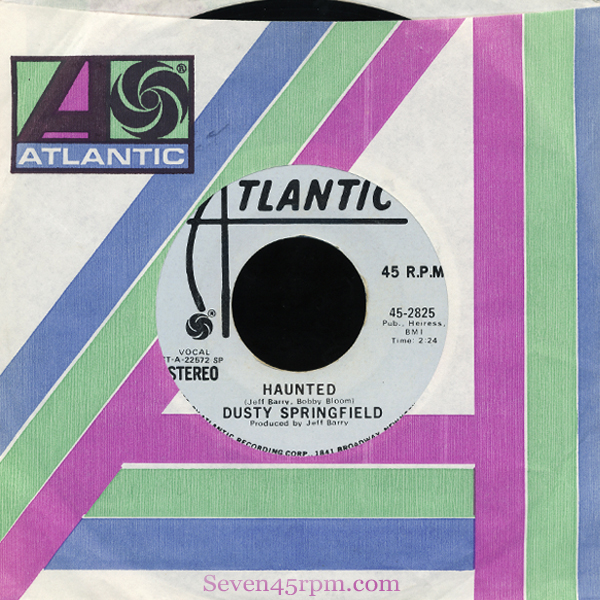
 Atlantic – 45-2825 US Year 1971
Mary Isabel Catherine Bernadette O’Brien was born on 16 April 1939, in West Hampstead, London, and grew up in a very influential music loving family. She learnt how to sing at home, and it was her childhood friends that first gave the young rough ‘n’ tumble tomboy her more suited name, Dusty.
By the late 50’s, Dusty had obviously been influenced with the music scene that was getting around town, and had grown into quite a fashionable and stylish young lady, ditching her glasses and finding her own look. She also was very keen to get out there and sing, and by 17 she had made her professional debut as a singer at a small club near Sloane Square. While she would continue to perform folk music as a solo artist, at small London clubs (apparently she was paid less than £10 a night), in ’58 she spotted an advert in The Stage from an established sister singing act, who were looking for a third member.
 They were called the Lana Sisters, and was formed by Riss Chantelle along with Lynne Abrams. Under the management of the Joe Collins agency, the trio secured bookings on television’s Six-Five Special and Drumbeat, and scored big with tours alongside Cliff Richard and Adam Faith. They also signed a contract with the U.K.’s Fontana Records, and between 1958 and 1960, they released seven singles…but it was all short lived for Dusty. In 1960 she left the group to join her brother Dion O’Brien and his friend Tim Feild, who had been working as a duo, The Kensington Squares. Dion became Tom Springfield, and Mary became Dusty Springfield, and the folk-pop trio The Springfields, was born. The Lana Sisters’ Riss Long, who had been calling herself Riss Lana, became Riss Chantelle and formed The Chantelles, and had some moderately successful records in the mid-60s.
Tom Springfield was a very knowledgeable folk singer, songwriter and arranger, and with the groups strong vocal harmonies as well as Dusty’s powerful lead, the mix was to prove perfect for success. They were signed to Philips Records in London and released their first single, Dear John, in 1961, followed by two UK chart hits with Breakaway and Bambino. They scored numerous television appearances and quickly the trio soon became very popular in the UK. Feild would be soon replaced by Mike Hurst, but the Springfields became even more successful. In 1962, their version of “Silver Threads and Golden Needles” reached the US Top 20 (Billboard), the first single by a British group ever to do so. The record also reached #1 in Australia!
The Springfields would go on to sell millions of records and score big on the charts, however Dusty felt limited by the group’s folksy act and Tom’s lead role within the trio, and also a shared frustration towards their growing American audience that mistook them for a country western group. At the end of 1963, Dusty decided to leave for a solo career, at which point the group disbanded.
In November 1963 Springfield released her first solo single, I Only Want to Be with You, which was was produced by Johnny Franz in a manner similar to Phil Spector’s “Wall of Sound”. Co-written and arranged by Ivor Raymonde, the instant smash hit rose to No. 4 on the UK charts, remained on the Billboard Hot 100 for 10 weeks, and it sold over one million copies! And on 1 January 1964, it was one of the first songs played on Top of the Pops, BBC-TV’s new music programme.
 On 17 April 1964 Dusty issued her debut album A Girl Called Dusty which included mostly cover versions of her favourite songs including Lesley Gore’s You Don’t Own Me, The Shirelles’ Mama Said, and the Burt Bacharach song Wishin’ and Hopin‘, which became a US Top 10 hit. She also released an incredible Italian version entitled Stupido Stupido on a 7 picture sleeve was is just ridiculously awesome!
In December 1964 Dusty’s tour of South Africa was controversially terminated, and she was deported, after she performed for an integrated audience at a theatre near Cape Town, which was against the then government’s segregation policy. That same year, she was voted the Top Female British Artist of the year in the New Musical Express poll, topping Lulu, Sandie Shaw, and Cilla Black. Springfield received the award again for the next three years.
Dusty would go on to release a string of successful 45’s and lp’s in the next few years, but lets touch on some of the really great stuff…well at least my 45 picks. Firstly in ’67, there’s the Philips release, What’s It Gonna Be…killer dusty stuff! Then there’s the spine tingling Am I the same Girl from ’69…um…wow! And then of course, from 1970, there is Spooky! As if saxophonist Mike Sharpe’s original version wasn’t fantastic enough, Dusty sprinkles her soul over it like haunting seductive icing…her voice dripping like warm honey all over the lyrics taken thank-you very much from the Classic IV’s ’67 release.
The Memphis Sessions: In ’69, Dusty who was now signed to Atlantic, was hoping to reinvigorate her career and boost her credibility as a soul artist, and turned to the roots of soul music. Although she had sung R&B songs before, she had never released an entire album solely of R&B songs, but was about to release in my opinion, her strongest and most important album, entitled Dusty in Memphis. She began recording the Memphis sessions at the infamous American Sound Studios which were recorded by the A team of Atlantic Records. It included producers Jerry Wexler (who coined the term “Rhythm and Blues”), Tom Dowd and Arif Mardin, the back-up singers Sweet Inspirations and the instrumental band Memphis Cats, (who had in the past backed Wilson Pickett, King Curtis and Elvis Presley), led by guitarist Reggie Young and bassist Tommy Cogbill. It sounds like these recordings were a challenge for Wexler, who was not used to working with an artist who was in such habitual pursuit of perfection.
To say yes to one song was seen as a lifetime commitment for Dusty, who claims that she actually did approve of Son of a Preacher Man and Just a Little Lovin. Wexler was surprised, given Dusty’s talent, by her apparent insecurity, but she herself later attributed her initial unease to a very real anxiety about being compared with the soul greats who had recorded in the very same studios. Eventually Dusty’s final vocals were recorded in New York.
While Memphis did include the now absolute Dusty classic Top 10 UK hit, Son of a Preacher Man, this powerful and incredible album did not garner significant commercial success upon its original release, and remained out of print for many years!
Faithful would have been the title of Dusty’s third album for Atlantic Records, which was entirely recorded in the first half of 1971. Two singles from the planned album, I Believe In You (flipped with Someone Who Cares), and Haunted (flipped with Nothing Is Forever, a track that supposedly was never intended for the album) were released in the U.S. in the fall of ’71, but both releases failed to chart nationally. Due to poor response (although how hard they were promoted I don’t know), and a rumoured falling out with Atlantic executives, Springfield’s contract with the company was not renewed, and the planned album was never given an official release, catalogue number, or title. Apparently a third single was planned I’ll Be Faithful, where the title Faithful was taken…but that never surfaced either.
For years it was believed that a fire in the mid-seventies at one of Atlantic’s storage sites was thought to have destroyed the Faithful session tapes, leaving only the two singles (and the possible third single) from the sessions intact. However, in the nineties the album’s producer, Jeff Barry, was asked about the sessions and revealed he had kept completed stereo mixes of all the tracks. Most were released as bonus tracks on the Rhino Records/Atlantic deluxe remastered edition of Dusty in Memphis in 1999.
Haunted is a profoundly beautiful soulful composition, and probably way to mature for commercial pop success. Dusty wasn’t the kind of gal to write for the only purpose of seeking sales and chart success, although she probably would have been grateful for the recognition. She was an incredible musician only interested in moving forward into new challenging territories…with no interest at all in recording the same song over and over, regardless of the success she may have received from past hits. Here she’s giving us that warm pure tone (that’s unmatched by any), as we would expect from her, but there’s also a new sound here…and that, she must have found exciting. I love this song. Loved it the first time I heard it…and I love it even more, every time I’ve heard it since…and believe you me…that’s a lot of times! Dusty would admit to be very demanding and standing her ground when it came to her art. But how could anyone question her talent and vision, or stand in her path of exploration…it’s just mind blowing.
 After the release of Dusty in Memphis, Springfield struggled to find musical compatibility with record labels, producers and musicians who all either misunderstood her vision or wanted her to be something other than herself. This resulted in a string of standard albums that achieved nominal success, but I can’t help but think that this path Dusty was on, was a path that she was given and not one that she chose, or was searching for.
She had some tough times…her alcoholism and drug dependency affected her musical career.She was hospitalised several times for self-harm, by cutting herself, and was diagnosed with Bipolar Disorder. She was constantly be “accused” about her sexual preferences and couldn’t understand the prying interest into her personal life. “Many people say I’m bent, and I’ve heard it so many times… I know I’m perfectly as capable of being swayed by a girl as by a boy. More and more people feel that way and I don’t see why I shouldn’t”.
In January 1994 while recording her final album, A Very Fine Love, in Nashville, Dusty Springfield felt ill. When she returned to England a few months later, her physicians diagnosed breast cancer. She received months of radiation treatment and the cancer was in temporary remission. The next year, in apparent good health, Springfield set about promoting the album. In mid-1996 the cancer had returned, and in spite of vigorous treatments, she died on 2 March 1999. Her induction into the Rock and Roll Hall of Fame in Cleveland, Ohio, had been scheduled two weeks after her death.
Note…During the Memphis sessions in November 1968, Dusty suggested to the heads of Atlantic Records to sign the newly formed Led Zeppelin. She knew the band’s bass player John Paul Jones, who had backed her in concerts before. Without having ever seen them and largely on Dusty’s advice, the record company signed a deal of $200,000 with them. For the time being, that was the biggest deal of its kind for a new band.
Recommended reading…
Ganimian & His Orientals – Come With Me To The Casbah
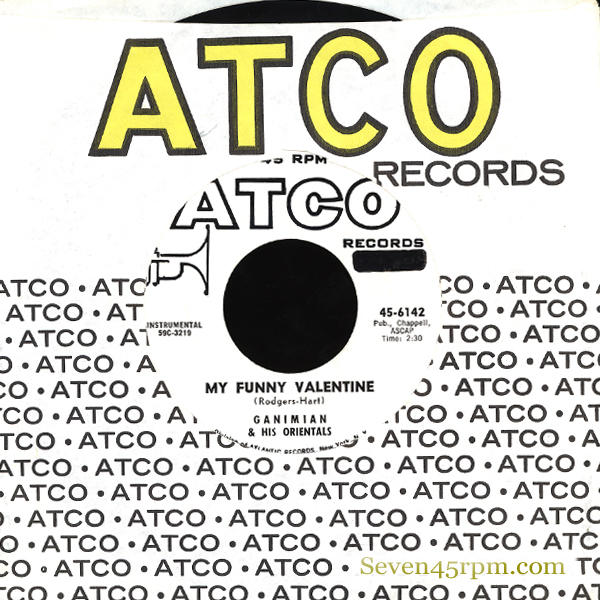
 ATCO 6142 US Year 1959
Charles “Chick” Ganimian was born in 1926 in Troy, New York, to Armenian parents who had emigrated from Marash in 1922. In his home he often heard the music of the “old country”, and the distinctive sound of the oud, performed by his immigrant father (who had arrived from Turkey). From an early age, young Charles had been fascinated with the music of his heritage, and after initially studying the violin and attaining quite some skills on the instrument, he would follow his father’s path and also switch to the oud.
So a bit about this “oud”. It is a pear-shaped stringed instrument commonly used in Arabic, Greek, Turkish, Hebrew-Jewish, Somali and Middle Eastern music, and it’s construction is similar to that of the lute. It is readily distinguished by its lack of frets and smaller neck, and is considered an ancestor of the guitar. According to Farabi, the renowned scientist, cosmologist, musician and philosopher of the Islamic Golden Age, the oud was invented by Lamech, the sixth grandson of Adam. The legend tells that the grieving Lamech hung the body of his dead son from a tree. The first oud was inspired by the shape of his son’s bleached skeleton. It has ten strings (five pairs tuned in unison), and sounds like a hoarse low pitched guitar.
Chick picked up a lot of interest towards this exotic and strange (to western ears) music, from his father. His awareness and taste for these foreign sounds developed more and more, and he would start to understand the rhythm patterns, phrasing and the varies complex styles.
In 1948, Chick first formed the Nor-Ikes Orchestra, a group largely comprised of Armenian musicians, with Steve Boghossian, Eddie Malkasian, Aram Davidian, and Souren Baronian. The band’s name was suggested by Souren Baronian’s father and means “new dawn” in Armenian (nor ayk), and they were one of the first to consciously revive this exotic music for mixed audiences, touring the eastern United States and playing for the broader Arab-American community.
In 1959, ATCO released G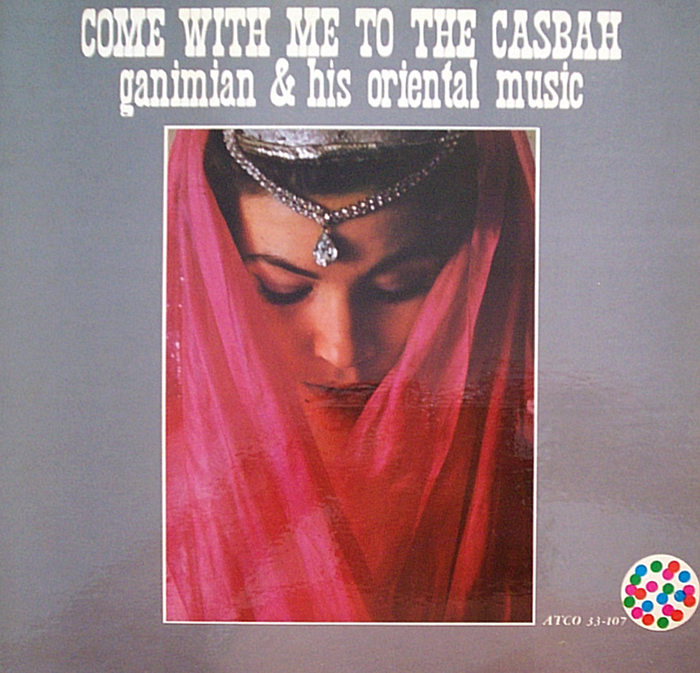 animian’s first LP Come With Me To The Casbah, which included 12 truly mind blowing exotic crossovers. Including some crazy oriental compositions, jams and some twisted standards, the album is really quite amazing and thoroughly enjoyable! While Chick is the clearly the musical fountain head for the band’s Near Eastern approach, having Steve Boghossian and Souren Baronian on reeds, who both add their honest feel for their instruments as played in the old traditional style, adding so much authenticity. An unusual example of jazz musicians who have done about as remarkable a piece of musical transformation as humanly possible.
According to Chick, It was all due to Steve’s (who plays clarinet) experience and musical background that allowed the band to successfully work out the difficult technical problems in playing this kind of music. Souren plays second clarinet, baritone-tenor sax and castanet and also came with very exceptionally high musical talents, and in fact, all the arrangements on the lp were by the three long time partners. Other members of Ganimian’s ensemble include Eddie Malkasian on tenor sax and various percussions, Aram Davidian is on oriental drums, and Ahmet Yatman is on the the kanoon. The kanoon (also spelled qanun) can be described as a lap plucking box zither with a narrow trapezoidal soundboard, with 63 to 84 strings, and has the most beautiful and distinctive shimmering sound.
Onnik Dinkjian provides English vocals on Hedy Lou, Daddy Lolo, and Haluah, although live, he supposedly also sang in Armenian and other Near Eastern tongues. Daddy Lolo (Oriental Rock And Roll) was released a year prior to this album’s release as a 45 on the EastWest label with Halvah on he flip, and Chick’s group was credited as Ganim’s Asia Minors . There is certainly a jazz influence on Ganimian’s recordings. To thank for that are jazz cats Peter Ind on bass, Billy Bauer on guitar, Al Schackman also on guitar and Pete Franco on drums. There’s certainly some amount of science and math that’s gone into some of the backbone scales going on here, with curious names! Oriental Jam is in “Nevahijaz”, The Whirling Dervish is in “Sabah”, while the turkish melody Nine-Eight is in “Hijaz”, which means yeah…it’s in nine-eight timing.
Come With Me To The Casbah is the big dancer from these recordings, and ‘ll be forever grateful that ATCO did decide to give it a 7″ release in ’59. The eerie intro is quite devilish, but the feverish tempo quickly kicks in, and really there’s no hope of doing anything other than dance and wiggle like crazy, for the remaining 2 and a bit minutes. I love dropping this one down and watching the dance floor’s reaction and transformation. It always makes me giddy, and brother, does it sound great on a good sound system! “How do you like the Casbah you little one? Man I dig it!”
Ganimian would continue performing in the ‘60s and ‘70s, making regular live and studio appearances and enjoying residencies in New Jersey and New York. Apparently there’s an independently-released 1975 LP with the Nor-Ikes out there…somewhere?
A standout collaboration I have to mention, would be his work he did with Herbie Mann on his Atlantic album from 1967, The Wailing Dervishes. Mann sits a bit back here and lets his dream team shine on this live recording which took place at Village Theater in New York City. An Lp that is quite an esoteric excursion for Mann, with no commercial or ethnic compromises. With the superb dumbek player Moulay “Ali” Hafid on percussion, Roy Ayers on vibraphone, Reggie Workman on bass, and Bruno Carr on drums, amongst others, this is one great platform for Chick to really let loose on and do his thang! There’s also a great version of Norwegian Wood where all the band get the opportunity to do some wild jammin’ and includes some incredible zither action by Esber Köprücü.
Chick also recorded on Mann’s prior Impressions of the Middle East Lp, which had the fine 7″ release Turkish Coffee.
Unfortunately, Chick’s dependence on alcohol had a debilitating effect on his ability to earn a living, and later on his health. Ganimian died in late 1989 while a resident of the Armenian Nursing Home in northern New Jersey.
But I did find some youtube footage of a live performance from the great man back in early 1984 here. I’m so grateful to the person who had upload it, and to see this for the first time was a pure joy.
Bobby Day – Pretty Little Girl Next Door

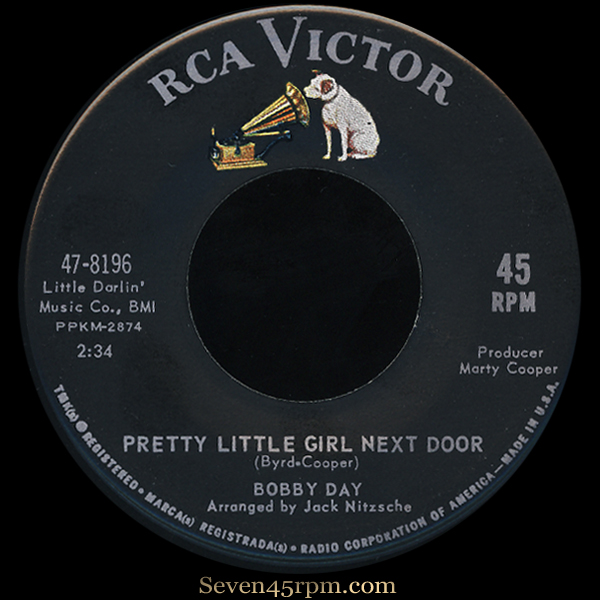 RCA Victor – 47-8196 US Year 1963
Track 1 – Pretty Little Girl Next DoorTrack 2 – Buzz Buzz Buzz
Okay, first thing’s first…Robert Byrd, alias Bobby Day, of the Hollywood Flames, who were formerly The Flames, is not to be confused with Bobby Byrd of the Famous Flames, who were formerly…The Flames…got that? Good!
Robert James Byrd was born July 1, 1928, in Fort Worth Texas, and moved to Los Angeles in 1947. His first vocal group, The Flames, originated in 1949, when all members were in there teens. They all met at the Largo Theater in Watts at a talent show given by the theater’s owner, which brought together many singers from various high schools in Los Angeles.
Bobby strung together tenor David Ford, second tenor Willie Ray Rockwell and eventually Curlee Dinkins, who sang baritone and bass (Byrd would sing bass, baritone, tenor). They quickly learned how to sound pretty darn good together, and as they all needed to earn some dosh, they decided to brave up to an audition they had heard about at the Johnny Otis owned Barrelhouse. They started winning a few prizes here and there and were offered a few little jobs, sometimes making five dollars each.
The Flames existed from 1949 to 1966. In that time, they recorded under a bewildering variety of names (Four Flames, Hollywood Four Flames, the Jets, the Ebbtides and the Satellites), for a bewildering number of labels, with a bewildering cast of personnel.
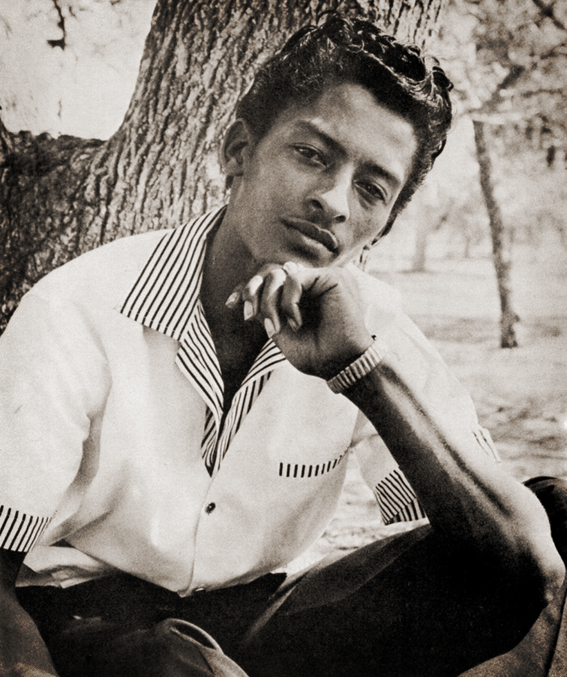 In ’57, Byrd penned and recorded the great, Buzz Buzz Buzz, (Earl Nelson on lead) as The Hollywood Flames on Ebb. When the song became a hit, Bobby found out that he didn’t have any publishing rights and only half the writer credit…and never received any money owed to him. That same year with his back up group the Satellites, he also wrote and recorded (as Bobby Day) the fab foot tapping hand clapping Little Bitty Pretty One, released by Class in August. Popularized with success for Thurston Harris, whose release beat Bobby’s out the gate, it reached No. 6 on the U.S. Billboard Hot 100 and No. 2 on the R&B chart…but I much prefer Bobby’s!
But the next year Day was the first to record Leon Rene’s (under the pseudonym of Jimmie Thomas) Rock-in’ Robin…the perfect counter attack, and Day’s most recognize and successful recording, which became Number 2 hit on the Billboard charts! Its flip, “Over and Over,” was a hit in its own right, and a cover by Dave Clark Five in ’65, brought a much more hip, modern youthful version back to the dance floors!
Bobby Day went on to partner with Earl Nelson and recorded as Bob & Earl from 1957 to 1959 on Class.
Moving on to 1963, and Bobby releases the incredibly uplifting Pretty Little Girl Next Door on RCA. I’m sure everyone reading this, has one song that they can rely on, that will always bring themselves a big damn smile, no matter what life is throwing at you! This is mine! From beginning to end, it’s a quite the pleasant build up. With it’s sweet caterpillar like beginnings, it quickly sprouts it’s wings and soars! The slinky groove grows, and it soon smothers you. And I’ve proved that this song can and will draw everyone within a kilometer radius of your turntable, onto your dance floor. Day gives it his all…he really shines in this one, and of course those gorgeous female backing vocals brings it all into perfect harmony! Imagine seeing this performed live by Mr.Day in ’63!
And on the flip, what a delight to have a revisit of his early Buzz Buzz Buzz! Just as great as the original, however this version may have a slower tempo, but certainly holds a stronger groove…and much more developed for the early sixties hipster dancers. Both tracks produced by genius Jack Nitzsche!
Bobby Day died from cancer on July 27, 1990, in Los Angeles and was buried in Holy Cross Cemetery in Culver City, California. He was survived by his wife, Jackie, and four children. He may not have had the successive chart success he very well deserved (he never achieved another Top 40 Hit apart from Rock-in’ Robin), but in my book, he was just as important as the best of them, especially with his major part in the early days of doo wop! He always lifts me, and Pretty Little Girl just makes me drunk with happiness!
Essential reading for a very in-depth and thorough journey with Bobby Day and his Hollywood Flames, by Marv Goldberg…The Hollywood Flames.
Big Buddy Lucas – I Can’t Go

Caprice 120 US Year 1963
Born Alonzo W. Lucas, 16 August 1914, Pritchard, Alabama, Buddy moved to Stamford, Connecticut, at the age of three. In years to come, a good neighbour noticed the young 11 year old’s interest in music and gave him a clarinet. This kind act must have been the true begins of where it all really started for Buddy! In the late 1940s he went to New York City, where he met drummer Herman Bradley, who helped him get his gigs and record dates.
But it wasn’t until ’51, when Lucas would make his first vocal recording on Soppin’ Molasses, for Jerry Blaine’s Jubilee label. Jubilee specialized in rhythm and blues and was the first independent record label to reach the white market with a black vocal group, when The Orioles recording of Crying in the Chapel reached the Top Twenty on the Pop charts in 1953. Lucas became leader of the house band and renamed his combo “The Band Of Tomorrow”. Scoring a #2 hit on the R&B charts in 1952 with the slow revived Diane, may have given the saxophonist some attention, but the flip Undecided is far more foot tapping and exciting! This set the pattern for most of his following Jubilee singles : a lush ballad on the A-side and an R&B sax led instrumental on the flip.
Lucas had one other hit on Jubilee, Heavenly Father (I Love You is the much preferred flip), sung by Edna McGriff (# 4 R&B in 1952), before moving on to RCA and its subsidiary Groove. Releasing a handful of 45’s, including the raw Greedy Pig, my pick of this bunch would have to be the Groove two sider My Pinch Hitter (along side Almeta Stewart, who I honestly have to say, I do not know enough about) and of course the great flip I Got Drunk! The title alone tells you that this here track was always going to be good! Also No Dice (flip to High Low Jack), should NOT be ignored, as Buddy really gets the opportunity to have some sexy fun with his sax and harmonica skills here!
From ’56 to ’57, Buddy had seven 45’s released on Bell Records, a budget label specializing in covers of the big hits of the day, including Hound Dog….okay stuff. BUT also in ’57, he comes out with the hammering Bo-Lee, on the Luniverse Records label. Established in 1956 by struggling songwriters Bill Buchanan and Dickie Goodma, but ceasing production in 1959, this label, with a few exceptions, were nearly all Buchanan-Goodman titles. As much as I admire Budy’s instrumentals, I think his vocal releases are just the bomb, as is the case with Bo-Lee!
in 1958, he became the nucleus of the Gone All Stars, George Goldner’s session band for his Gone Label. Fun stuff, but no real earth shaking releases, well especially compared to the previous Luniverse monster.
Carlton released Beulah in ’59…fantastic stuff, but incredibly similar, if slightly more bizarre, to Bo-lee!
Many more releases were to come in the next few years from Lucas on various labels including Vim, Tru-Sound and Pioneer (I recommend Get Away Fly on the latter label), but let’s move to 1963 and this mind blowing Caprice release!
At just age 28, Gerry Granahan became the youngest record executive in the music biz to that time, when he formed his own company, Caprice Records. He was a former disc jockey at WPTS in Pittston and in 1957, he was the first white artist on the Atlantic’s subsidiary label, Atco. He had a lot of success with numerous solo and group projects (including as pseudonym Dicky Doo and the Don’ts and group The Fireflies), but in 1960, he found being a performer, composer and producer for all his different acts, was too much to handle and realized his future success would come from sitting on the other side of the desk. Granahan had used Buddy’s talents on some of his own previous recordings, so it’s no surprise he brought him over to his new label. I can’t really find out much about the Gerry Granahan Orchestra that accompanies Buddy’s composition. While the label did have some major successes (and why this track wasn’t one of those I’ll never understand…although I have to suspect poor marketing perhaps?), the label folded in ’63 due to some dodgy “off the books sales” from a business partner.
I Can’t Go is an absolute Big Buddy gem! He writes about finding love and fame, and not holding onto to either tight enough. It’s blues…I guess…but so contradictorily upbeat! The cheeky keyboards, the wriggling bass and the outstanding dry production are all perfectly synced. Sometimes I really struggle to understand how music can be this great! And I’d love to find out who is responsible for the fabulous backing vocals…perhaps again former Granahan collaborators?
After researching this great musician, it seems evident that Buddy is much more known and credited for his prolific tenor sax and harmonica contributions, than as the cool cat vocalist that he certainly was. And he did put down some mean grooves with plenty of talent. In the 50’s he worked with Frankie Lymon & The Teenagers on Why Do Fools Fall In Love, and also with Little Willie John on his remarkable Fever take! He would work with blues and soul queens Big Maybelle, Big Mama Thornton, Aretha Franklin, Roberta Flack and Nina Simone! He would also get wild with Bernard “Pretty” Purdie, Yusef Lateef, Jimmy Smith and Count Basie. It’s obvious that here was a man with incredible talent to share, and I’m sure many friendships were made in his lifetime. And while his recording credits can be all laid out to a point without too much unraveling, it kinda saddens me that I can’t seem to find out much more about the man himself, behind those great notes, with such an important historic relevance to soul and blues. There must be interviews out there somewhere with either himself or collaborators. Even some photos?!
Buddy would continue to work with countless more musicians including Hendricks and George Benson, offering his harp and sax skills. In 1980, Buddy had his right lung removed after cancer was discovered, but continued to play alongside his old friend Herman Bradley, that he meet back in the ’40’s. In December 1982, due to ill-health, he finally had to give up doing what he loved most. He passed away on March 18th, 1983.
Referencing Dik from Black Cat Rockabilly
Also great Buddy discography here at Hallelujah Rock ‘n’ Roll
…and here at WangDangDula
And some definitive reading on Caprice Executive Gerry Granahan
Marie Knight – Come On Baby (Hold My Hand)

 Okeh 4-7147 US Year 1962 Marie Roach was born June 1, 1925, in Sanford, Florida, and grew up in Newark. At the sweet little age of 5, she impressed the congregation at her parents church by singing the gospel song Doing All the Good We Can, and of course later became a soloist in her church’s youth choir.
In 1939, the young lady first toured with Evangelist Frances Robinson, touring the national gospel circuit (she married preacher Albert Knight in ’41 but divorced later).
In 1946, she made her first recordings as a member of The Sunset Four (aka Sunset Jubilee Singers) for Signature and Haven (these labels would merge, but became defunct at the end of 1960 after being purchased earlier in the year by Roulette Records), and released a mighty fine handful of spiritual releases.
The now legendary guitar playing Sister Rosetta Tharpe, who was a major recording artist on the Decca Records label, and who many would say, brought gospel music to a broad audience, first heard Knight sing at a Mahalia Jackson concert in New York in 1946. Tharpe recognized “something special” in Marie’s contralto voice, and two weeks later, she showed up at Knight’s house in Newark, N.J., to invite her to go on the road with her.
Tharpe and Knight toured through the late ’40s, appearing in clubs, arenas, churches and auditoriums, sometimes acting out the parts of “the Saint and the Sinner”, with Tharpe as the saint and Knight as the sinner.
Together they had plenty of successes, including Up Above My Head, credited jointly to both singers, and reached # 6 on the US R&B at the end of 1948. The great Didn’t It Rain also did well and Knight’s solo version of Gospel Train reached # 9 on the R&B chart in 1949.
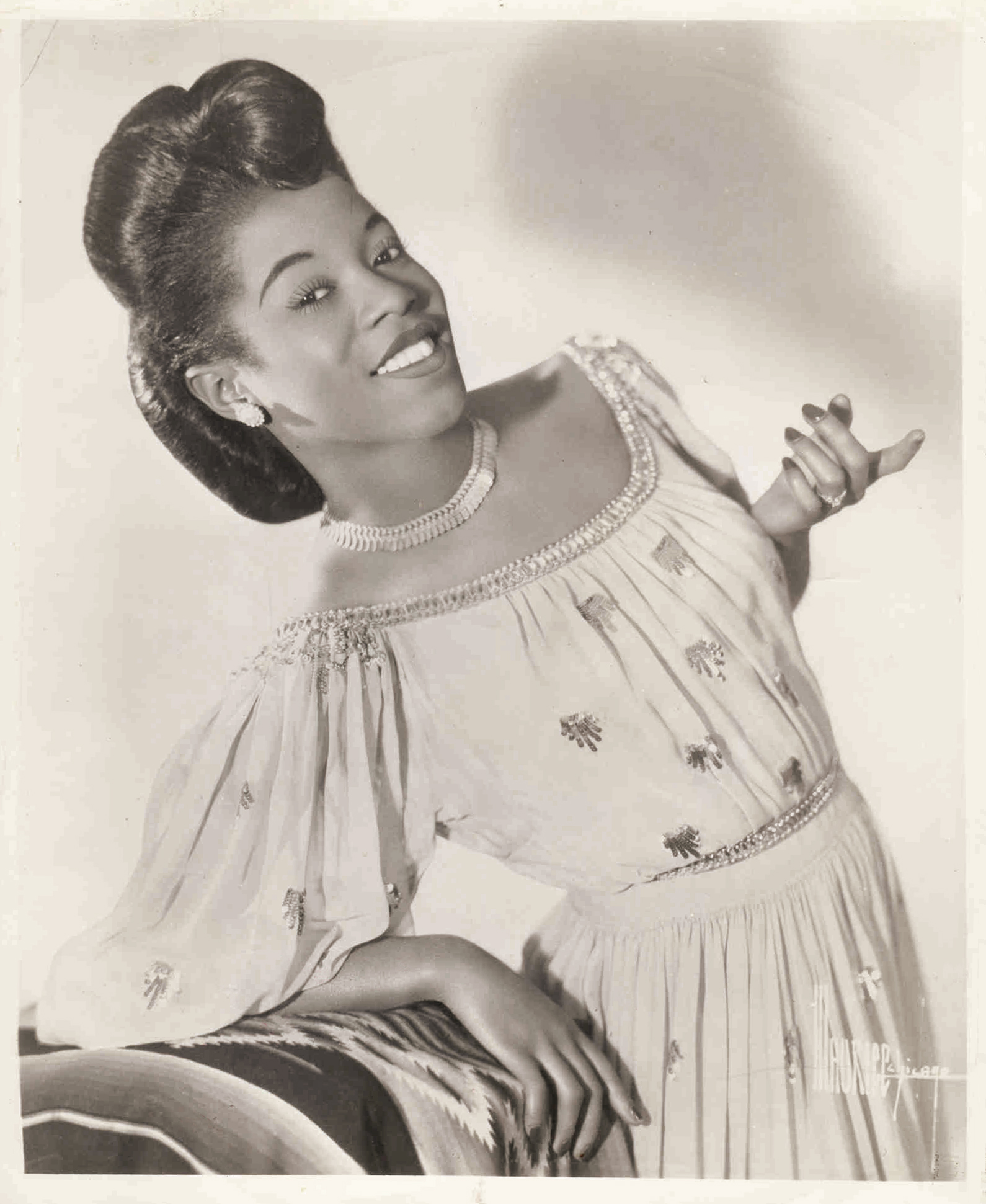 Knight left Tharpe to go solo around 1951, and released further more gospel recordings on Decca. But around April 1954, Marie Knight makes a change as she records straight ahead R & B songs I Know Every Move You Make and You Got A Way Of Making Love. These Rhythm & Blues tunes may have turned away a great many of Knight’s gospel fans, but she continues this move with a release during July of This Old Soul Of Mine and I Tell It Wherever I Go, and a November release of Trouble In Mind and What More Can I Do.
Both Knight and Tharpe’s friendship has stayed very strong and close, and in ’55, they get back into the recording studio together and release Stand and Storm on Decca, and together they score a two week stand at Chicago’s Black Orchid. In October, Knight lands a part of the lineup of the “Lucky Seven Blues Tour” along with Earl King, Little Willie John and other greats! Soon after the tour is over, she signs on for another all star touring show called the Rock ‘n’ Roll Jubilee which kicks off at L.A.’s Shrine Auditorium and again features star players including B.B. King, the classy Shirley Gunter, and sax cat Hal Singer.
In the spring of ’56, Knight follows her close friend Tharpe, from Decca to Mercury Records. While a couple more gospel releases sprouted once again, Knight decides to release another R&B beauty Grasshopper Baby (flip to Look At Me). In march of 1957 Mercury brings out the doo-wopping Am I Reaching For The Moon? and I’m The Little Fooler. In ’59, Knight and Tharpe record together again, and release Shadrack on Decca, which has to be one of my top picks from their almighty strong partnership!
1961 saw the release of the Knight bomb To Be Loved By You on Addit…you need to hear this if you don’t know it…amazing! That same year she recorded Come Tomorrow, released on Okeh, a tune which became much more famous after it was covered four years later by British rockers Manfred Mann.
And in ’62, she hits us with this…Come On Baby (hold my hand), again on the Okeh label. Quite slinky for Miss Knight, and you can’t help but feel this kinda tune has been waiting to burst out from her for some time. Another heart felt sound about love, but much more personal here than say spiritual. Not a lot can be found about this Roy Glover arranged session, and why this track is very rarely mentioned when reading up on Knight is a mystery to me, but it is well respected in the R&B community and on many collector’s want list for good reason.
Knight recorded and released a bunch more 45’s with various labels up til about 65, then slowly faded away from the scene. Her ripping version of Cry Me a River reached # 35 on the U.S. Billboard R&B charts in ’65, and was a powerful stamp to close an important chapter.
Knight remained friends with Tharpe, and helped arrange her funeral in 1973. In 1975, having given up performing secular music, she recorded another gospel album, Marie Knight: Today.
In 2002, Knight made a comeback in the gospel world, recording for a tribute album to Tharpe. She also released a full-length album, Let Us Get Together, on her manager’s label in 2007. She died in Harlem of complications from Pneumonia on August 30, 2009, but her legacy will live on…no doubt about it!
Jacqueline Taïeb – 7 heures du matin
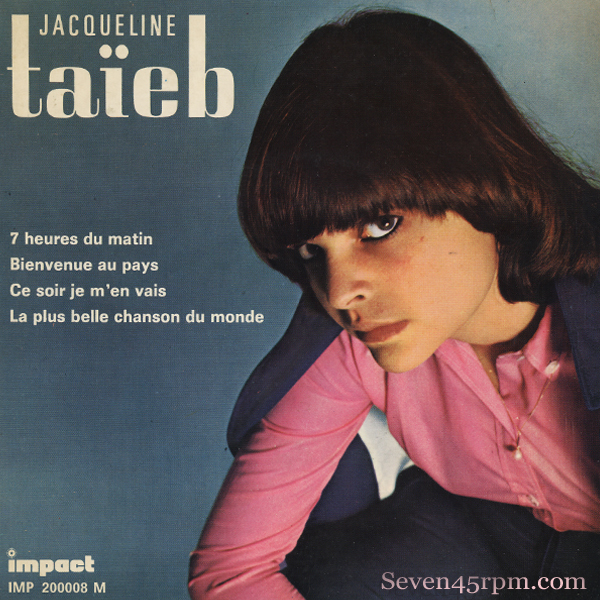
 Impact IMP 200008 M France 1967
Track 1 – 7 heures du matin Track 2 – Ce Soir Je M’en Vais
Born 1948 in Carthage, Tunisia, the young Taïeb arrived in France with her parents at age eight. Her father gifted her with a guitar at 12 (like every good dad should do) which she must have really connected with, because soon she would be composing her own songs. It wasn’t long before a talent scout would discover her while singing with friends. It was ’66, and what an exciting time it must have been for the big eyes of 18 year old singer-songwriter, scoring a contract with the record label Impact, and then being quickly whisked away off to London for her first recording sessions.
1967 saw a string of 7″ releases for the then 19 year old Jacqueline, but it’s this debut EP release (in January) that she is most well worshiped for. All four songs on the EP were composed by the young singer herself, which you have to remember for that time, was quite rare, as most female singers were expected to perform songs that had been written for them, or perhaps covers of other popular high selling hits.
Though the lead track, the almighty ye ye classic 7 heures du matin, was only a small hit at the time, it has gone on to become considered a classic of the French girl pop genre. It is the story of a young student waking up too early, at 7am, on a Monday morning, struggling with the thoughts of what the day will throw at her. She fantasizes about her boy crush Paul McCartney, helping her complete her homework, while tormenting on which sweater to wear for the day. Obviously a girl who is after trouble, the rebellious girl even considers playing her Elvis record loudly just to upset the neighbors. I mean really…how cute is that!?
It’s a simple song, but a huge dance floor monster! With it’s Steppin’ Stone garage power chords and it’s rebellious Elvis meets The Who attitude, it’s freakin’ impossible not to adore this one! And obviously very high in demand in the collectors circle. This track really brings back some great memories of the Sounds Of Seduction nights we once were fortunate to encounter here in Sydney in the 90’s, hosted by the great Jay Katz, (a friend who is responsible for introducing me to so much great lost European dance and film music of the sixties). And this song was also the trigger to the beginnings of my Ye ye obsession!
Update! A few years back I managed to get my hands on the elusive Australian issue of this masterpiece, with both 7AM and the flip side, which translates to Tonight I’m Going Home, sung in English! And finally getting a chance to upload. I love both these English renditions, even as a purist to the French originals! This issue has a catalogue date set to 1968.


W & G – WG-S-8124 Australia 1968
Side A – 7 am.
Side B – Tonight I’m Going Home
More Jacqueline Taieb 7″s to come as well a whole lot more Ye Ye!!!
Ann Sexton – You’ve Been Gone Too Long
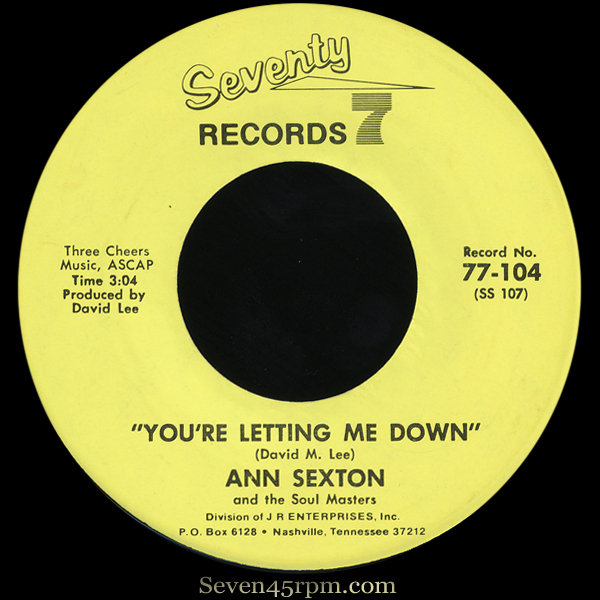
 Seventy 7 Records 77-104 US Year 1972
Track 1 – You’ve Been Gone Too Long Track 2 – You’re Letting Me Down  Mary Ann Sexton was born In Greenville, South Carolina and was yet another child raised by a family heavily influenced by gospel music (a time it seems when heavenly angels were certainly handing out some great voices to their young followers). Her path was always going to be singing amongst her church choir, but she was also open to talents shows on the side, which by no surprise ,she won more than a few times.
In 1967, Ann had her first recording experience as a featured singer on Elijah and the Ebonies’ I Confess on Gitana (credited as Mary Sexton). A beautiful soul ballad that’s hard to come by, and a track that really demonstrates the beginnings of her talent…a teasing taste of things to come from Sexton. The Ebonies’ Tenor and Alto sax player, Melvin Burton (who gained notoriety as a youth playing for Mosses Dillard), must have shared a certain spark with Ann, falling in love, they married soon after and started their own group, Ann Sexton and the Masters of Soul.
Soon song writer David Lee would discover the dynamic soul group while performing at a club in North Carolina in 1970. He had the small label Impel at the time and had to have them on board, so he penned the ballad You’re Letting Me Down, and also with the coloration of Ann and Melvin, what must be the most incredible soul B side ever…You’ve Been Gone Too Long. I’m not evening going to try and explain the purity and greatness of this track. If you don’t feel it, then there’s nothing I can do to help you…although I’ve never know anyone not to love this track. And the A side is a little monster ballad too.
 Now I usually strive with all my might, to sort first pressings whenever I can, but this red Impel 1971 pressing has eluded me for some time. It rarely surfaces around the collectors market although a little while back, a handful did show up briefly. And it is rumored that this was due to a freak find someone was fortunate to discover…a box of mint jukebox 45’s, including a nice handful of these pressings. While they did prove to be way over my budget, maybe it’s a regret I may now have to live with.
The Impel release gave Ann the recognition she needed and soon after, was signed to Nashville’s soul DJ and label owner John Richbourg’s Seventy Seven Records. In 72, this killer double sider was thankfully re-released, (Richbourg must have realised how deserving and worthy these two great compositions would be for his label) but even this first Seventy Seven pressing for Sexton isn’t an easy one to find. There is an alternate label press also, with a later more graphic, brighter label, and while I do believe it is a slightly later press, I’m not sure what the time frame between each pressing is (anyone out there know?)
1972-74 were busy years for Sexton, releasing five 7’s, including the must have You’re Losing Me (penned by Ann and Melvin) flipped with the great You’re Gonna Miss Me. Recording in Nashville and Memphis, she also released her first album Loving You, Loving Me produced by Lee and Richbourg (Ann and Melvin penned six of the songs)….to this day, a much sorted LP.
1977 saw the release of Ann’s 2nd studio album The Beginnings (Sound Stage 7)… now a classic album with some beautiful ballads like Be Serious and I Want To Be Loved, but it also included the very danceable You Can’t Lose With The Stuff I Use and the soulie I Had A Fight With Love. Unfortunately there was only one single release from the album, I’m His Wife.
After her second album, Ann decided to leave the music industry and relocate to New York. Looking to escape the stressful politics of the music industry, she embraced a career change. Her desire to help the community inspired her to become a school teacher.
I am pleased to report that today, Sexton has been rediscovered, and due to popular demand, she is now on the occasion performing back on the stage, where she can once again share that incredibly beautiful voice. But I believe Ann has never needed a stage to shine, she has warmed many turntables and dance floors around the world for many years, whether she has been aware of it or not.
The Miller Sisters – The Hully Gully Reel

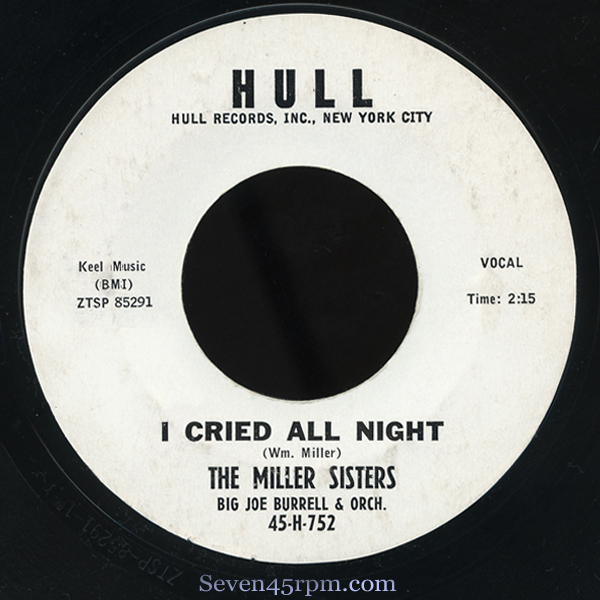 HULL Records Inc. 45-H-752 US Year 1962
As I’m researching this fabulous piece of R&B dance floor femme gem, I quickly discover that there is actually a lot of conflicting and confusing information (again!) out there, regarding this 5 pc. Miller Sisters vocal group and Sun’s Rockabilly sibling partnership that were around at a similar time, with the same name. Two completely different groups yet both so brilliant. I will be posting on the Elsie Jo and Mildred Miller sisters soon I promise!
The Miller Sisters (from Long Island, NY) are Jeanette, Maxine, Nina, Sandy and Vernel, and were the talented daughters of music entrepreneur William Miller, A&R director for Hull Records.
They first recorded Hippity Ha with the adorable flip Until You’re Mine for Herald back in 1955, the same year they also scored a starring role in Fritz Pollar’s R&B picture Rockin’ the Blues, which also included the Harptones, Hurricanes, Wanderers and the great Lula Reed.
In ’56, after releasing Guess Who / How Am I To Know on Ember, they moved to Hull Records, which was the label former Herald Records executive Blanche (Bea) Kaslin’s established along with Billy Dawn and Mr. Miller (apparently Kaslin had just had enough of seeing artists being mistreated, not paid appropriately, and being taken advantage of with contracts). The label had some great R&B success with their very first release from The Heartbeats Crazy For You / Rockin-‘n-Rollin-‘n-Rhythm-‘n-Blues-‘n in ’55. While the sisters were at Herald records, their father obtained their release from an exclusive contract that they held with the label and would thereafter freelance for Hull, ACME, Onyx, Riverside, Roulette, Capri and others.
 Moving forward to ’61, and it was hully gully fever that was scuffing the dance floors, and the Glodis release Pop Your Finger (flip to You Got To Reap What You Sow) certainly would have been getting some heavy rotations around the dance halls.
1962 brought some crackers for the girls, firstly Rayna’s superb release Dance Little Sister (flipped with I Miss You So), and this is the stuff that just thrills me. Slow and swinging, but heavy on the rhythm, and brutally charming vocals with more sass than one can handle. Then on Riverside, the dizzyingly beautiful ballad Tell Him (flipped with Dance Close).
But the year also brought out this beast…The Hully Gully Reel! It’s a mass of rhythm delivered by a thundering steam train. A good one to drop when the dance floor is all warmed up and salivating. Feels very Eddie Bo…it’s got that empowering rhythm, but it’s the legendary Big Joe Burrell with his big Sax driving the orchestration with full pelt. Burrell would work with the Sisters on tour and other recordings for a big part of their career, and it’s obvious a match made in heaven. If 2.15 minutes of non stop frantic hully gullying rocks your boat, then you’re getting you money’s worth here on this 45! Not for the faint hearted! And by the way, how good is that electric organ?! It’s on fire!
In ’64, Big Joe and the ladies struck again with Cooncha – Hey You which they recorded in Quebec for Capri in ’64, supposedly while on tour together…driving stuff! (Their father was credited as “Pop Miller” on the label). The Sisters weren’t done though as far as killer 45’s go. A much more soulful I’m Telling It Like It Is on GMC from ’65 is also very desirable!
The Miller Sisters recorded around 22 singles for various labels, and as is the case with this one, some are not easy to find. I feel very fortunate to have my hands on this one, and have made an oath to share it on as many dance floors as I can!
Discography : (as far as I can make out from Goldmine and other sources)
1955 – Hipetty Ha / Until you’r mine (Herald 455)
1956 – Guess Who / How am i to know (Ember 1004)
1956 – Please Don’t Leave / Do You Wanna Go (Hull 718)
1957 – Sugar Candy / My Own (Onyx 507)
1957 – Let’s Start Anew / The Flip Skip (Acme 111)
1957 – You Made Me A Promise / Crazy Billboard Song (Acme 717)
1958 – Let’s Start Anew / The Flip Skip (Acme 721)
1960 – Oh Lover / Remember that (Miller 1140)
1960 – Pony Dance / Give me some old-Fashioned love (Miller 1141)
1960 – Just Wait And See / Black Pepper (Instrumental) (Hull 736)
1961 – You got to reap what you sow / Pop your finger (Glodis 1003)
1962 – I miss you so / Dance little sister (Rayna 5001)
1962 – Walk on / Oh Why (Rayna 5004)
1962 – Roll Back The Rug (And Twist) / Don’t You Forget (Hull 750)
1962 – Cried All Night / Hully Gully Reel (Hull 752)
1962 – Dance Close / Tell him (Riverside 4535)
1963 – Baby your Baby / Silly girl (Rolette 4491)
1964 – Cooncha / Feel good (Stardust 3001)
1964 – Cooncha / Hey You (Capri 950) Quebec
1965 – Looking over my life / Si Senor (Yorktown 75)
1965 – Your Love / Please Don’t Say Goodbye Dear (GMC 10003)
1965 – I’m telling it like it is / Until you comme home, I’ll walk alone (GMC 10006)
Darondo – Didn’t I


Music City USA Cat#45-894 Year 1972
Upon learning of the recent loss of the great and mighty Darondo, I thought it an appropriate time to praise what I think, is one of the most beautiful and soulful songs you will ever hear in your lifetime, by this unknown master.
Born October 5, 1946, William Daron Pulliam was raised in Berkeley, California, where his mother bought him his first guitar when he was around eight. When Darondo hit his later teens, he and a bunch of high-school friends formed The Witnesses, who became the house band for a strict early night “teenage nightclub” in Albany called the Lucky 13 Club. He fell in love with the R&B and rock that was popular at the time, but it wasn’t until he picked up Kenny Burrell’s 1963 album Midnight Blue that he found his niche. “I learned guitar from listening to Kenny Burrell,” Darondo says. “Him and Wes Montgomery. I got my chords from them. Kenny Burrell was cold“.
Darondo may have trained to be an electrician in his twenties, perhaps doubting his abilities to reach a professional music career, but obviously there was a light within him that needed to rise up and out into the world…and indeed, there certainly was an incredible and important voice that needed to be heard.
His friends may have treated his determination for releasing his own record with skepticism, however he insisted “I’m going to show you suckers something. I don’t care if I have to do it myself; I’m going to put this thing out.”
Darondo’s big break came when he met experienced jazz pianist Al Tanner, who was impressed with Darondo’s style and suggested that he should go into the studio. That session produced the great “Darondo Pulliam” two-sider, I Want Your Love So Bad, flipped with the mover How I Got Over, on Leroy Smith’s Ocampo label. Although the song didn’t exactly light up the charts, it caught the attention of Ray Dobard, who owned the record label Music City.
Darondo and Tanner recorded nearly an entire LP in one session at Dobard’s studio. The session produced the fat funk Black Power anthem Let My People Go and the killer jam Legs, but it was the soul pouring “Didn’t I” that became Darondo’s 7″ release in ’72. Local radio put the song into heavy rotation, and the single went on to sell 35,000 copies. Unfortunately, no LP ever came out of that session. “We did about ten tracks,” says Darondo. “I think [Dobard] stole the records. I don’t know what happened to those songs, I don’t know what he did with it.”
But in ’74, there was a third and final single to come out from those sessions, his rarest 7″, recorded for the uber-obscure Af-Fa World imprint (Let My People Go/Legs). By this time, Darondo’s voice had matured, settling in with a refined falsetto that harkened to his years listening to and singing gospel, or what he calls, “spiritual things.” “Spiritual and rhythm and blues—it’s two different things,” he explains. “If you can sing a spiritual thing, you can mostly sing anything, because you are hitting so many more…high pretty notes.”
During his early-’70s run, Darondo opened up for James Brown, became a close acquaintance with Sly, and by all accounts, lived the high life. He’d purchased his signature Rolls Royce from a “cold” car dealer. “This Rolls had racing lights,” he recalls. “It had a bar in the back …I put all the scanners and other mess up in it, so that if the police pulled up behind you, you could hear everything they say. It was too cold. At that time, I had mink coats, diamond rings. I stayed sharp.”
 While it may have seemed Darondo was living a little too well for a fledgling regional star, it is rumoured he had other sources of income, as a successful pimp, though it’s a topic he himself refused to speak about, neither confirming nor denying, though he did elliptically refer to it as his “fast life” days. “When people see something, they’re going to think one way or they’re going to think another way,” he muses. “When they saw a chauffeur driving me around in a Rolls, they said, ‘That boy is a pimp.’ I made money, but I was working. I had a job … I was a janitor. I drove up [to the hospital] in the back of my Rolls with my mink coat on … and I’d take the elevator down and change in [the janitor’s locker].”
But back to Didn’t I. It only takes one listen to this haunting, down-tempo breakup ballad to realise that there is something pretty special happening here. And to tell you the truth, I actually don’t play this very often, even in the company of no one else but me and my dog…and it’s a 45 that’s never left the house. Darondo’s wiry falsetto, his lonely guitar chords and understated, melancholic orchestration makes it all just too personal and devastatingly beautiful. I don’t know really what else to say, only that this composition deserves respect. This means if I’m going to play this record, I’m doing nothing else but sitting back with your eyes closed and my soul wide open.
Ubiquity Records put together 2006’s Let My People Go, a collection of reissued classics and unearthed demos. The album won praise in the national press, and Darondo after so many years away in another life, was once again performing live shows. “I never imagined this,” he told SF Weekly in 2007 about his return to the stage.
Darondo died of heart failure on Sunday June 9, 2013.
Be sure to read the following references from Sam Chennault and Oliver Wang.
-Piero
Bobby Bland – Honey Child

 DUKE USA cat# 433 (promo) Year 1964 Robert Calvin “Bobby” Bland was born January 27, 1930, in the small town of Rosemark, Tennessee, later moving to Memphis with his mother in 1947. He worked at a garage during the week and sang spirituals on weekends, singing with local gospel groups including, amongst others The Miniatures. He began frequenting the city’s famous Beale Street where he became associated with a like minded bunch of aspiring musicians, who were referred to as the Beale Streeters (although they never used that name themselves), which included such future blues stars as Johnny Ace, B.B. King, Junior Parker, and Rosco Gordon .
Between 1951-52 he recorded four 7″s for Chess, produced by Sam Phillips, alongside Rosco Gordon and as The Bobby Blues Band. While the results of those recordings were not a huge success to say the least, that didn’t stop local DJ David Mattis from cutting Bland on a couple of 1952 singles for his fledgling Duke logo. That same year Bobby was drafted to serve his country, he went off to war, and had to put his career on hold.
When the singer returned in 1954, he found that the Memphis he once knew was no more. Sun Records had found its fair haired boy, Rock and Roll was breaking down the old barriers between “race” and “pop,” and Duke Records had been sold to entrepreneur Don Robey, owner of Peacock Records in Houston, while several of his former associates, including Johnny Ace, were enjoying considerable success. But Bobby’s talent and maturity as a vocalist had exceeded even more in just those last years, and now Duke was ready to push Bland full steam ahead, with It’s My Life, Baby, Woke Up Screaming and Time Out all released in ’55. Bobby’s first national hit, which went to number 1 on the R&B charts, is the driving Farther Up the Road, which was released in 57′, and burns almighty with the insistent guitar riffing contributed by Pat Hare, another vicious picker who would eventually die in prison after murdering his girlfriend and a cop. In ’61 the beautiful I Pity The Fool and the great soul number Turn On Your Love Light also did well for Bobby and deservedly so.
Bland spent the latter half of the Fifties maturing into a masterful singer and assured entertainer. From 1957 to 1961 he played the chitlin’ circuit with Junior Parker and his band, the Blue Flames. But in 1961 Bland broke with Parker, went out on his own, and rose to his greatest popularity.
And now we jump to 1964, Honey Child, easily my pick of the crop from such a expansive field of BB soul jewels. And why this flip to Ain´t Nothing You Can Do is so over looked, I will never know! His distinctive silky smooth vocal style slides perfectly into the slinky, swinging rhythms, and it really pulls you in. And in a sudden, the sheer beauty of it all gets pretty overwhelming and inescapable. Adorable and modest guitar phrasing from Wayne Bennett complements the sometimes rampant yet soulful horns which I’m assuming only the great Joe Scott (trumpeter, band leader and Don Robey’s chief talent scout) could be responsible for holding this dance floor gem all together!
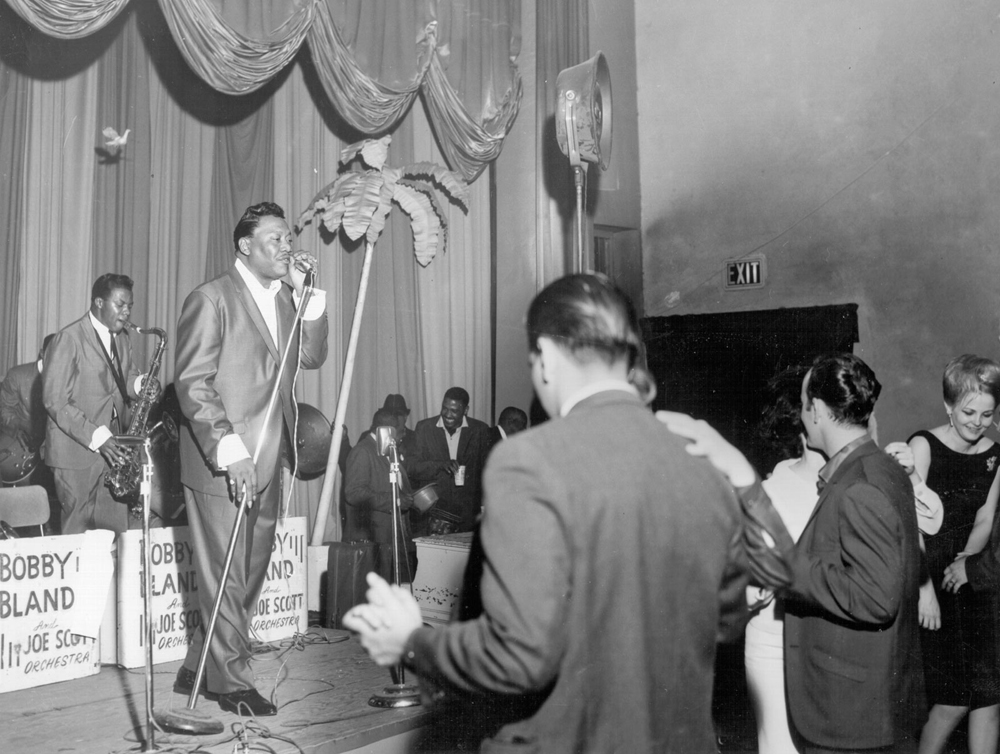 Bobby was sometimes referred to as the “Lion of the Blues”, and without a guitar, harmonica, or any other instrument to fall back upon, all he had to offer was his magnificent, charismatic voice. A voice unmatched in my opinion. With his captivating live performances (and a legion of female fans who deemed him a sex symbol even late into his career) he helped bring the blues out of Delta juke joints and into urban clubs and theaters. Bland’s records mostly sold on the R&B market and he had 23 Top Ten hits on the Billboard R&B charts and in the 1996 Top R&B book by Joel Whitburn, Bland was rated the #13 all-time best selling artist. I believe he is still performing to this day!
Note: I originally posted this entry back in early June 2013. He died on June 23, just 2 weeks later, at his home in Germantown, Tennessee, after what family members described as “an ongoing illness”. He was 83. After his death, his son told news media that Bland had recently discovered that musician James Cotton was his half-brother.
The Stovall Sisters – Hang On In There

 Reprise Records USA Cat#1028 Year 1971
The Stovall Sisters may have come from a strong gospel upbringing, but this thumpin’ delivery is a hymn praising winged angels with halos of fiery funk!
Born in Kentucky and raised in Indianapolis, Indiana, sisters Nettie, Lillian, and Rejoyce, were three of ten children of James and Della Stovall. Their mother was keen to lay down a musical path for her children, by kick-starting their singing voices from around the age of two, and as they grew up, they would tour the roads of the Midwest and South with the family gospel groups.
The first family group was known as the Four Loving Sisters (the name was later changed to the Valley Wonders) and consisted of the four eldest sisters, Billie, Dorothy, Frances, and Georgia. Prior to joining the Valley Wonders, Wayne, Nettie, Lillian, and Joyce performed in a separate family act known as God’s Little Wonders for as long as their childhood held out. When they grew too big to persist as ‘Little Wonders they inherited the mantle of the Valley Wonders from the four older sisters whose careers had succumbed to marriages. Della managed and negotiated recording contracts for them, who also recorded as The Stovall Family (accompanied by two brothers).
In 1964 the family moved to Oakland where the already seasoned performers finished high school and began worrying about economic survival. They continued to sing in church but the Stovall sisters had to support themselves with weekday jobs. During this period they broadened their repertoire to include rock ‘n’ roll and rhythm and blues which gained them entrance to Oakland area night clubs, sometimes under the name of Sister Three.
In 1968 the three girls decided to go for it, a full time professional rock n’ roll career. Their initial step in this direction was naive but direct. According to Lillian “We put an ad in the Oakland Tribune – Three black girls looking for a Caucasian band to sing with”. The only serious response was from a man named William Tuckway. “He came right in and sat on the floor like we’d be knowing him for years”. Tuckway would soon co-produced their debut album on Reprise along with Erik Jacobsen.
 Hang On In There is the funk standout on their sole Warner/Reprise gospel/R&B crossover album and I’m so damn thankful that it was issued on a beautiful and loud 45. It looks like it was only released as a promo two same-sided track, in mono and stereo. It’s a big groove song…and a wildly uptempo-ed journey! The band is hot, tight and super sharp…going from album credits-Bass: Doug Killmer, Drums: Bill Meeker, Guitar: Dennis Geyer and on Horns: Ron Stallings, John Wilmeth, Hart McNee, David Ginsburg and Neil Kantor. Too good not to share and deserves far more attention than it gets!
The three sisters maintained a successful career as studio professionals and touring backup singers for an impressive list of well-known artists that include The Staple Singers, Bobby Womack, Ray Charles & The Blind Boys, BB King, Big Mama Thornton, Etta James, Jackie Wilson, Joe Tex, Parliament-Funkadelic and briefly performed as the Ikettes with Ike & Tina Turner, 1967.
The Stovall Sisters would go on to record unreleased tracks for an album with Earth, Wind & Fire’s Philip Bailey and Maurice White but would disband before its release. The Stovall Sisters currently reside in Oakland, Calif.
Recommended reading Opal Louis Nations
Bobby Scott – Moanin’

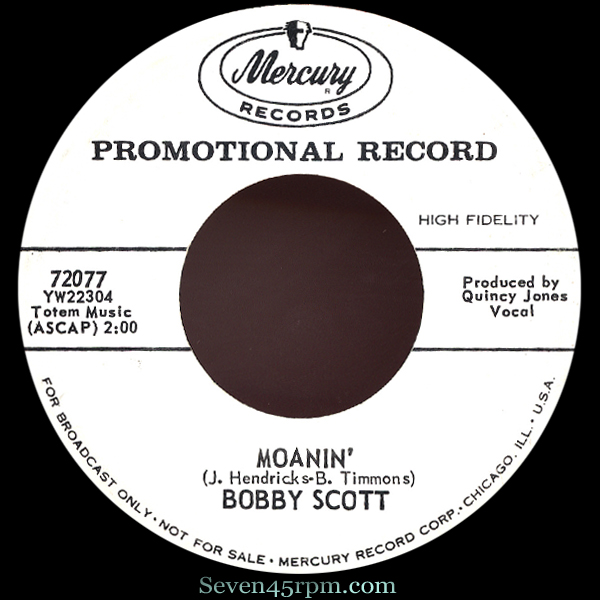 Mercury USA 7″, Cat# 72077, 1962
Hip cat Bobby Scott (born Robert William Scott, in 1937, Mt. Pleasant, New York) is one of those mysterious lost and shadowed artists that really deserves to be pushed into the brightest spotlight, and for those of you out there that love your RnB snappy and snazzy and don’t know this one…well, you should!
Scott was a gifted music prodigy, one who could play piano, double bass, cello, vibraphone, accordion, clarinet, and of course knew how to use his voice box just fine! He studied under Edvard Moritz at the La Follette School of Music at the age of eight, and then in 1949 studied composition with Edvard Moritz, a former pupil of Claude Debussyand, and was working professionally at 11.
It was the early 50’s and despite his early classical training, Scott followed his teen callings towards jazz and played with small bands led by the great Louis Prima and Gene Krupa and cut some tracks for Verve Records with a few of these great small groups.
At 16, he started recording for several other record labels including Bethlehem, Savoy, and ABC, who in 1956, released the hit “Chain Gang” written by Sol Quasha and Hank Yakus, which peaked at #13 on the U.S. Billboard Hot 100!
In 1960, Scott began teaching music theory and harmony and returned to his studies under Moritz. He also signed with Atlantic, releasing a trio of albums under his own name, and started working with other artists, notably Bobby Darin, who he would become a very dear friend to.
That same year, Bobby Scott wrote the title theme for the Broadway version of Shelagh Delaney’s 1958 British play “A Taste Of Honey”, which was exotically made famous by pianist Martin Denny. The instrumental tune was soon given lyrics and was stylishly recorded by the beautiful Julie London, and also Sarah Vaughan, Bobby Darin and by some band called The Beatles. All these versions are quite unique to each other, and I’m sure Mr.Scott must have been pretty chuffed with every interpretation.
Bobby’s big hit won him a Grammy in 1962, but thanks to Herb Alpert’s US Top 10 take, 3 more were added to the list 3 years later. It has been covered so many times by so many great artists but it’s Martin Denny’s 69′ Exotic Moog version I find the most intriguing.
Around 1962, Scott entered one of the few stable periods of his career, taking on as staff producer at Mercury records and working extensively with Quincy Jones. There he would output four albums including the vocal release When the Feeling Hits You, which also happens to be the flip of this killer 45!
Moanin’ first appeared on the self titled Art Blakey and the Jazz Messengers album, recorded in 1958, and was written by pianist Bobby Timmons. Soon after, the composition was given lyrics by Jon Hendricks, who is considered one of the originators of “Vocalese”, and was taken up by Lambert, Hendricks & Ross who released a really super smooth vocal version on Columbia, which even sounds better with a Martini or two!
But it’s Scott’s version that blows the stripey socks off! His mod take is tempting from the first few seconds the open piano chords call. It’s jazz, but it cops a big whack with a broken bottle of rock ‘n’roll, and that mix is deliriously delightful! And again, here we get some extra topping, quite a lot actually, with some killing twang! One of my favourite guitar jigs to dance to, it’s relentless, stabbing and stabbing, but the blade is blunt and dirty. You step to the left, then side step to the right, but it just keeps on gettin’! On his return, Bobby is a slight crazed, and disheveled, then we see him fade into a dark lane far too quickly…and we’re left wondering if that all really just happened?!
Bobby Scott continued to compose up until the mid to late 70’s, but recorded a final farewell album For Sentimental Reasons in 89′. He died only 18 months after, succumbing to lung cancer on November 5, 1990 at the age of 53 in New York City. He was as a top-flight pianist, composer and arranger who was so important to the jazz world, but with a release like this one, for a brief moment, he was the king of snap jazz n’ pop!
Referencing and recommended reading…..
Nina Simone – Come On Back, Jack

 Colpix CP 614 US Year 1960
“She earned the moniker ‘High Priestess of Soul’ for she could weave a spell so seductive and hypnotic that the listener lost track of time and space as they became absorbed in the moment.” Official ninasimone.com.
As we all know, she was arguably one of the most important and influential women of the soul, blues and jazz genre, and I think the only real place to start a 45 collective journey is at the beginning. And it was in the early 60’s, a time when Nina was singing some of her most intimate and bluesy compositions of her career, when this little fiery monster surfaced amongst it all!
But first a little bit about Eunice Kathleen Waymon. She was born in Tryon, North Carolina on February 21st, 1933, the sixth child to a Methodist minister mother and a handyman and preacher father, and started playing piano by ear at the age of three. Her parents taught her right from wrong, to carry herself with dignity, and to work hard, which would in time mold her into the incredibly strong woman she grew up to be. She played piano in her mother’s church, displaying remarkable talent early in her life, but didn’t sing at that time.
Able to play virtually anything by ear, she was soon studying classical music with an Englishwoman named Muriel Mazzanovich, and quickly developed a lifelong love of Bach, Chopin, Brahms and Beethoven. After graduating from her high school, her local community raised money for a scholarship to study at Julliard in New York City before applying to the prestigious Curtis Institute of Music in Philadelphia. Eunice’s hopes for a career as a pioneering African American classical pianist were dashed when the school denied her admission. To the end, she herself would claim that racism was the reason she did not attend.
To survive, she began teaching music to local students, and also began singing in bars, which Eunice’s mother would refer that practice as “working in the fires of hell”. But quickly she attracted club goers up and down the East Coast with her unique jazz-blues renditions of Gershwin, Porter and Rodgers standards. And then Eunice Waymon became Nina Simone, taking the nickname “Nina” meaning “little one” in Spanish and “Simone” after the actress Simone Signoret.
At the age of 24, Nina came to the attention of Syd Nathan, owner of the Ohio-based King Records, and was signed to his Jazz imprint, Bethlehem Records. While at first Nathan had insisted on choosing songs for her debut set, he eventually relented and allowed Nina to delve in the repertoire she had been performing at clubs and was well known for. What I think is one of her most outstanding jazz compositions on Bethlehem is the B sided African Mailman released in 1960, and one you really need to check out!
Nina’s stay with Bethlehem Records was short lived and in 1959, after moving to New York City, she was signed by Joyce Selznik, the eastern talent scout for Colpix Records, a division of Columbia Pictures, founded in 1958. Her stay with Colpix resulted in some incredible recordings, including 9 albums, and some mighty fine 45’s including Forbidden Fruit and her beautiful version of I Got It Bad.
Produced by big band legend Stu Phillips, Come On Back, Jack is Nina’s response to Ray Charles dance floor bomb Hit The Road Jack, (written by rhythm and bluesman Percy Mayfield) which was released that same year! But while it does share a similar riff and beat, I have to say it’s Nina’s jam that has got Jack running the fastest and packs as much, if not more, dance floor impact. Unavailable on LP, this is a prized diamond hidden amongst so many jewels in Nina’s treasure trove that’s worth hunting for!
Finally, this post is only a very small chapter of this remarkable woman’s life and her recording career, but please stay tuned for future Simone posts here, as there’s certainly a few more 45’s that deserve to be spotlighted!
To find out so much more on this incredible woman’s highly influential life and music visit ninasimone.com.
And also….I Put A Spell On You: The Autobiography Of Nina Simone
The Kane Triplets – Theme from “Mission: Impossible”
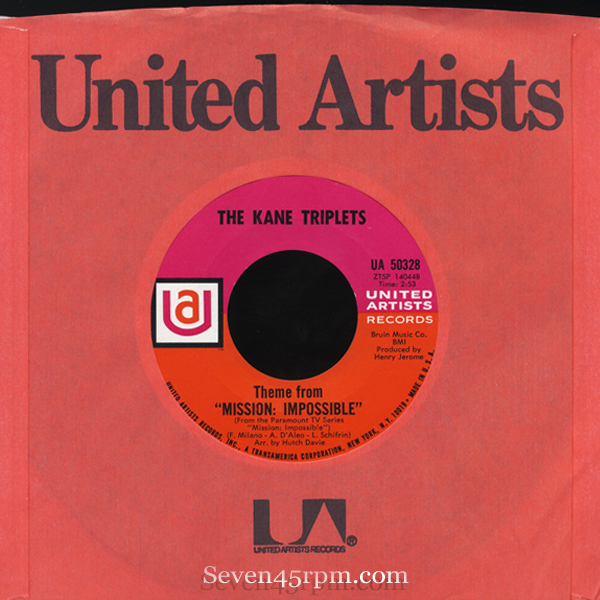
 United Artists 50328 US Year 1968 The Kane Triplets were a three piece vocal sensation made up of the sweet identical triplets Lucille, Jeanne and Maureen Kane, and started their professional show business career very early in life. As children, they were discovered by the McGuire Sisters after performing on the Arthur Godfrey Talent Scout Show, and were asked to join with them in their act on the road and on several television shows. As you can imagine, these little ladies must have been so overly cute and wholesome, but from the footage that you can track down on the net, you cannot deny them of their harmony abilities!Reaction to the girls was amazing! The triplets established their own act and with their growing success, worked in very renowned venues throughout the country, and making Vegas their second home. They even got to work with huge celebrities like Tony Bennett, Andy Williams, Sergio Mendes, Smokey Robinson and the Temptations
The ladies released a few 45’s but it was in 1968 when this little monster was unleashed to the world! Easily their most stin ging and thrilling recording, which really does give justice to Lalo Schifrin’s original 66′ master piece. While writing credits go to Fred Milano and Angelo D’Aleo of The Belmonts, I can’t tell you if this was in fact the first vocal release, but it’s by far the best I’ve heard. The fact that these now adorably blossomed but still innocent looking ladies are behind this big composition and production makes it even more tastier!
 The Kane Triplets were in show business for more than 20 years and made dozens of television appearances, but sadly another sad ending to this story learning that Jeanne Kane was found murdered at a Staten Island (New York City) commuter rail station parking lot, murdered by her ex-husband and retired sergeant John Galtieri in 2007. But on a nicer note, this song always get a great reaction on the dance floor when played and will keep these three little sisters shining on together for many more years.
The Pussycats – I Want Your Love

 Columbia 4-43272 US Year 1965
Track 1 – I Want Your Love Track 2 – The Rider
One of my top tens here and it just kills me that I cannot find out any real information on these garage grrls and this killer recording! It’s looking like this mighty four piece girl group may have only ever laid down four studio tracks in their career, including this release with The Rider on the flip, and also You Can’t Stop Loving Me (Columbia 4-43587), which I’m guessing was released that same year. You also get the strange and delightful Dressed In Black on that flip, made popular by The Shangrilas in ’66 on Red Bird.
 I Want Your Love, written by Tony Michaels, has all you could possibly want in my opinion. Opening with a dangerous blues riffing companionship with overdrive guitar and bar piano, insert seductive vocal “Hey you…. come here” and before you know it, you’re in the widow’s web. The first verse is playful and desperate, and the backing doo-wops and harmonies are starting to spin you in a spiral. We are now only 30 seconds in and the guitar gets dirtier and the build up, like a steep roller coaster climb, is making you nervous. You’re pretty much trapped by now, and can’t help feeling like that little mouse that kitty just won’t let die…all in the name of selfish pleasure perhaps. This track ticks all the boxes for me! It’s raw and driving, like good garage should be. It’s got great horns and pace, stomping percussion and stinging guitar, and of course those femme fatale vocals….innocent yet sultry, and even soulful! Great production from Michaels and killer arrangement by Artie Butler!
The Rider is more down tempo but still just as charming and has more of that Spector sound that I can’t get enough of! All four Pussycats recordings also came out as an EP (Portugal) through CBS in ’66 with a killer pic sleeve (above) with all band members. As always, I would love to know more about these elusive ladies and their recordings.
Darrow Fletcher – What Good Am I Without You
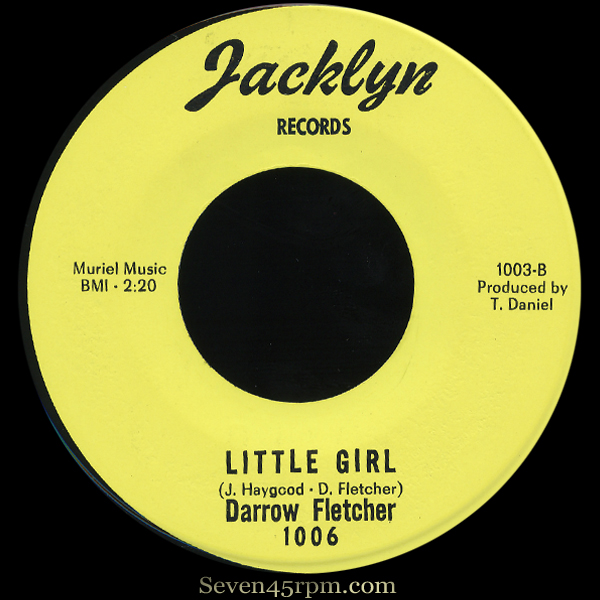
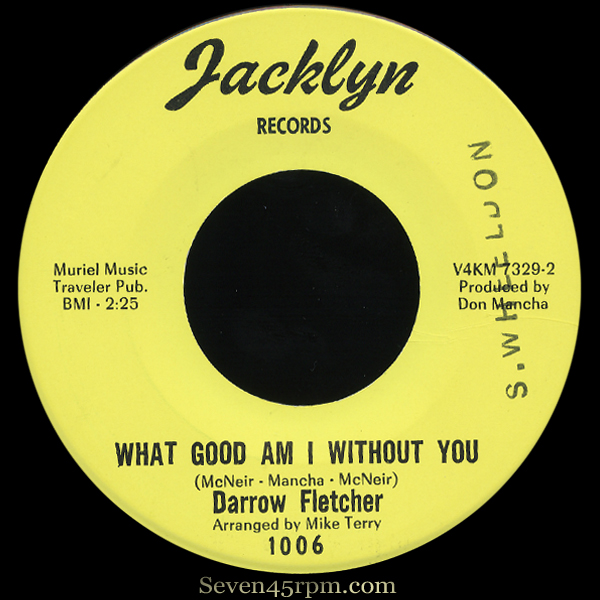 Jacklyn Records 1006 US Year 1967The first time I heard Darrow Fletcher, which was a few years ago now, was one of those life changing experiences. An instant connection and a desire for his records and his sound. A man with an active 7″ soul catalogue, however somehow still quite unknown and mysterious as far as main stream popularity goes. Wasn’t really too sure what to present for my first DF post, but why not go with one of his very best on Jackyln. But first a little history on this great man, and the best place for that lesson is to dig over at Soul Source.
Darrow, born 23 January 1951, moved with his family to Chicago when he was 3, from the Detroit suburb of Inkster. It seems even as a young 6 year old, he was never uncertain about his stage and singing destiny. His love and enthusiasm for song and performance was a gift he must have truly accepted without any hesitance. Whilst he was a freshman in high school in December, 1965, he recorded “The Pain Gets A Little Deeper”, written by himself and producer Ted Daniels, and cut with the help of his stepfather-motivated business man, Johnny Haygood. Is this really the voice and heart of a young 14 year old school kid !? An impressive debut to say the very least! The record was leased to Groovy, a small New York label owned by Sam and George Goldner and Kal Rudman. They got the record on the national R&B charts for seven weeks in early 1966, and was also released on London in the UK.
Soon Darrow was touring the “chitlin” circuit, playing venues like The Apollo, The Uptown and the Regal, where, in July ’66 he shared the bill with B B King, Lee Dorsey and Stevie Wonder. Following three not so successful follow-ups on Groovy, Darrow’s stepfather formed Jacklyn Records in 1966, named after one of his daughters. Darrow cut three singles on Jacklyn, “Sitting There That Night” scored immediately, 2,500 sales for the record in Chicago alone. Darrow co wrote it with his stepfather, and is also providing one of the sweetest guitar solos here, still at the age of 14! The flip “What Have I Got Now” is an insanely beautifully tempo-ed soul track and makes that a 7″ monster must have!
What Good Am I Without You was penned by Don Mancha and produced and arranged by horn player Mike Terry a year later. Again, this is a very big song and arrangement. The pace is high, just as the heart is beating. The strings and backing vocals are stuffed with passion and the chorus is an out pour! To tell you the truth, I’m really not sure if it can ever get better than this! The flip’s Little Girl is a sweet ballad Darrow co-wrote again with his stepfather.
I think it’s fair to say that Darrow had two very distinctive periods to his career. The first part were the records he made in Chicago between 1965 and 1970, and then the handful of singles cut in Los Angeles in the 70s, which had quite a different more modern soul feel, which I’ll dig deeper into in related future posts. But I love them all. There’s an honesty in his voice that I find so compelling and desirable and I hold him up high in praise as one of my all time favourite artists.
A must read is this recent enlightening interview by Boxy from Soul Source…Darrow Fletcher – The Interview – The Full Story
Sly and the Family Stone – Underdog

 Epic 5-9951 US Year 1967
Track 1 Underdog Track 2 Bad Risk
Sylvester Stewart was born in Dallas, Texas, in March of 1944 & began his recording career at the very early age of four as a vocalist on the gospel tune On the Battlefield for My Lord. In the 50’s, his family moved to the San Francisco area where he & his brother Freddie learned to play various instruments & made music under the name the Stewart Four. Stewart also played & sang with doo-wop groups & in high school sang with a group called the Viscanes, appearing on their record Yellow Moon, & at sixteen made a solo record called Long Time Away which gained him some modest fame.
Stone studied music composition, theory, & trumpet at Vallejo Junior College in the early 60’s & began playing in several groups on the Bay Area scene. Around ’64 he had become a disc jockey at the R&B station KSOL, & his radio appearances led to a job producing records for Autumn Records. There he worked with a number of San Franciscan garage & psychedelic bands & he himself recorded three 7’s titled Buttermilk PT1-2 & Temptation Walk PT1-2, both in 65, & also the unusual surf track I Just Learned To Swim in ’64 flipped with Scat Swim, which is a personal fav’ that I’ll have to share sometime in the future…it’s a little insane!
As a DJ he gained notoriety as one of the more eccentric voices on radio, blending sound effects with public service announcements & mixing soul singles with rock & roll records by Bob Dylan & the Beatles, & was generally considered the top R & B commentator in the area.
In ’66 Stewart’s current band The Stoners split, & it was saxophonist Jerry Martini who approached Stewart, who was content at the time with his DJ gig, into fronting a new band. Along with Martini, Stewart enlisted brother Freddie as guitarist & his sister Rosie to play piano, with the addition of bassist Larry Graham & drummer Greg Errico & ex-Stoners trumpet player Cynthia Robinson. Stewart changed his name to Sly Stone, & the Family Stone was born.
The band quickly attracted the attention of Columbia Records A&R executive David Kapralik & soon signed with Columbia, releasing its debut LP, A Whole New Thing, in 1967 on the Columbia subsidiary Epic Records. The album didn’t fare particularly well, but my only explanation for that could possibly be only because of the lack of radio hits, & definitely not the lack of fat funk! The opening track on that Lp, Underdog is a killer & the debut album’s only 7″ release which, I suspect, was a promo only (please correct me if I’m wrong!). I myself think this is the most desirable & important Sly 45 to have! It’s an epic tune, with big vocals, snappy rap versing & the sharpest percussion. I’m just not sure the world was ready for this!
But it didn’t take long for the Family to hit it big, which they certainly did with the almighty (& much more radio friendly) US. and UK. Top 10 smash Dance To The Music, from their follow up LP of the same name. Even Sly admits he wasn’t ready for what was about to hit them!
In ’69, Sly released the album ‘Stand’ which included the next big follow up hit Everyday People. A big album, with some big songs, also including I Want To Take You Higher & my personal fav’ from the album, the title track Stand!
This album went on to sell two million copies.
Underdog was also released on a french picture sleeve as a B side to Dance To The Music, but it’s this bad boy you want with the baddest Bad Risk on the flip!
It must be noted that Sly & the Family Stone did release a mysterious 7″ with the titles I Ain’t Got Nobody & Otis Redding’s I Can’t Turn You Loose on the flip, on a small San Francisco-based Loadstone label. This is said to be the first “Family” 7″, however the dates I’m getting on this release are all over the place ranging from 67 to 72. The track also appeared on their ’68 LP.
The Family Stone are credited as one of the first racially integrated bands in music history, belting their message of peace, love & social consciousness through a string of hit anthems. Their music fused R&B, soul, pop, jazz, & an emerging genre soon to be dubbed funk! Sly developed a formula for the band’s recordings, which would still promote his visions of peace, brotherly love, and anti-racism while appealing to a wider audience. And his new fused sound not only worked in selling records, but influenced the entire music industry. When “Dance to the Music” became a Top 10 pop hit, soul producers and labels immediately began appropriating the new “Psychedelic soul” sound. By the end of 1968, The Temptations had gone psychedelic, and The Impressions and Four Tops would join them within the space of two years.
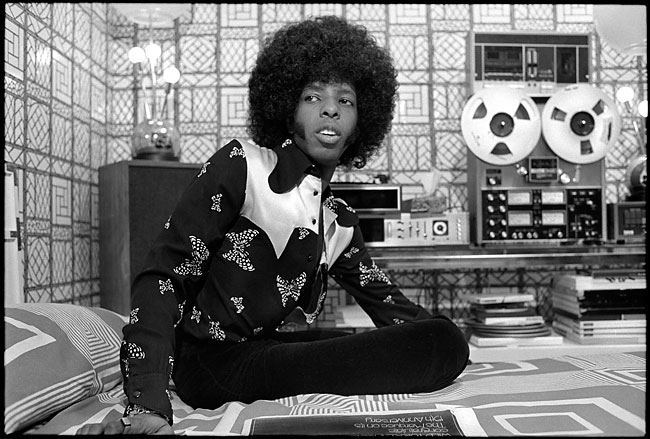 Sadly Sly eventually fell down the spiral with his constant drug addictions over some many years. While he still may have that spark in his eyes, & that beautiful energy in his aura, he clearly has paid a price for those early years of fame. He was inducted into the Rock & Roll Hall Of Fame in 1993, & is the recipient of the 2002 R&B Foundation Pioneer Award.
Referencing and recommendations…
www.slystonemusic www.soulwalking
Documentary – Sly & the Family Stone “Coming back for more” (I would love to see this!)
Documentary -Sly Stone: Portrait of a Legend
Dee Dee Warwick – You’re No Good


Jubilee 45-5459 US Year 1963
Track 1 – You’re No Good Track 2 – Don’t Call Me Anymore
If there’s ever a 7″ that deserves an A for “attitude”, then this is it!
Jersey gal Delia Mae “Dee Dee” Warwick (sister of Dionne Warwick, niece of Cissy Houston and cousin of Whitney Houston) brings us this dizzying monster two-sider from way back in the early 60’s on Jubilee.
A young Dee Dee sang with her sister and their aunt in the New Hope Baptist Church Choir in Newark, New Jersey. Eventually the three women formed the gospel trio the Gospelaires, and at a performance with the Drinkard Singers at the Apollo Theater in 1959, the Warwick sisters were recruited by a record producer for session work and, along with Doris Troy, subsequently became a prolific New York City area session singing team.
Dee Dee began her solo career in 1963 cutting You’re No Good, produced by Jerry Leiber and Mike Stoller, then in ’64 on the Tiger Label, releasing the lovely ballad Don’t Think My Baby’s Coming Back, before signing with Mercury in 65.
Vee-Jay’s head a&r man Calvin Carter found You’re No Good while visiting New York City in search of material for his label’s roster and he originally intended to cut it with Dee Dee, but as he recalls, “when I went to rehearsal with the tune, it was so negative, I said, ‘Hey, guys don’t talk negative about girls, because girls are the record buyers. No, I better pass on that.’ So I gave the song to Betty Everett”. Still uncertain as to why there’s an exception when Betty sings it however, maybe it was her more “acceptable” feminine approach she gave it?
Dee Dee’s delivery and conviction is nasty on this little gem. The tempo is scathing, the backing vocals are damn sassy! The song hits you in the head like on old piece of hard timber….she’s letting you know! And just as you think you can’t take anymore, you soon discover the rusty nail in the form of some serious fuzz tone delivered by a short but intimidating guitar rant.
While this tune proved to be much more successful for Everett, which she released only 2 months later in November, (the single peaked at number fifty-one on the Hot 100, and at number five on “Cashbox’s R&B Locations” chart), I’m definitely a lot more infatuated with this dirty raw punchier version of Dee Dee’s from what I like to call her “early punk” R&B days. I don’t wish to ever take anything away from Betty’s take, which really is something special (it may start off quite sweet and slick, but it builds up and gets swinging, and she does finally get a bit worked up towards the end).
There’s only one thing better than a two-sider, and as in this case, two tracks that you could say relate to each other in subject (another great example is Ann Sexton’s You’re Losing Me flipped with You’re Gonna Miss Me). The flip Don’t Call Me Any More is simply great and again, hard hitting, and makes this 7″ release quite an interesting one, when in a time most soul songs were about love and sorrow in relationships, and not so much about attitude and angst.


On a sad note…
The more I research about these wonderful artist’s that gave us these incredible songs, too often I find that there’s another darker side to their story. Dee Dee Warwick struggled with narcotics addiction for many years and was in failing health for some time. Her sister was with her when she died on October 18, 2008 in a nursing home in Essex County, New Jersey, aged 66.
Other Dee Dee recommendations!
Dee Dee Warwick – Foolish Fool – Mercury 72880 Year 1969
Dee Dee Warwick – Cold Night In Georgia – Atlantic 2091-057 Year 1971
The Gayletts – Son Of A Preacher Man

 Steady Records S 126 – Hourglass HG 005 Year 1969
The Gayletts formed in 1967 in Jamaica consisting of Merle Clemonson, Beryl Lawson and the legendary Judy Mowatt, but sadly broke up in 1970 when Lawson and Clemonson left for America. While it’s difficult to tell you much more about this lovely short lived reggae soul formation, they did leave us a handful of 7″s including this smashing Dusty tune, Son of a Preacher Man, the adorable Silent River Runs Deep, and another great cover, Brenda Lee’s Here Comes That Feeling.
Judy Mowatt of course did go on to become quite the prominent reggae queen there after. In the earlier 70’s she wrote tracks for Wailers’ front man Bunny Livingston, but got her big break in ’74 when she joined up with Bob Marley & The Wailers’ backing vocal trio the I Threes, along with Rita Marley and Marcia Griffiths. Mowatt continued to record for decades after, including a spree of gospel albums between 1998-02.
Preacher was arranged by Ken Lazurus, who once sang for Byron Lee And The Dragonaires, and was released on Steady Records and also on Hourglass the same year . The flip That’s How Strong My Love Is, is a very loving slow ballad with 2.37 mins. of the sweetest harmonies.
The Gayletts is that perfect explosion you get when you mix up a nice dash of doo wop, a big clump of rock steady and a generous sprinkle of heart and soul, and then stirred with the most beautiful rhythm. I find this track so uplifting and a hard one to beat when it comes to female soul groups!
Ernie K. Doe – Here Come The Girls

 Janus Records J-167 US Year 1973
Just criminal that this here dance floor monster was not the hit it deserved to be back in ’73 for K-Doe!!
Born in New Orleans on February 22, 1936, Ernest Kador Jr.’s first public singing was in church choirs at the age of nine, and went on to sing with such spiritual groups as the Golden Choir Jubilees and the Divine Traveler. Not able to resist the pull of doo wop and R&B, he advanced his career by briefly singing with The Flamingos and the Moonglows in Chicago in the early fifties.
K-Doe began hanging out at the famed Dew Drop Inn and other New Orleans clubs like the Sho-Bar, and also sang briefly with a local group, The Blue Diamonds, with whom he recorded on the Savoy label. As a solo artist he signed with Herald and Specialty and released a few hits, but it was the release of Mother-In-Law in ’61 on Minit that gave him his first real taste of sucess! It reached number one on Billboard‘s R&B chart during May of 1961, and it was the young 23 year old songwriter/producer Allen Toussaint who arranged the song, with backing vocals by the great Benny Spellma. Ironically, K-Doe abandoned Mother-in-Law during rehearsal because it had not gone well. However, as Toussaint recollected in K-Doe’s obituary in the New Orleans Times-Picayune: “It found its way back out of the trash can and into my hands, so we could try again. I’m so glad we did.” Mother-In-Law was one of the biggest records to come out of New Orleans in the 60’s, selling in the millions!
The now successful and flamboyant K-Doe went on to release a string of great tracks there after, include Dancing Man, Popeye Joe, the self penned Te-Ta-Te-Ta-Ta, and one I highly recommend A Certain Girl, which was very nicely covered by The Yardbirds in ’64 with a truly big sound.
It’s 1973…K-Doe is on a new label Janus, and teams up once again with Toussaint, but this time releasing something a lot more funkier than ever before (well it was the 70’s!). Releasing a brilliant self titled LP, with Toussaint’s session hipsters, The Meters as his recording band, and it’s the dynamite Here Come The Girls that gets the single release (the flip being A Long Way Back From Home). The moment the distinctive military intro kicks in, you are forced to attention, and quickly that melodic verse sweeps you in. Driven with that tight rhythmic Meters strumming, along with that catchy bridge and chorus, you soon realise that this is more the funk that’s definitely derived from good R&B and soul roots! It’s snappy, tight and the pace is perfect!
Although this mighty tune may not have reached the success or attention of his hey day 61′ classic, or whether it even made the charts at all at the time, it’s hard to believe that it wasn’t the soundtrack to plenty of dance floor lovers of the time. It just must have been! While the great man is no longer with us, the good news is today, it’s a tune certainly on many dj’s set lists (or wish lists), and still gets a whole lot of people jivin’ 40 years later! 

Lots of info online on this great artist and here’s some I referenced and recommend!
Laura Johnson – I know how it feels

 Brent 7035 US Year 1962
Track 1 – I Know How It Feels Track 2 – Wondering If You Miss Me
This heart wrenching soul ballad is an absolute pearl and one I keep very close to my heart. A song to play late at night, with a stiff hard drink, on your own (well maybe with a pet friend), and not one that I play in public too often. A mysterious recording, certainly not an easy one to find particular specs on, so I had to visit my fav’ research web site Soulful Detroit once again for most of the info here.
Laura Johnson, an amateur singer from Detroit, who happened to work in the Correc-tone’s offices, paid for her own studio time and recorded these two stirring tracks at Wilbert Golden’s legendary Correc-tone studios. The self-penned “Wondering If You Miss Me”, and “I Know How It Feels”, which was written by infamous Popcorn Wylie and Motown’s Janie Bradford, and produced by Robert Bateman, were released in ’62 on Bob Shad’s New York Brent label. It’s likely that Correc-tone’s session musicians of that time, bassist James Jamerson, drummer Benny Benjamin and guitarist Robert White recorded on these tracks, but I can’t confirm that. I’m pretty sure that’s the incredibly beautiful “Andantes” backing her up here.
Laura also had a hand in writing a couple of gems cut by Marva Josie, including the excellent “Later For You Baby” which was released on Brent’s sister label,Time, also released in ’62.
“I Know How It Feels” was earlier released by The Satintones on Motown (the first band to ever record for that label) in ’61, then also with The Marvelettes on their Please Mr.Postman LP debut, that same year in November. Both versions are a delight in their own ways, but Johnson gets the badge of honor for me.
Seems not too many people out there really knew much more about this elusive artist and these remarkable isolated recordings. Sadly, it doesn’t look like Johnson was to ever record again, and with that remarkable tone, it’s the greatest shame!
The Jackson Sisters – I Believe In Miracles

 Prophesy Records ZS7 3005 Year 1973
Detroit based sibling funksters, The Jackson Sisters, bring you this absolute killer version of Mark Capanni’s I Believe In Miracles, circa 1973.
The Jackson Sisters were a soul family group from Compton, California, comprising of Jacqueline Jackson-Rencher (the eldest), Lyn Jackson, Pat Jackson, Rae Jackson and Gennie Jackson (the youngest). The girls would practice on an old beaten up piano in their dad’s garage, composing songs after school, and would draw all the neighboring kids to watch. After a handful of talent show wins, the young siblings soon found themselves opening for Smokey Robinson and the Miracles, then known as The Mark Taper Form. It was Smokey’s farewell concert (entitled The Last Miracle) and include other feature acts including Al Green, Edwin Starr, Eddie Kendricks, The Whispers and The Three Degrees.
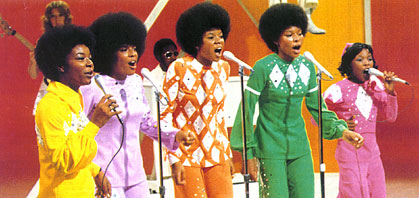 It was 1973, and within that same year, they signed a contract with a small recording company, Prophesy Records in Beverly Hills, California. That is when they recorded I Believe in Miracles, co-written by Mark Capanni & produced by Bobby Taylor. This track is truly a rich and rare funk, soul classic, with amazing harmony vocals, and a tempo that really would light any dance floor on fire! I believe it is the youngest of the sisters, Gennie, that takes most of the lead vocals on the song (I’m guessing she’s running that bridge that leads to the monster chorus), and her vocal power is pure brilliance. And no surprise that they were nominated for best new vocal group for the Black Image Awards and best new female artist by Record World Magazine in 1974-1975 which was announced on Soul Train an aired Feb. 22, 1975.
Sadly the parent album, scheduled to be released on Tiger Lily Records in 1976, was withdrawn, although a few promo copies went into circulation and they now retail for big bucks as one would expect. The musical tracks were the works of the late great Gene Page. The vocals were produced by Pete Moore of the famous Smokey Robinson & The Miracles along with Bobby Taylor.
While they did get to release a few 45’s, Miracles is the most sought after and not too easy to find. Originally on a red Prophesy label with the flip (Why Can’t We Be) More Than Just Friends, and also as a white label promo with 2 heavy cuts of track A, one in big fat mono! There was also a release on UK label Mums Records, and a re-release on Polydor in 1976.
The original version of I Believe In Miracles, which was first recorded in 1973 and performed by Mark Capanni, is an absolute beautiful soul masterpiece, well deserved of the highest praise and well worth tracking down. Despite the Capanni version having been pressed, it failed to make an impact and the record was pulled, making it very sought after. But it was the Jackson Sisters that did the dance floor business, with their feverish thumpin’ funk monster, which was unleashed in 1974.
Recommended reading…
The Jackson Sisters
A ’70s Girl Group Seeks Second Act
Soul Walking
Baby Earl & The Trini-dads – Back Slop

 S.P.Q.R. 45-3317 US Year 1964
Well I’m going to start off by saying that this here, has to be one of my favourite examples of crossover R&B and Ska! It moves, and it shuffles, and oh just so nicely!
Tenor Sax extraordinaire Earl Swanson and his Trini-dads are killing it here on this one off 1964 recording, but actually this band of merry men is one of many incarnations of producer Frank Guida and his Legrand Records house band, The Church Street Five.
Guida owned a number of record labels, including Le Monde (distributed by Atlantic), then Legrand (home to many early sixties hits by Gary U.S.Bonds) and finally sister label S.P.Q.R. (distributed by London). Guida was of Italian extraction and while stationed in Trinidad during the Second World War, he fell under the influence of calypso, an obvious influence passed on in many of his productions. Much of the Gary U.S. Bonds sound was created by the Church Street Five (based in Virginia), featuring Gene “Daddy G” Barge and Earl Swanson on the earlier cuts. The Church Street Five also featured Ron “Junior” Fairley on bass, Willie Burnell on piano, Leonard Barks on trombone, Eric Sauls and Wayne Beckner on guitar, and Melvin Glover and Nabs Shields on drums.
Everybody Do The Ska is the flip, and it’s a much more traditional ska-reggae composition that really is out shined by Back Slop!
While Jamaican ska was originally influenced by the sound of American R&B and jazz picked up in Kingston from radio broadcasts in New Orleans and Miami, the sound of early 60’s ska also had an impact on American pop music of the same era. And here is the what can happen when both these beautiful styles marry. This uptempo instrumental is really hot stuff. The ripping guitar blues solo, the Baby Earl grooves, the constant but addictive rhythms, mixing boogaloo with soulful ska, it’s made strictly for the dance floor!
Other facts: Guida opened a record store in Norfolk, Virginia, named Frankie’s Got It in 1953 (it’s motto was Shakespeare’s “If music be the food of love, play on!”, which later became a song on a Bonds B-side).
SPQR is the abbreviation for the Latin, Senate and Citizens of Rome, emblem of the Roman Empire (Senatus Populesque Romanus) and may have been a nod to Guida’s family’s original home, but it may have also stood for Sound Proof Quality Records.
In 1955, Ruth Brown met Swanson on the Griffin Brothers Orchestra tour and soon married, but sadly Swanson was not a nice husband at all! He was a womanizer, drug user and a wife beater, and made Brown’s life hell (you can read in more detail of the relationship here Icons of R&B).
Referencing…
Billy Daniels – Woe Woe Woe

 Liberty 55716 US Year 1964
Not a lot of information can be found on this massive Daniels recording, but I have to say it’s up there in my top favs to spin and not an easy one to find.
Daniels’ (born in Jacksonville, Florida, 1915) most recognised and popular recording That Old Black Magic is what you’ll find on the A side here. First recorded back in around 1948 for Apollo records (1101), it had quite a few successful releases on Mercury (5721 10″ Shellac where it was released as That Ol’ Black Magic, Mercury 5721×45 7″ 1950, a UK picture sleeve EP and also on Oriele) so it’s is obviously a re-release. On this Liberty release, over a decade later however, we have the almighty Jack Nitzsche reworking the Mercer-Arlen composition, and the production is what you’d expect from this great “Nitzsche era” of recordings. It’s smooth and it’s cool, and the overall sound is far more “hip” than the earlier recordings, but it’s on the flip where the real black magic happens!
Woe Woe Woe is the one you want to drop on this 45, and I’m not sure what really happens here to Daniels, but I can only assume that he was somehow possessed by the devil in that studio session! Maybe it was all the fame and those late nights in Vegas, after all it was 1964, what a place to be! Maybe after all his success with ballads and standards, he wanted to finally just give it all…and he certainly does here, come that short monstrous chorus line. The sax solo here is so, so very slinky and sexy, and I really want to know who is responsible! The percussion is slick, the tempo is dangerous, and the sound is big and nasty! Then adding those sultry, foxy backing vocals…well, it just makes this the most thrilling 2 minutes of soulful rocking R&B you’re likely to ever experience!
As always, I’m keen to find out more about this recording, especially the recording artists! The promo – audition cream copies seems to appear more often than the regular liberty copies, but still not an easy one to get your hands on, and well worth the hunt!
 Seven45rpm
Recent Comments